Psalms 65 KJV
Praise for God's Bounty
About This Psalm
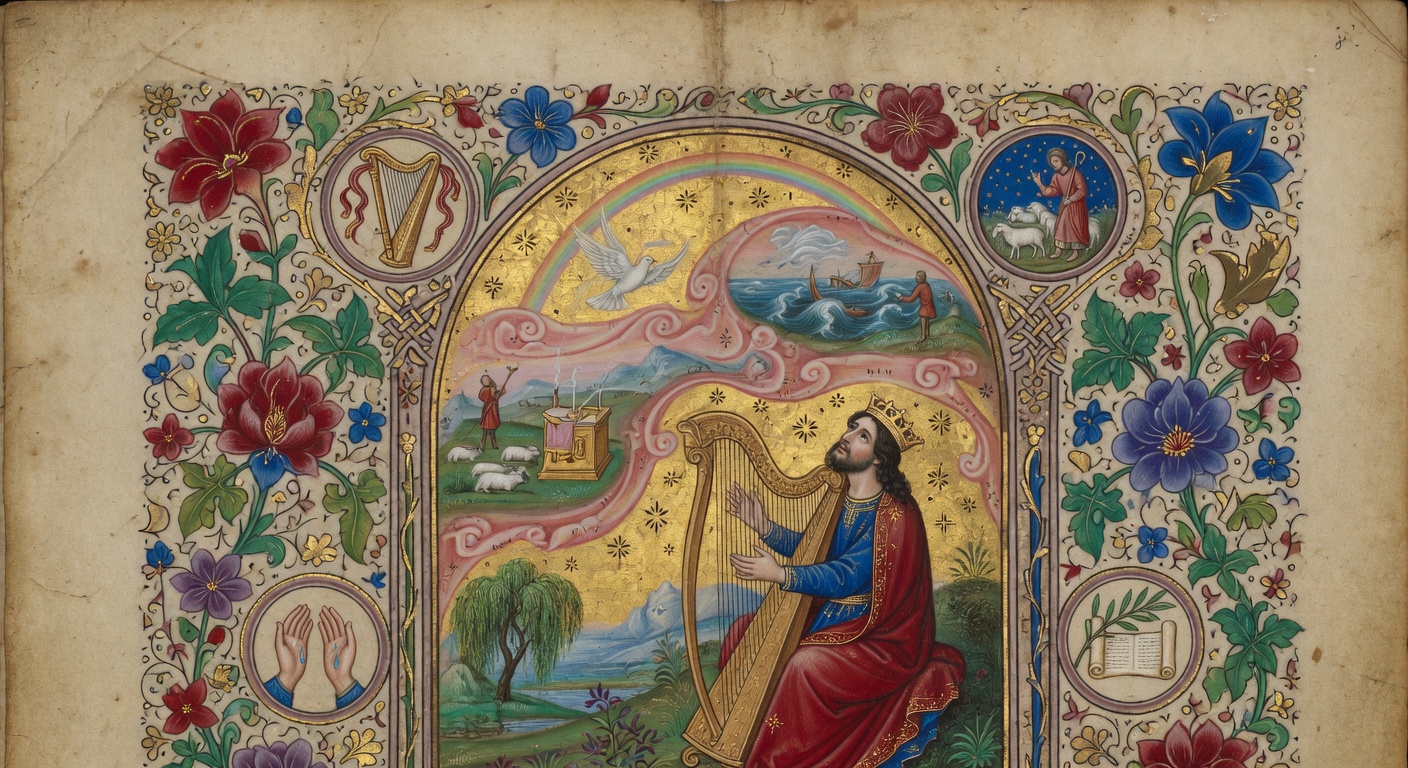
A harvest thanksgiving. God waters the earth, crowns the year with goodness, and the hills rejoice. Gratitude for abundance.
 1raise waiteth for thee, O God, in Sion: and unto thee shall the vow be performed.
2 O thou that hearest prayer, unto thee shall all flesh come.
3 Iniquities prevail against me: as for our transgressions, thou shalt purge them away.
4 Blessed is the man whom thou choosest, and causest to approach unto thee, that he may dwell in thy courts: we shall be satisfied with the goodness of thy house, even of thy holy temple.
5 By terrible things in righteousness wilt thou answer us, O God of our salvation; who art the confidence of all the ends of the earth, and of them that are afar off upon the sea:
6 Which by his strength setteth fast the mountains; being girded with power:
7 Which stilleth the noise of the seas, the noise of their waves, and the tumult of the people.
8 They also that dwell in the uttermost parts are afraid at thy tokens: thou makest the outgoings of the morning and evening to rejoice.
9 Thou visitest the earth, and waterest it: thou greatly enrichest it with the river of God, which is full of water: thou preparest them corn, when thou hast so provided for it.
10 Thou waterest the ridges thereof abundantly: thou settlest the furrows thereof: thou makest it soft with showers: thou blessest the springing thereof.
11 Thou crownest the year with thy goodness; and thy paths drop fatness.
12 They drop upon the pastures of the wilderness: and the little hills rejoice on every side.
13 The pastures are clothed with flocks; the valleys also are covered over with corn; they shout for joy, they also sing.
← → arrow keys to navigate chapters · spacebar to play/pause audio
Did You Know?
Psalm 65 links divine forgiveness directly to agricultural abundance, implying that atonement restores not only the worshipper but the fertility of the land itself in line with covenant curses and blessings.
The phrase 'the river of God' in verse 9 evokes an ancient Near Eastern motif of a heavenly stream originating from the deity's throne, later echoed in Ezekiel's temple vision and Revelation's river of life.
By describing God as stilling the roaring seas and the tumult of the peoples in parallel lines, the psalm merges cosmogonic control over chaos with political sovereignty, a fusion rare outside wisdom literature.
Its harvest imagery, including the crowning of the year with goodness, aligns with Canaanite fertility language yet redirects all credit to Yahweh, functioning as subtle polemic against Baal worship during autumn festivals.
The closing personification of pastures, valleys, and hills singing together creates a deliberate reversal of the curse in Genesis 3, where the ground is silenced, anticipating new-creation themes in later prophetic texts.
While fleeing Saul, David sought refuge among the Philistines and feigned madness before King Achish of Gath by scribbling on the city gates and letting saliva run down his beard, successfully avoiding recognition.
Solomon conscripted 30,000 Israelite men for monthly rotations of forced labor in Lebanon to harvest cedar and cypress timber for the temple, while assigning an additional 150,000 Canaanite laborers to quarry and transport stone, reflecting the ancient Near Eastern practice of corvée labor systems.
The New Testament further develops this imagery to portray the heavenly Jerusalem where believers gather to the living God.
The city has been destroyed at least twice, besieged 23 times, and captured 44 times.
Commentary & Study Notes Jamieson-Fausset-Brown (1871) · Public Domain Praise waiteth for thee — literally, "To Thee silence praise," or (compare Ps 62:1), To Thee silence is praise — that is, Praise is waiting as a servant; it is due to Thee. So the…
Classic verse-by-verse commentary on Psalms 65 from Jamieson, Fausset & Brown (1871). Covers: This is a song of praise for God's spiritual blessings to his people and his kind providence over all the earth.
- 1
- Praise waiteth for thee — literally, "To Thee silence praise," or (compare Ps 62:1), To Thee silence is praise — that is, Praise is waiting as a servant; it is due to Thee. So the last clause expresses the duty of paying vows. These two parts of acceptable worship, mentioned in Ps 50:14, are rendered in Zion, where God chiefly displays His mercy and receives homage.
- 2
- All are encouraged to pray by God's readiness to hear.
Read all 10 notes on Psalms 65 →