Psalms 88 KJV
A Cry in Darkness
About This Psalm
The darkest psalm - no resolution, no hope expressed, ends in darkness. Sometimes faith is just showing up when there's no light.
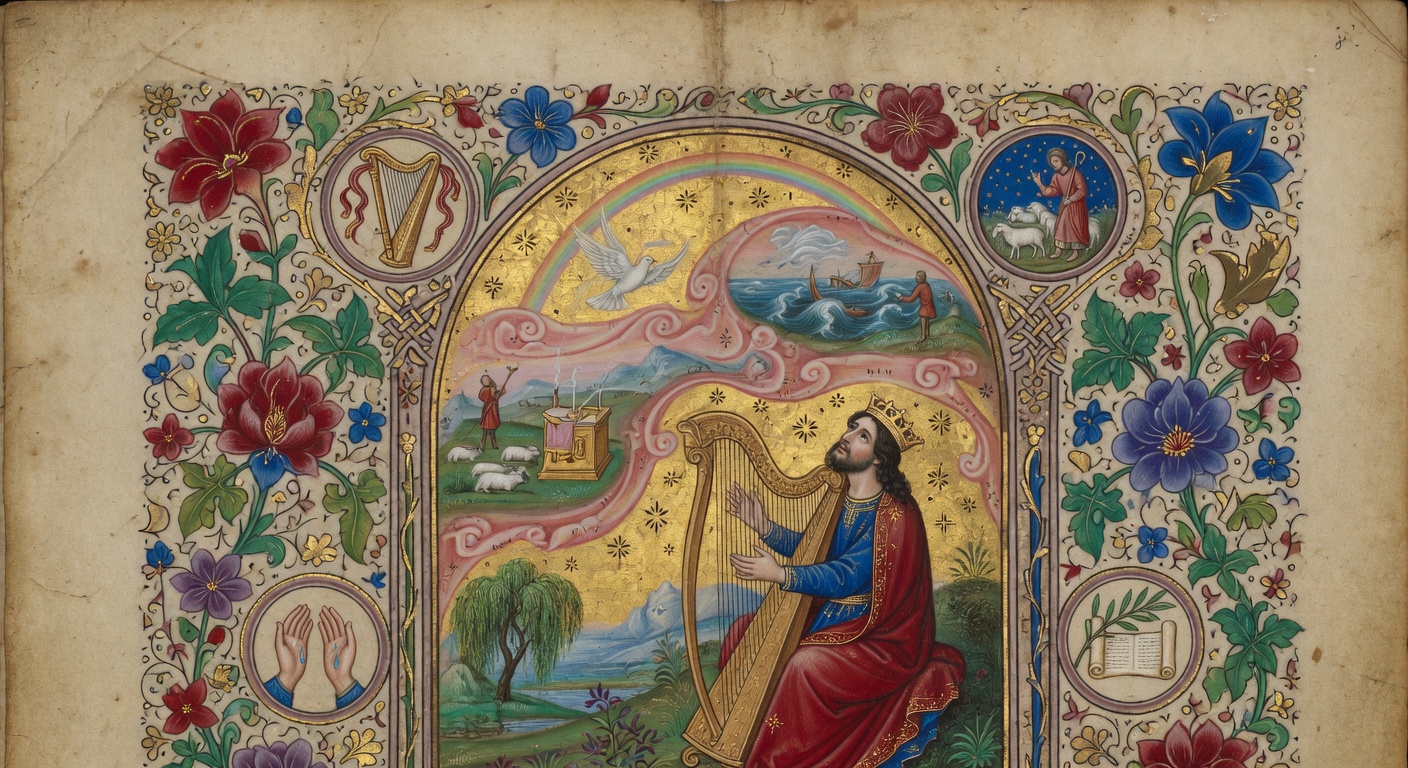
 1 LORD God of my salvation, I have cried day and night before thee:
2 Let my prayer come before thee: incline thine ear unto my cry;
3 For my soul is full of troubles: and my life draweth nigh unto the grave.
4 I am counted with them that go down into the pit: I am as a man that hath no strength:
5 Free among the dead, like the slain that lie in the grave, whom thou rememberest no more: and they are cut off from thy hand.
6 Thou hast laid me in the lowest pit, in darkness, in the deeps.
7 Thy wrath lieth hard upon me, and thou hast afflicted me with all thy waves. Selah.
8 Thou hast put away mine acquaintance far from me; thou hast made me an abomination unto them: I am shut up, and I cannot come forth.
9 Mine eye mourneth by reason of affliction: LORD, I have called daily upon thee, I have stretched out my hands unto thee.
10 Wilt thou shew wonders to the dead? shall the dead arise and praise thee? Selah.
11 Shall thy lovingkindness be declared in the grave? or thy faithfulness in destruction?
12 Shall thy wonders be known in the dark? and thy righteousness in the land of forgetfulness?
13 But unto thee have I cried, O LORD; and in the morning shall my prayer prevent thee.
14 LORD, why castest thou off my soul? why hidest thou thy face from me?
15 I am afflicted and ready to die from my youth up: while I suffer thy terrors I am distracted.
16 Thy fierce wrath goeth over me; thy terrors have cut me off.
17 They came round about me daily like water; they compassed me about together.
18 Lover and friend hast thou put far from me, and mine acquaintance into darkness.
← → arrow keys to navigate chapters · spacebar to play/pause audio
Did You Know?
Psalm 88 stands alone in the Psalter by directing every verse to God yet refusing any pivot toward trust or thanksgiving, thereby modeling a theology in which unrelieved suffering remains a valid form of prayer.
Its superscription credits Heman the Ezrahite, linking the psalm to the same wisdom circles that produced Proverbs and Job and suggesting that temple musicians transmitted sophisticated reflections on theodicy rather than simple cultic formulas.
The psalm reworks Canaanite underworld imagery (Sheol, Abaddon, waves of death) by addressing these forces to Yahweh himself, transforming polytheistic chaos motifs into a direct accusation against the covenant God.
Verse 18’s final word, “darkness,” functions as an inclusio with the opening cry, creating a literary structure that deliberately withholds any glimmer of dawn and mirrors the experience of chronic, undiagnosed illness in ancient Israel.
Although grouped with the Korahite collection in many manuscripts, the Ezrahite attribution creates a deliberate editorial juxtaposition with Psalm 89, whose royal covenant promises are immediately undercut by the preceding psalm’s unresolved despair.
David twice spared Saul's life in the wilderness, once cutting off a piece of his robe in the En Gedi cave and later removing his spear and water jug while he slept, demonstrating restraint amid pursuit.
The Queen of Sheba traveled roughly 1,200 miles from her Arabian kingdom with a caravan of camels carrying spices, gold, and stones to test Solomon's wisdom with riddles, then exchanged lavish gifts including 120 talents of gold that funded further temple adornments.
In the prophetic writings it stands as the center of God's redemptive plan, embodying covenant faithfulness and the expectation of a coming Messiah who would rule from Zion in justice and peace.
Jerusalem is mentioned over 800 times in the Bible. More than any other city.
Commentary & Study Notes Jamieson-Fausset-Brown (1871) · Public Domain Compare on the terms used, Ps 22:2; 31:2.
Classic verse-by-verse commentary on Psalms 88 from Jamieson, Fausset & Brown (1871). Covers: Upon mahalath--either an instrument, as a lute, to be used as an accompaniment (leannoth, "for singing") or, as others think, an enigmatic title (see on ps 5:1, ps 22:1, and ps 45:1, titles), denoting the subject--that is, "sickness or disease, for humbling," the idea of spiritual maladies being often represented by disease (compare ps 6:5, 6; 22:14, 15, &c.). On the other terms, see on ps 42:1 and ps 32:1. Heman and ethan (see on ps 89:1, title) were David's singers (1ch 6:18, 33; 15:17), of the family of kohath. If the persons alluded to (1ki 4:31; 1ch 2:6), they were probably adopted into the tribe of Judah. Though called a song, which usually implies joy (ps 83:1), both the style and matter of the psalm are very despondent; Yet the appeals to God evince faith, and we may suppose that the word "song" might be extended to such compositions.
- 1,2
- Compare on the terms used, Ps 22:2; 31:2.
- 3
- grave — literally, "hell" (Ps 16:10), death in wide sense.
Read all 15 notes on Psalms 88 →