Psalms 95 KJV
A Call to Worship
About This Psalm
Come, let us worship and bow down. But don't harden your hearts like Israel did in the wilderness. Worship requires soft hearts.
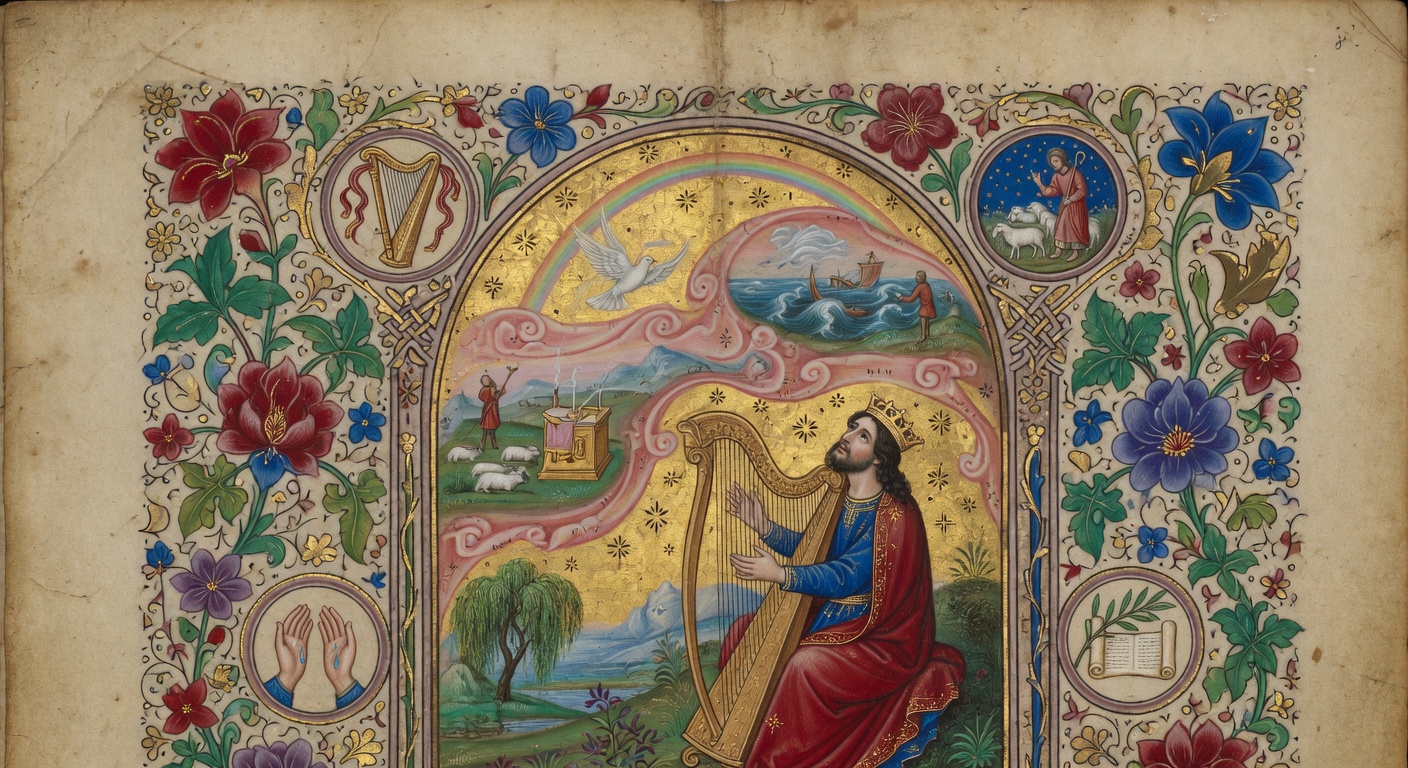
 1 come, let us sing unto the LORD: let us make a joyful noise to the rock of our salvation.
2 Let us come before his presence with thanksgiving, and make a joyful noise unto him with psalms.
3 For the LORD is a great God, and a great King above all gods.
4 In his hand are the deep places of the earth: the strength of the hills is his also.
5 The sea is his, and he made it: and his hands formed the dry land.
6 O come, let us worship and bow down: let us kneel before the LORD our maker.
7 For he is our God; and we are the people of his pasture, and the sheep of his hand. To day if ye will hear his voice,
8 Harden not your heart, as in the provocation, and as in the day of temptation in the wilderness:
9 When your fathers tempted me, proved me, and saw my work.
10 Forty years long was I grieved with this generation, and said, It is a people that do err in their heart, and they have not known my ways:
11 Unto whom I sware in my wrath that they should not enter into my rest.
← → arrow keys to navigate chapters · spacebar to play/pause audio
Did You Know?
Psalm 95 is quoted at length in Hebrews 3-4 to argue that the wilderness generation's failure to enter rest remains a present warning, transforming an ancient liturgy into an eschatological exhortation for Christian perseverance.
The opening address to God as 'the rock of our salvation' deliberately echoes the Meribah rock of Exodus 17, linking creation praise with the memory of miraculous provision and Israel's subsequent rebellion.
Verses 8-11 present an unmediated divine oracle inside a psalm, a rare liturgical feature implying prophetic mediation during temple worship where a cultic speaker channels God's voice to the congregation.
By calling God 'a great King above all gods' while immediately affirming His formation of the sea and dry land, the psalm navigates ancient Near Eastern divine council imagery yet subordinates all other powers to Yahweh's unchallenged sovereignty.
The abrupt shift from plural communal invitation ('let us') to singular divine warning ('harden not your heart') enacts the very obedience it demands, forcing hearers to move from collective praise to personal decision in a single poetic unit.
While fleeing Saul, David sought refuge among the Philistines and feigned madness before King Achish of Gath by scribbling on the city gates and letting saliva run down his beard, successfully avoiding recognition.
Solomon conscripted 30,000 Israelite men for monthly rotations of forced labor in Lebanon to harvest cedar and cypress timber for the temple, while assigning an additional 150,000 Canaanite laborers to quarry and transport stone, reflecting the ancient Near Eastern practice of corvée labor systems.
The New Testament further develops this imagery to portray the heavenly Jerusalem where believers gather to the living God.
Three major world religions consider Jerusalem a holy city.
Commentary & Study Notes Jamieson-Fausset-Brown (1871) · Public Domain The terms used to express the highest kind of joy. rock — a firm basis, giving certainty of salvation (Ps 62:7).
Classic verse-by-verse commentary on Psalms 95 from Jamieson, Fausset & Brown (1871). Covers: David (heb 4:7) exhorts men to praise God for his greatness, and warns them, in God's words, against neglecting his service.
- 1
- The terms used to express the highest kind of joy. rock — a firm basis, giving certainty of salvation (Ps 62:7).
- 2
- come... presence — literally, "approach," or, meet Him (Ps 17:13).
Read all 8 notes on Psalms 95 →