Revelation 12 KJV
The Woman and the Dragon
The Woman and the Dragon
The chapter's dragon with seven heads and ten horns reworks imagery from Daniel 7 and 8 but assigns it explicitly to the primordial serpent of Genesis 3, framing Roman imperial power as an extension of Edenic chaos rather than a new political entity.
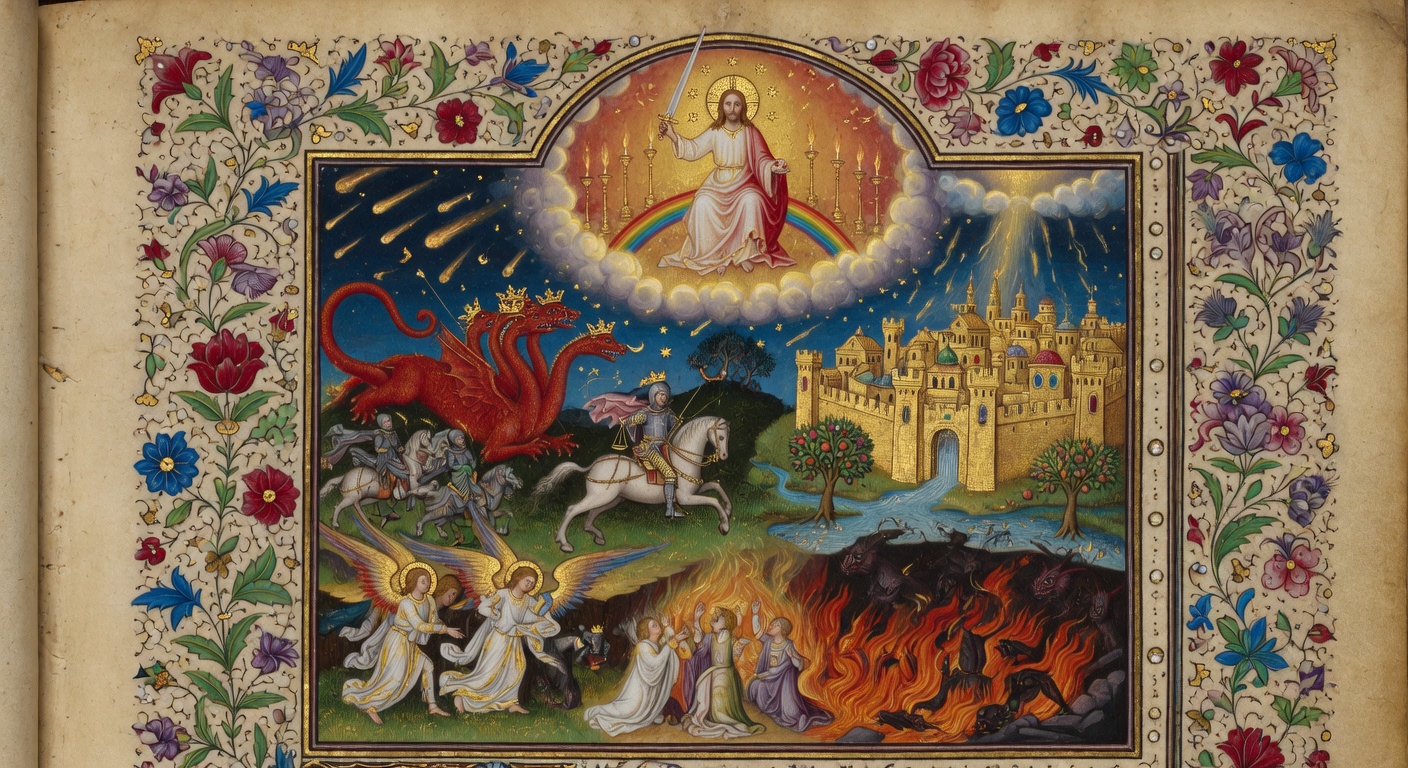
 1nd there appeared a great wonder in heaven; a woman clothed with the sun, and the moon under her feet, and upon her head a crown of twelve stars:
2 And she being with child cried, travailing in birth, and pained to be delivered.
3 And there appeared another wonder in heaven; and behold a great red dragon, having seven heads and ten horns, and seven crowns upon his heads.
4 And his tail drew the third part of the stars of heaven, and did cast them to the earth: and the dragon stood before the woman which was ready to be delivered, for to devour her child as soon as it was born.
5 And she brought forth a man child, who was to rule all nations with a rod of iron: and her child was caught up unto God, and to his throne.
6 And the woman fled into the wilderness, where she hath a place prepared of God, that they should feed her there a thousand two hundred and threescore days.
7 And there was war in heaven: Michael and his angels fought against the dragon; and the dragon fought and his angels,
8 And prevailed not; neither was their place found any more in heaven.
9 And the great dragon was cast out, that old serpent, called the Devil, and Satan, which deceiveth the whole world: he was cast out into the earth, and his angels were cast out with him.
10 And I heard a loud voice saying in heaven, Now is come salvation, and strength, and the kingdom of our God, and the power of his Christ: for the accuser of our brethren is cast down, which accused them before our God day and night.
11 And they overcame him by the blood of the Lamb, and by the word of their testimony; and they loved not their lives unto the death.
12 Therefore rejoice, ye heavens, and ye that dwell in them. Woe to the inhabiters of the earth and of the sea! for the devil is come down unto you, having great wrath, because he knoweth that he hath but a short time.
13 And when the dragon saw that he was cast unto the earth, he persecuted the woman which brought forth the man child.
14 And to the woman were given two wings of a great eagle, that she might fly into the wilderness, into her place, where she is nourished for a time, and times, and half a time, from the face of the serpent.
15 And the serpent cast out of his mouth water as a flood after the woman, that he might cause her to be carried away of the flood.
16 And the earth helped the woman, and the earth opened her mouth, and swallowed up the flood which the dragon cast out of his mouth.
17 And the dragon was wroth with the woman, and went to make war with the remnant of her seed, which keep the commandments of God, and have the testimony of Jesus Christ.
← → arrow keys to navigate chapters · spacebar to play/pause audio
Did You Know?
The chapter's dragon with seven heads and ten horns reworks imagery from Daniel 7 and 8 but assigns it explicitly to the primordial serpent of Genesis 3, framing Roman imperial power as an extension of Edenic chaos rather than a new political entity.
The woman's flight to the wilderness for 1260 days echoes Israel's exodus wanderings yet inverts the manna narrative: instead of divine provision from heaven, the earth itself swallows the dragon's flood, portraying creation as an active covenant partner.
Michael's heavenly victory (vv. 7-9) is the only New Testament scene in which an archangel is named as combatant, deliberately avoiding any direct Christological participation in the battle and thereby preserving the Lamb's victory as exclusively earthly and sacrificial.
The 'third part of the stars' cast down (v. 4) alludes to both fallen angels and the astrological 'wandering stars' of Greco-Roman cosmology, suggesting that Satan's rebellion disorders the created order itself rather than merely opposing human believers.
The child's immediate ascension to God's throne (v. 5) omits any reference to Jesus' earthly ministry or crucifixion, a narrative compression unique to Revelation that presents the incarnation solely through its cosmic, pre- and post-incarnate dimensions.
Daniel 12:1 uniquely identifies Michael as the 'great prince' who will arise to protect Israel during the eschatological time of distress, directly linking his intervention to the resurrection of the dead.
Isaiah 14 and Ezekiel 28, often linked to Satan's fall, originally addressed the kings of Babylon and Tyre respectively, with their imagery later applied to the devil in Christian tradition.
Jesus exclusively taught the crowds in parables to fulfill Isaiah's prophecy of hearing without understanding, reserving explanations for his disciples alone as described in Mark 4.
Although Peter arrived first at the empty tomb, John was the disciple who entered, saw the folded face cloth, and immediately believed in the resurrection (John 20:8).
Patmos is a tiny island only 10 miles long and 6 miles wide.
Jerusalem is mentioned over 800 times in the Bible. More than any other city.
The Hanging Gardens of Babylon were one of the Seven Wonders of the Ancient World.
Commentary & Study Notes Jamieson-Fausset-Brown (1871) · Public Domain This episode (Re 12:1-15:8) describes in detail the persecution of Israel and the elect Church by the beast, which had been summarily noticed, Re 11:7-10, and the triumph of the fa…
Classic verse-by-verse commentary on Revelation 12 from Jamieson, Fausset & Brown (1871). Covers: Vision of the woman, her child, and the persecuting dragon.
- 1
- This episode (Re 12:1-15:8) describes in detail the persecution of Israel and the elect Church by the beast, which had been summarily noticed, Re 11:7-10, and the triumph of the faithful, and torment of the unfaithful. So also the sixteenth through twentieth chapters are the description in detail of the judgment on the beast, &c., summarily noticed in Re 11:13,
- 18
- The beast in Re 12:3, &c., is shown not to be alone, but to be the instrument in the hand of a greater power of darkness, Satan. That this is so, appears from the time of the eleventh chapter being the period also in which the events of the twelfth and thirteenth chapters take place, namely, 1260 days (Re 12:6, 14; Re 13:5; compare Re 11:2, 3). great — in size and significance. wonder — Greek, "sign": significant of momentous truths. in heaven — not merely the sky, but the heaven beyond just mentioned, Re 11:19; compare Re 12:7-9. woman clothed with the sun... moon under her feet — the Church, Israel first, and then the Gentile Church; clothed with Christ, "the Sun of righteousness." "Fair as the moon, clear as the sun." Clothed with the Sun, the Church is the bearer of divine supernatural light in the world. So the seven churches (that is, the Church universal, the woman) are represented as light-bearing candlesticks (Re 1:12, 20). On the other hand, the moon, though standing above the sea and earth, is altogether connected with them and is an earthly light: sea, earth, and moon represent the worldly element, in opposition to the kingdom of God — heaven, the sun. The moon cannot disperse the darkness and change it into-day: thus she represents the world religion (heathenism) in relation to the supernatural world. The Church has the moon, therefore, under her feet; but the stars, as heavenly lights, on her head. The devil directs his efforts against the stars, the angels of the churches, about hereafter to shine for ever. The twelve stars, the crown around her head, are the twelve tribes of Israel [AUBERLEN]. The allusions to Israel before accord with this: compare Re 11:19, "the temple of God"; "the ark of His testament." The ark lost at the Babylonian captivity, and never since found, is seen in the "temple of God opened in heaven," signifying that God now enters again into covenant with His ancient people. The woman cannot mean, literally, the virgin mother of Jesus, for she did not flee into the wilderness and stay there for 1260 days, while the dragon persecuted the remnant of her seed (Re 12:13-17) [DE BURGH]. The sun, moon, and twelve stars, are emblematical of Jacob, Leah, or else Rachel, and the twelve patriarchs, that is, the Jewish Church: secondarily, the Church universal, having under her feet, in due subordination, the ever changing moon, which shines with a borrowed light, emblem of the Jewish dispensation, which is now in a position of inferiority, though supporting the woman, and also of the changeful things of this world, and having on her head the crown of twelve stars, the twelve apostles, who, however, are related closely to Israel's twelve tribes. The Church, in passing over into the Gentile world, is (1) persecuted; (2) then seduced, as heathenism begins to react on her. This is the key to the meaning of the symbolic woman, beast, harlot, and false prophet. Woman and beast form the same contrast as the Son of man and the beasts in Daniel. As the Son of man comes from heaven, so the woman is seen in heaven (Re 12:1). The two beasts arise respectively out of the sea (compare Da 7:3) and the earth (Re 13:1, 11): their origin is not of heaven, but of earth earthy. Daniel beholds the heavenly Bridegroom coming visibly to reign. John sees the woman, the Bride, whose calling is heavenly, in the world, before the Lord's coming again. The characteristic of woman, in contradistinction to man, is her being subject, the surrendering of herself, her being receptive. This similarly is man's relation to God, to be subject to, and receive from, God. All autonomy of the human spirit reverses man's relation to God. Woman-like receptivity towards God constitutes faith. By it the individual becomes a child of God; the children collectively are viewed as "the woman." Humanity, in so far as it belongs to God, is the woman. Christ, the Son of the woman, is in Re 12:5 emphatically called "the MAN-child" (Greek, "huios arrheen," "male-child"). Though born of a woman, and under the law for man's sake, He is also the Son of God, and so the HUSBAND of the Church. As Son of the woman, He is "'Son of man"; as male-child, He is Son of God, and Husband of the Church. All who imagine to have life in themselves are severed from Him, the Source of life, and, standing in their own strength, sink to the level of senseless beasts. Thus, the woman designates universally the kingdom of God; the beast, the kingdom of the world. The woman of whom Jesus was born represents the Old Testament congregation of God. The woman's travail-pains (Re 12:2) represent the Old Testament believers' ardent longings for the promised Redeemer. Compare the joy at His birth (Isa 9:6). As new Jerusalem (called also "the woman," or "wife," Re 21:2, 9-12), with its twelve gates, is the exalted and transfigured Church, so the woman with the twelve stars is the Church militant.
Read all 20 notes on Revelation 12 →