Revelation 22 KJV
The River of Life
Echoes & Connections 1 connections
The River of Life
The last chapter of the Bible returns to Eden's imagery - tree of life, river, no curse Themes: Second Coming
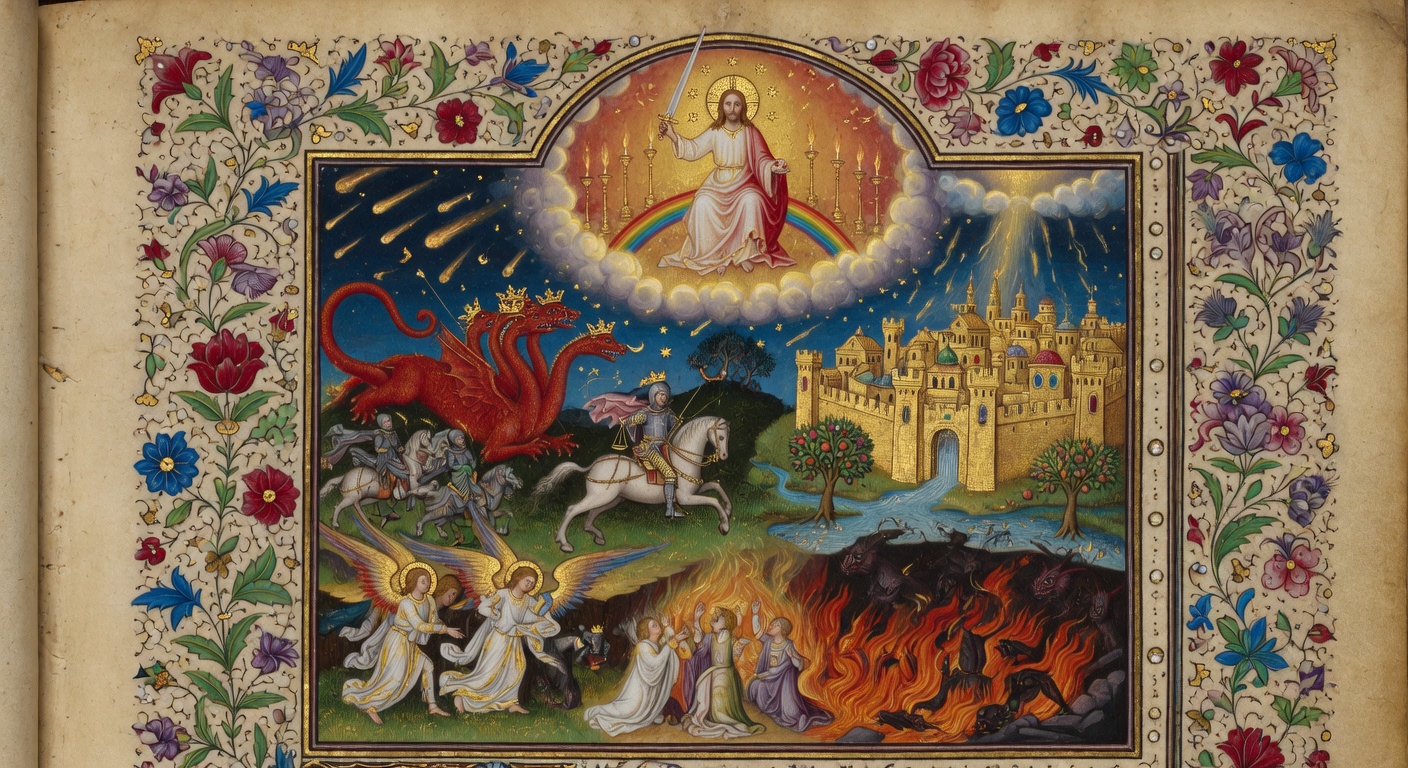
 1nd he shewed me a pure river of water of life, clear as crystal, proceeding out of the throne of God and of the Lamb.cf.
2 In the midst of the street of it, and on either side of the river, was there the tree of life, which bare twelve manner of fruits, and yielded her fruit every month: and the leaves of the tree were for the healing of the nations.cf.
3 And there shall be no more curse: but the throne of God and of the Lamb shall be in it; and his servants shall serve him:
4 And they shall see his face; and his name shall be in their foreheads.
5 And there shall be no night there; and they need no candle, neither light of the sun; for the Lord God giveth them light: and they shall reign for ever and ever.
6 And he said unto me, These sayings are faithful and true: and the Lord God of the holy prophets sent his angel to shew unto his servants the things which must shortly be done.
7 Behold, I come quickly: blessed is he that keepeth the sayings of the prophecy of this book.
8 And I John saw these things, and heard them. And when I had heard and seen, I fell down to worship before the feet of the angel which shewed me these things.
9 Then saith he unto me, See thou do it not: for I am thy fellowservant, and of thy brethren the prophets, and of them which keep the sayings of this book: worship God.
10 And he saith unto me, Seal not the sayings of the prophecy of this book: for the time is at hand.
11 He that is unjust, let him be unjust still: and he which is filthy, let him be filthy still: and he that is righteous, let him be righteous still: and he that is holy, let him be holy still.
12 And, behold, I come quickly; and my reward is with me, to give every man according as his work shall be.
13 I am Alpha and Omega, the beginning and the end, the first and the last.
14 Blessed are they that do his commandments, that they may have right to the tree of life, and may enter in through the gates into the city.
15 For without are dogs, and sorcerers, and whoremongers, and murderers, and idolaters, and whosoever loveth and maketh a lie.
16 I Jesus have sent mine angel to testify unto you these things in the churches. I am the root and the offspring of David, and the bright and morning star.
17 And the Spirit and the bride say, Come. And let him that heareth say, Come. And let him that is athirst come. And whosoever will, let him take the water of life freely.
18 For I testify unto every man that heareth the words of the prophecy of this book, If any man shall add unto these things, God shall add unto him the plagues that are written in this book:
19 And if any man shall take away from the words of the book of this prophecy, God shall take away his part out of the book of life, and out of the holy city, and from the things which are written in this book.
20 He which testifieth these things saith, Surely I come quickly. Amen. Even so, come, Lord Jesus.
21 The grace of our Lord Jesus Christ be with you all. Amen.
Words in red are the direct words of Jesus Christ.
← → arrow keys to navigate chapters · spacebar to play/pause audio
Did You Know?
The last chapter of the Bible returns to Eden's imagery - tree of life, river, no curse
'Behold, I come quickly' - repeated 3 times in this chapter
'Let him that is athirst come' (v.17) - the Bible's final invitation is open to all
A curse is pronounced on anyone who adds to or takes from this book (v.18-19)
'Even so, come, Lord Jesus' (v.20) - the last prayer in the Bible
Jesus exclusively taught the crowds in parables to fulfill Isaiah's prophecy of hearing without understanding, reserving explanations for his disciples alone as described in Mark 4.
Although Peter arrived first at the empty tomb, John was the disciple who entered, saw the folded face cloth, and immediately believed in the resurrection (John 20:8).
Isaiah 14 and Ezekiel 28, often linked to Satan's fall, originally addressed the kings of Babylon and Tyre respectively, with their imagery later applied to the devil in Christian tradition.
Daniel 12:1 uniquely identifies Michael as the 'great prince' who will arise to protect Israel during the eschatological time of distress, directly linking his intervention to the resurrection of the dead.
John was exiled here during Emperor Domitian's persecution around AD 95.
Jerusalem sits at about 2,500 feet elevation. Higher than most surrounding areas.
Babylon's walls were reportedly wide enough for two chariots to pass side by side.
Commentary & Study Notes Jamieson-Fausset-Brown (1871) · Public Domain pure — A, B, Vulgate, and HILARY 22, omit. water of life — infinitely superior to the typical waters in the first Paradise (Ge 2:10-14); and even superior to those figurative ones…
Classic verse-by-verse commentary on Revelation 22 from Jamieson, Fausset & Brown (1871). Covers: The river of life: the tree of life: the other blessednesses of the redeemed. John forbidden to worship the angel. Nearness of Christ's coming to fix man's eternal state. Testimony of Jesus, his spirit, and the bride, any addition to which, or subtraction from which, shall be eternally punished. Closing benediction.
- 1
- pure — A, B, Vulgate, and HILARY 22, omit. water of life — infinitely superior to the typical waters in the first Paradise (Ge 2:10-14); and even superior to those figurative ones in the millennial Jerusalem (Eze 47:1, 12; Zec 14:8), as the matured fruit is superior to the flower. The millennial waters represent full Gospel grace; these waters of new Jerusalem represent Gospel glory perfected. Their continuous flow from God, the Fountain of life, symbolizes the uninterrupted continuance of life derived by the saints, ever fresh, from Him: life in fulness of joy, as well as perpetual vitality. Like pure crystal, it is free from every taint: compare Re 4:6, "before the throne a sea of glass, like crystal." clear — Greek, "bright."
- 2
- The harmonious unity of Scripture is herein exhibited. The Fathers compared it to a ring, an unbroken circle, returning into itself. Between the events of Genesis and those at the close of the Apocalypse, at least six thousand or seven thousand years intervene; and between Moses the first writer and John the last about one thousand five hundred years. How striking it is that, as in the beginning we found Adam and Eve, his bride, in innocence m Paradise, then tempted by the serpent, and driven from the tree of life, and from the pleasant waters of Eden, yet not without a promise of a Redeemer who should crush the serpent; so at the close, the old serpent cast out for ever by the second Adam, the Lord from heaven, who appears with His Bride, the Church, in a better Paradise, and amidst better waters (Re 22:1): the tree of life also is there with all its healing properties, not guarded with a flaming sword, but open to all who overcome (Re 2:7), and there is no more curse. street of it — that is, of the city. on either side of the river — ALFORD translates, "In the midst of the street of it (the city) and of the river, on one side and on the other" (for the second Greek, "enteuthen," A, B, and Syriac read, ekeithen: the sense is the same; compare Greek, Joh 19:18); thus the trees were on each side in the middle of the space between the street and the river. But from Eze 47:7, I prefer English Version. The antitype exceeds the type: in the first Paradise was only one tree of life; now there are "very many trees at the bank of the river, on the one side and on the other." To make good sense, supposing there to be but one tree, we should either, as MEDE, suppose that the Greek for street is a plain washed on both sides by the river (as the first Paradise was washed on one side by the Tigris, on the other by the Euphrates), and that in the midst of the plain, which itself is in the midst of the river's branches, stood the tree: in which case we may translate, "In the midst of the street (plain) itself, and of the river (having two branches flowing) on this and on that side, was there the tree of life." Or else with DURHAM suppose, the tree was in the midst of the river, and extending its branches to both banks. But compare Eze 47:12, the millennial type of the final Paradise; which shows that there are several trees of the one kind, all termed "the tree of life." Death reigns now because of sin; even in the millennial earth sin, and therefore death, though much limited, shall not altogether cease. But in the final and heavenly city on earth, sin and death shall utterly cease. yielded her fruit every month — Greek, "according to each month"; each month had its own proper fruit, just as different seasons are now marked by their own productions; only that then, unlike now, there shall be no season without its fruit, and there shall be an endless variety, answering to twelve, the number symbolical of the world-wide Church (compare Note, see on Re 12:1; Re 21:14). ARCHBISHOP WHATLEY thinks that the tree of life was among the trees of which Adam freely ate (Ge 2:9, 16, 17), and that his continuance in immortality was dependent on his continuing to eat of this tree; having forfeited it, he became liable to death; but still the effects of having eaten of it for a time showed themselves in the longevity of the patriarchs. God could undoubtedly endue a tree with special medicinal powers. But Ge 3:22 seems to imply, man had not yet taken of the tree, and that if he had, he would have lived for ever, which in his then fallen state would have been the greatest curse. leaves... for... healing — (Eze 47:9, 12). The leaves shall be the health-giving preventive securing the redeemed against, not healing them of, sicknesses, while "the fruit shall be for meat." In the millennium described in Eze 47:1-23 and Re 20:1-15, the Church shall give the Gospel-tree to the nations outside Israel and the Church, and so shall heal their spiritual malady; but in the final and perfect new Jerusalem here described, the state of all is eternally fixed, and no saving process goes on any longer (compare Re 22:11). ALFORD utterly mistakes in speaking of "nations outside," and "dwelling on the renewed earth, organized under kings, and saved by the influences of the heavenly city" (!) Compare Re 21:2, 10-27; the "nations" mentioned (Re 21:24) are those which have long before, namely, in the millennium (Re 11:15), become the Lord's and His Christ's.
Read all 22 notes on Revelation 22 →