1 Corinthians 10 KJV
Warnings from Israel's History
Echoes & Connections 1 connections
Warnings from Israel's History
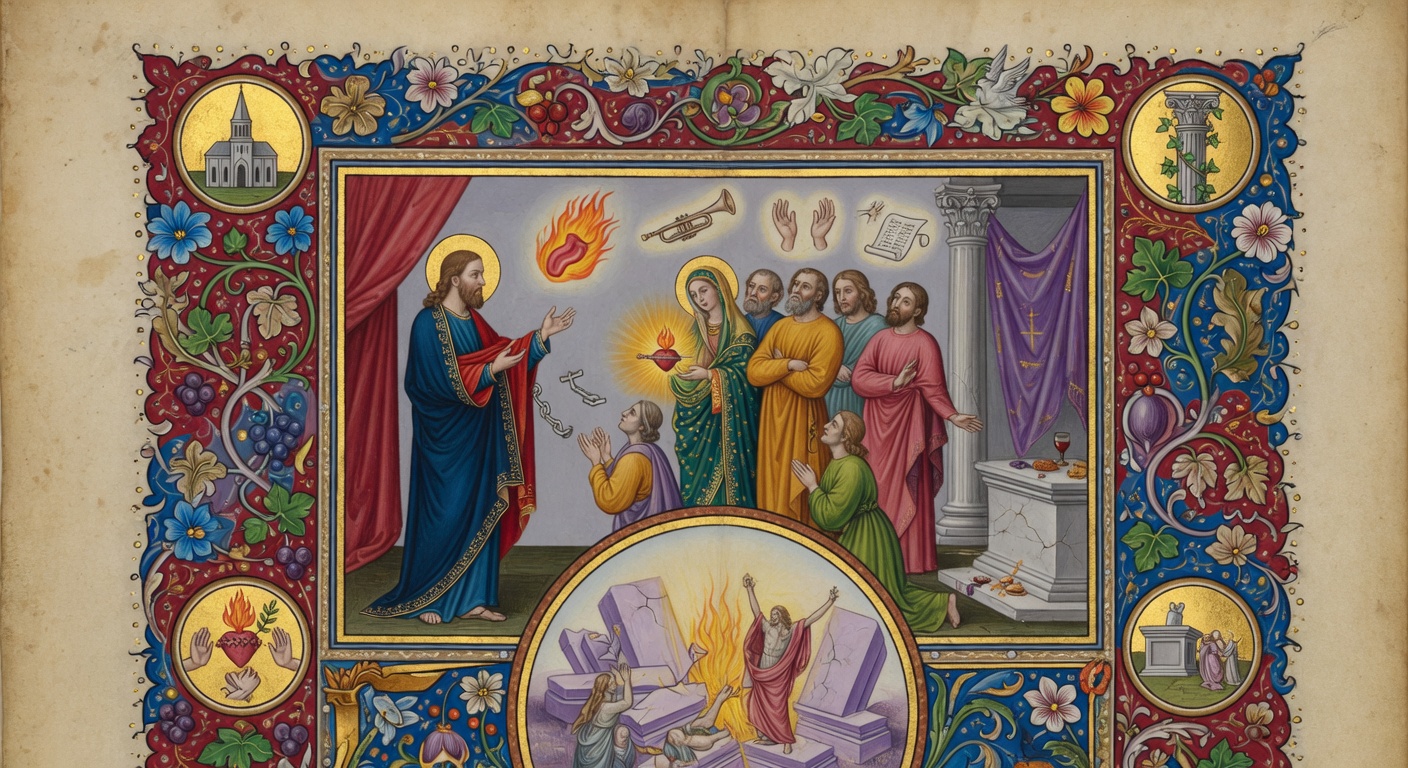
Paul interprets the wilderness wanderings as typological warnings written specifically for the church age, declaring that the Israelites' failures occurred 'for ensamples' and were recorded 'for our admonition, upon whom the ends of the world are come.' Themes: Temptation, Faithfulness
 1oreover, brethren, I would not that ye should be ignorant, how that all our fathers were under the cloud, and all passed through the sea;cf.
2 And were all baptized unto Moses in the cloud and in the sea;cf.
3 And did all eat the same spiritual meat;cf.
4 And did all drink the same spiritual drink: for they drank of that spiritual Rock that followed them: and that Rock was Christ.cf.
5 But with many of them God was not well pleased: for they were overthrown in the wilderness.
6 Now these things were our examples, to the intent we should not lust after evil things, as they also lusted.
7 Neither be ye idolaters, as were some of them; as it is written, The people sat down to eat and drink, and rose up to play.
8 Neither let us commit fornication, as some of them committed, and fell in one day three and twenty thousand.
9 Neither let us tempt Christ, as some of them also tempted, and were destroyed of serpents.
10 Neither murmur ye, as some of them also murmured, and were destroyed of the destroyer.
11 Now all these things happened unto them for ensamples: and they are written for our admonition, upon whom the ends of the world are come.
12 Wherefore let him that thinketh he standeth take heed lest he fall.
13 There hath no temptation taken you but such as is common to man: but God is faithful, who will not suffer you to be tempted above that ye are able; but will with the temptation also make a way to escape, that ye may be able to bear it.
14 Wherefore, my dearly beloved, flee from idolatry.
15 I speak as to wise men; judge ye what I say.
16 The cup of blessing which we bless, is it not the communion of the blood of Christ? The bread which we break, is it not the communion of the body of Christ?
17 For we being many are one bread, and one body: for we are all partakers of that one bread.
18 Behold Israel after the flesh: are not they which eat of the sacrifices partakers of the altar?
19 What say I then? that the idol is any thing, or that which is offered in sacrifice to idols is any thing?
20 But I say, that the things which the Gentiles sacrifice, they sacrifice to devils, and not to God: and I would not that ye should have fellowship with devils.
21 Ye cannot drink the cup of the Lord, and the cup of devils: ye cannot be partakers of the Lord’s table, and of the table of devils.
22 Do we provoke the Lord to jealousy? are we stronger than he?
23 All things are lawful for me, but all things are not expedient: all things are lawful for me, but all things edify not.
24 Let no man seek his own, but every man another’s wealth.
25 Whatsoever is sold in the shambles, that eat, asking no question for conscience sake:
26 For the earth is the Lord’s, and the fulness thereof.
27 If any of them that believe not bid you to a feast, and ye be disposed to go; whatsoever is set before you, eat, asking no question for conscience sake.
28 But if any man say unto you, This is offered in sacrifice unto idols, eat not for his sake that shewed it, and for conscience sake: for the earth is the Lord’s, and the fulness thereof:
29 Conscience, I say, not thine own, but of the other: for why is my liberty judged of another man’s conscience?
30 For if I by grace be a partaker, why am I evil spoken of for that for which I give thanks?
31 Whether therefore ye eat, or drink, or whatsoever ye do, do all to the glory of God.
32 Give none offence, neither to the Jews, nor to the Gentiles, nor to the church of God:
33 Even as I please all men in all things, not seeking mine own profit, but the profit of many, that they may be saved.
← → arrow keys to navigate chapters · spacebar to play/pause audio
Did You Know?
Paul interprets the wilderness wanderings as typological warnings written specifically for the church age, declaring that the Israelites' failures occurred 'for ensamples' and were recorded 'for our admonition, upon whom the ends of the world are come.'
The phrase 'baptized unto Moses in the cloud and in the sea' presents an early Christian sacramental reading of the Exodus, equating the cloud and sea crossing with a form of baptismal identification with a leader.
Verse 4's claim that the Israelites drank from a spiritual Rock 'that followed them' and that 'that Rock was Christ' draws on extra-biblical Jewish traditions of a mobile, water-giving rock accompanying Israel, which Paul then christologically reinterprets.
Paul's statement that Gentile sacrifices are offered 'to devils, and not to God' supplies a demonological explanation for idolatry, positioning pagan meals as actual fellowship with malevolent spiritual powers rather than mere superstition.
The numerical detail that 'three and twenty thousand' fell in one day (v. 8) diverges from the 24,000 recorded in Numbers 25:9, illustrating how New Testament writers sometimes adapted or rounded Old Testament figures for rhetorical or mnemonic purposes.
Paul's Roman citizenship, acquired through his birth in the prominent city of Tarsus, granted him the rare legal privilege to appeal directly to Caesar, which he exercised during his trial before Festus and ultimately led to his voyage to Rome.
Apollos originated from Alexandria, the intellectual center of the Hellenistic world where the Septuagint was translated, which likely equipped him with exceptional rhetorical training and mastery of the Greek Old Testament unmatched by most early preachers.
The city had two harbors, making it one of the wealthiest trade centers in the ancient world.
Commentary & Study Notes Jamieson-Fausset-Brown (1871) · Public Domain Moreover — The oldest manuscripts read "for." Thus the connection with the foregoing chapter is expressed. Ye need to exercise self-denying watchfulness notwithstanding all your pr…
Classic verse-by-verse commentary on 1 Corinthians 10 from Jamieson, Fausset & Brown (1871). Covers: Danger of fellowship with idolatry illustrated in the history of Israel: such fellowship incompatible with fellowship in the Lord's supper. Even lawful things are to be forborne, so as not to hurt weak brethren.
- 1
- Moreover — The oldest manuscripts read "for." Thus the connection with the foregoing chapter is expressed. Ye need to exercise self-denying watchfulness notwithstanding all your privileges, lest ye be castaways. For the Israelites with all their privileges were most of them castaways through want of it. ignorant — with all your boasted "knowledge." our fathers — The Jewish Church stands in the relation of parent to the Christian Church. all — Arrange as the Greek, "Our fathers were all under the cloud"; giving the "all" its proper emphasis. Not so much as one of so great a multitude was detained by force or disease (Ps 105:37) [BENGEL]. Five times the "all" is repeated, in the enumeration of the five favors which God bestowed on Israel (1Co 10:1-4). Five times, correspondingly, they sinned (1Co 10:6-10). In contrast to the "all" stands "many (rather, 'the most') of them" (1Co 10:5). All of them had great privileges, yet most of them were castaways through lust. Beware you, having greater privileges, of sharing the same doom through a similar sin. Continuing the reasoning (1Co 9:24), "They which run in a race, run all, but one receiveth the prize." under the cloud — were continually under the defense of the pillar of cloud, the symbol of the divine presence (Ex 13:21, 22; Ps 105:39; compare Isa 4:5). passed through the sea — by God's miraculous interposition for them (Ex 14:29).
- 2
- And — "And so" [BENGEL]. baptized unto Moses — the servant of God and representative of the Old Testament covenant of the law: as Jesus, the Son of God, is of the Gospel covenant (Joh 1:17; Heb 3:5, 6). The people were led to believe in Moses as God's servant by the miracle of the cloud protecting them, and by their being conducted under him safely through the Red Sea; therefore they are said to be "baptized unto" him (Ex 14:31). "Baptized" is here equivalent to "initiated": it is used in accommodation to Paul's argument to the Corinthians; they, it is true, have been "baptized," but so also virtually were the Israelites of old; if the virtual baptism of the latter availed not to save them from the doom of lust, neither will the actual baptism of the former save them. There is a resemblance between the symbols also: for the cloud and sea consist of water, and as these took the Israelites out of sight, and then restored them again to view, so the water does to the baptized [BENGEL]. OLSHAUSEN understands "the cloud" and "the sea" as symbolizing the Spirit and water respectively (Joh 3:5; Ac 10:44-47). Christ is the pillar cloud that screens us from the heat of God's wrath. Christ as "the light of the world" is our "pillar of fire" to guide us in the darkness of the world. As the rock when smitten sent forth the waters, so Christ, having been once for all smitten, sends forth the waters of the Spirit. As the manna bruised in mills fed Israel, so Christ, when "it pleased the Lord to bruise Him," has become our spiritual food. A strong proof of inspiration is given in this fact, that the historical parts of Scripture, without the consciousness even of the authors, are covert prophecies of the future.
Read all 35 notes on 1 Corinthians 10 →