1 Corinthians 2 KJV
Wisdom from the Spirit
Wisdom from the Spirit
Verse 10's reference to the Spirit searching 'the deep things of God' echoes Job 11:7 and Daniel 2:22, recasting divine inaccessibility as now accessible through revelation rather than human inquiry. Themes: Heaven
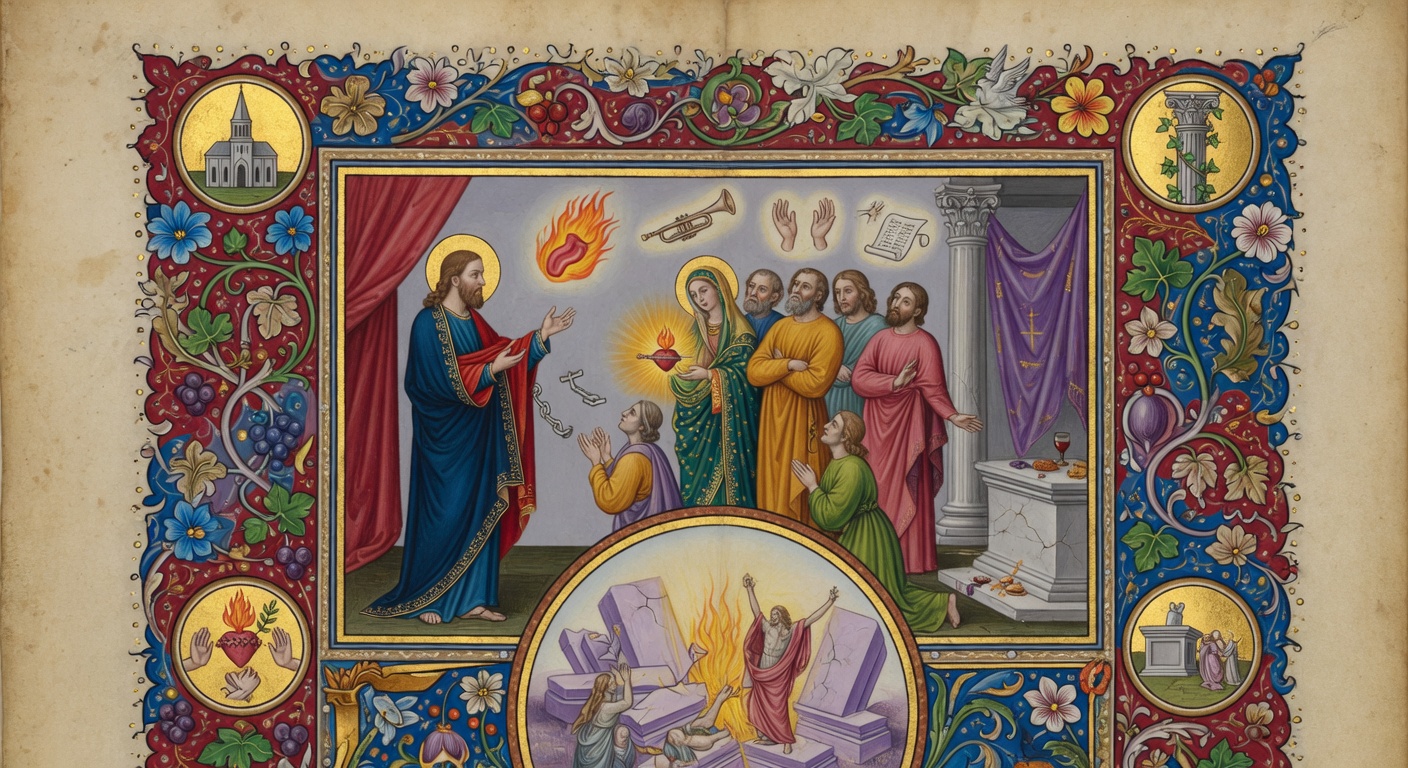
 1nd I, brethren, when I came to you, came not with excellency of speech or of wisdom, declaring unto you the testimony of God.
2 For I determined not to know any thing among you, save Jesus Christ, and him crucified.
3 And I was with you in weakness, and in fear, and in much trembling.
4 And my speech and my preaching was not with enticing words of man’s wisdom, but in demonstration of the Spirit and of power:
5 That your faith should not stand in the wisdom of men, but in the power of God.
6 Howbeit we speak wisdom among them that are perfect: yet not the wisdom of this world, nor of the princes of this world, that come to nought:
7 But we speak the wisdom of God in a mystery, even the hidden wisdom, which God ordained before the world unto our glory:
8 Which none of the princes of this world knew: for had they known it, they would not have crucified the Lord of glory.
9 But as it is written, Eye hath not seen, nor ear heard, neither have entered into the heart of man, the things which God hath prepared for them that love him.
10 But God hath revealed them unto us by his Spirit: for the Spirit searcheth all things, yea, the deep things of God.
11 For what man knoweth the things of a man, save the spirit of man which is in him? even so the things of God knoweth no man, but the Spirit of God.
12 Now we have received, not the spirit of the world, but the spirit which is of God; that we might know the things that are freely given to us of God.
13 Which things also we speak, not in the words which man’s wisdom teacheth, but which the Holy Ghost teacheth; comparing spiritual things with spiritual.
14 But the natural man receiveth not the things of the Spirit of God: for they are foolishness unto him: neither can he know them, because they are spiritually discerned.
15 But he that is spiritual judgeth all things, yet he himself is judged of no man.
16 For who hath known the mind of the Lord, that he may instruct him? But we have the mind of Christ.
← → arrow keys to navigate chapters · spacebar to play/pause audio
Did You Know?
Verse 10's reference to the Spirit searching 'the deep things of God' echoes Job 11:7 and Daniel 2:22, recasting divine inaccessibility as now accessible through revelation rather than human inquiry.
Paul's rejection of 'enticing words of man's wisdom' in verse 4 targets the sophistic rhetorical culture dominant in Corinth, where orators like those described by Dio Chrysostom competed for prestige through stylistic flourish.
The quotation in verse 9 adapts Isaiah 64:4 by inserting 'neither have entered into the heart of man,' fusing it with motifs from Isaiah 65:17 to shift focus from future eschatology to present pneumatic disclosure.
Verse 15's claim that the spiritual person 'judgeth all things' draws on Daniel 7's motif of the saints receiving judgment authority, applying apocalyptic imagery to everyday discernment of spiritual realities.
The chapter's closing allusion to Isaiah 40:13 in verse 16 positions 'the mind of Christ' as an inversion of the LXX's rhetorical question, implying believers now participate in Christ's own divine wisdom through union.
Paul studied under the renowned Pharisee Gamaliel in Jerusalem, receiving advanced training in Jewish law that he later referenced when defending his background before the Sanhedrin and in his epistles.
Paul deliberately downplayed his own role versus Apollos in 1 Corinthians 3 by describing himself as the planter and Apollos as the waterer, a metaphor drawn from Alexandrian agricultural practices to defuse Corinthian personality cults.
Paul worked as a tentmaker in Corinth to support himself while planting the church.
Commentary & Study Notes Jamieson-Fausset-Brown (1871) · Public Domain And I — "So I" [CONYBEARE] as one of the "foolish, weak, and despised" instruments employed by God (1Co 1:27, 28); "glorying in the Lord," not in man's wisdom (1Co 1:31). Compare 1…
Classic verse-by-verse commentary on 1 Corinthians 2 from Jamieson, Fausset & Brown (1871). Covers: Paul's subject of preaching, Christ crucified, not in worldly, but in heavenly, wisdom among the perfect.
- 1
- And I — "So I" [CONYBEARE] as one of the "foolish, weak, and despised" instruments employed by God (1Co 1:27, 28); "glorying in the Lord," not in man's wisdom (1Co 1:31). Compare 1Co 1:23, "We." when I came — (Ac 18:1, &c.). Paul might, had he pleased, have used an ornate style, having studied secular learning at Tarsus of Cilicia, which STRABO preferred as a school of learning to Athens or Alexandria; here, doubtless, he read the Cilician Aratus' poems (which he quotes, Ac 17:28), and Epimenides (Tit 1:12), and Menander (1Co 15:33). Grecian intellectual development was an important element in preparing the way for the Gospel, but it failed to regenerate the world, showing that for this a superhuman power is needed. Hellenistic (Grecizing) Judaism at Tarsus and Alexandria was the connecting link between the schools of Athens and those of the Rabbis. No more fitting birthplace could there have been for the apostle of the Gentiles than Tarsus, free as it was from the warping influences of Rome, Alexandria, and Athens. He had at the same time Roman citizenship, which protected him from sudden violence. Again, he was reared in the Hebrew divine law at Jerusalem. Thus, as the three elements, Greek cultivation, Roman polity (Lu 2:1), and the divine law given to the Jews, combined just at Christ's time, to prepare the world for the Gospel, so the same three, by God's marvellous providence, met together in the apostle to the Gentiles [CONYBEARE and HOWSON]. testimony of God — "the testimony of Christ" (1Co 1:6); therefore Christ is God.
- 2
- The Greek implies, "The only definite thing that I made it my business to know among you, was to know Jesus Christ (His person) and Him crucified (His office)" [ALFORD], not exalted on the earthly throne of David, but executed as the vilest malefactor. The historical fact of Christ's crucifixion had probably been put less prominently forward by the seekers after human wisdom in the Corinthian church, to avoid offending learned heathens and Jews. Christ's person and Christ's office constitute the sum of the Gospel.
Read all 16 notes on 1 Corinthians 2 →