1 Samuel 13 KJV
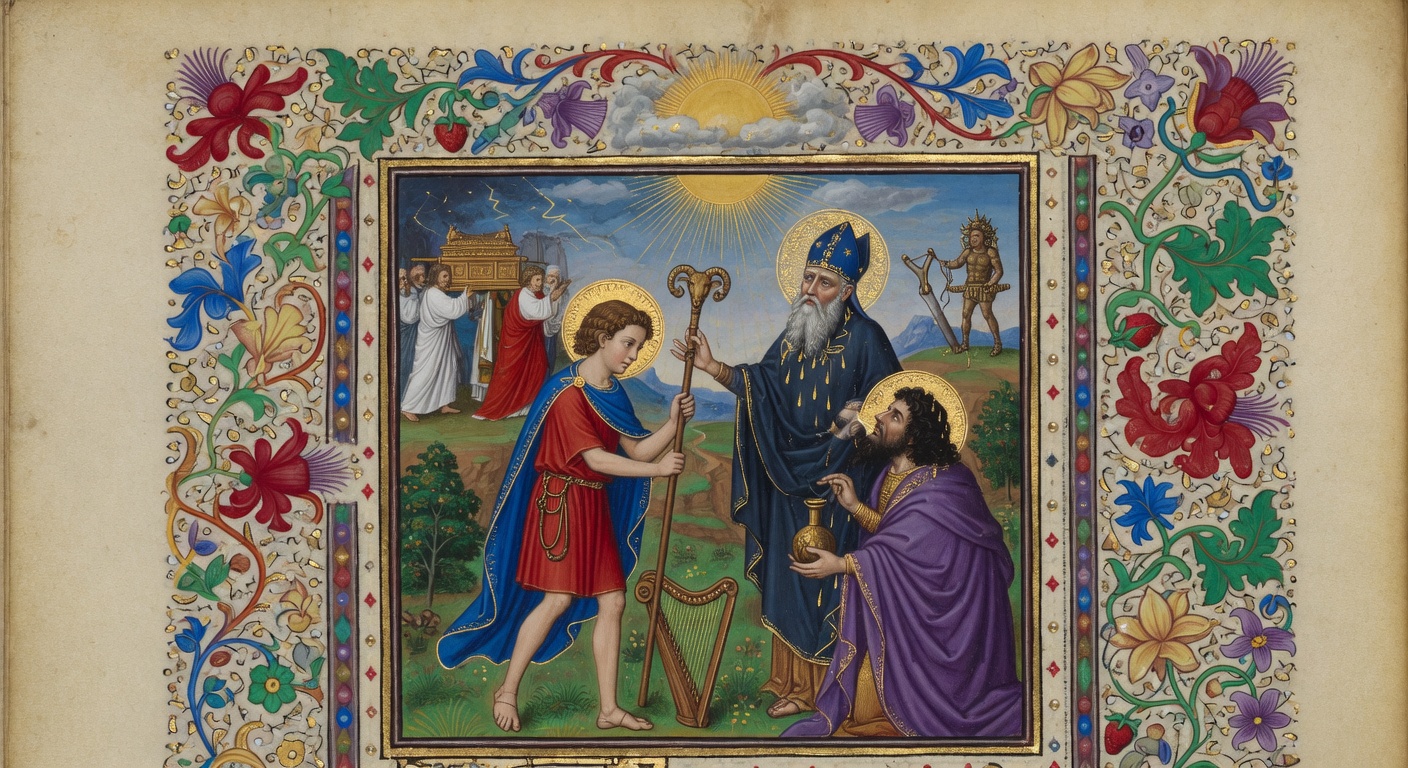
Saul's Unlawful Sacrifice
Saul's Unlawful Sacrifice
The phrase 'a man after his own heart' first appears in 13:14 as God's direct response to Saul's premature sacrifice, establishing the theological criterion that will later define David's selection and the entire Davidic covenant trajectory.
 1aul reigned one year; and when he had reigned two years over Israel,
2 Saul chose him three thousand men of Israel; whereof two thousand were with Saul in Michmash and in mount Bethel, and a thousand were with Jonathan in Gibeah of Benjamin: and the rest of the people he sent every man to his tent.
3 And Jonathan smote the garrison of the Philistines that was in Geba, and the Philistines heard of it. And Saul blew the trumpet throughout all the land, saying, Let the Hebrews hear.
4 And all Israel heard say that Saul had smitten a garrison of the Philistines, and that Israel also was had in abomination with the Philistines. And the people were called together after Saul to Gilgal.
5 And the Philistines gathered themselves together to fight with Israel, thirty thousand chariots, and six thousand horsemen, and people as the sand which is on the sea shore in multitude: and they came up, and pitched in Michmash, eastward from Bethaven.
6 When the men of Israel saw that they were in a strait, (for the people were distressed,) then the people did hide themselves in caves, and in thickets, and in rocks, and in high places, and in pits.
7 And some of the Hebrews went over Jordan to the land of Gad and Gilead. As for Saul, he was yet in Gilgal, and all the people followed him trembling.
8 And he tarried seven days, according to the set time that Samuel had appointed: but Samuel came not to Gilgal; and the people were scattered from him.
9 And Saul said, Bring hither a burnt offering to me, and peace offerings. And he offered the burnt offering.
10 And it came to pass, that as soon as he had made an end of offering the burnt offering, behold, Samuel came; and Saul went out to meet him, that he might salute him.
11 And Samuel said, What hast thou done? And Saul said, Because I saw that the people were scattered from me, and that thou camest not within the days appointed, and that the Philistines gathered themselves together at Michmash;
12 Therefore said I, The Philistines will come down now upon me to Gilgal, and I have not made supplication unto the LORD: I forced myself therefore, and offered a burnt offering.
13 And Samuel said to Saul, Thou hast done foolishly: thou hast not kept the commandment of the LORD thy God, which he commanded thee: for now would the LORD have established thy kingdom upon Israel for ever.
14 But now thy kingdom shall not continue: the LORD hath sought him a man after his own heart, and the LORD hath commanded him to be captain over his people, because thou hast not kept that which the LORD commanded thee.
15 And Samuel arose, and gat him up from Gilgal unto Gibeah of Benjamin. And Saul numbered the people that were present with him, about six hundred men.
16 And Saul, and Jonathan his son, and the people that were present with them, abode in Gibeah of Benjamin: but the Philistines encamped in Michmash.
17 And the spoilers came out of the camp of the Philistines in three companies: one company turned unto the way that leadeth to Ophrah, unto the land of Shual:
18 And another company turned the way to Bethhoron: and another company turned to the way of the border that looketh to the valley of Zeboim toward the wilderness.
19 Now there was no smith found throughout all the land of Israel: for the Philistines said, Lest the Hebrews make them swords or spears:
20 But all the Israelites went down to the Philistines, to sharpen every man his share, and his coulter, and his axe, and his mattock.
21 Yet they had a file for the mattocks, and for the coulters, and for the forks, and for the axes, and to sharpen the goads.
22 So it came to pass in the day of battle, that there was neither sword nor spear found in the hand of any of the people that were with Saul and Jonathan: but with Saul and with Jonathan his son was there found.
23 And the garrison of the Philistines went out to the passage of Michmash.
← → arrow keys to navigate chapters · spacebar to play/pause audio
Did You Know?
The phrase 'a man after his own heart' first appears in 13:14 as God's direct response to Saul's premature sacrifice, establishing the theological criterion that will later define David's selection and the entire Davidic covenant trajectory.
Verses 19-22 reveal the Philistines' deliberate suppression of Israelite metallurgy, creating a monopoly on iron weapons that left Israel's forces dependent on enemy forges and explains why only Saul and Jonathan possessed swords amid 600 men.
Saul's offering at Gilgal occurs at the same site where his kingship was publicly confirmed in chapter 11 and where Joshua renewed the covenant, underscoring the monarchy's failure to uphold the conditional terms of covenant obedience from its inception.
The reported Philistine force of 30,000 chariots in verse 5 represents an exaggerated scale that emphasizes overwhelming technological superiority rather than literal numbers, highlighting Israel's existential vulnerability before any battle begins.
Samuel's rebuke in 13:13-14 pronounces the end of Saul's dynastic hopes before the later Amalekite failure in chapter 15, demonstrating that the king's disqualification was triggered by cultic overreach rather than battlefield defeat alone.
The spirit of Samuel summoned by the medium at Endor appeared wearing his distinctive mantle, the same garment he had used decades earlier to signal the tearing away of Saul's kingdom when David secretly cut its hem in the cave of En Gedi.
The tall Benjamite king experienced ecstatic prophetic episodes both at his anointing and later among a group of prophets, prompting the popular saying "Is Saul also among the prophets?" which underscored the unexpected charismatic dimensions of his early reign.
David twice spared Saul's life in the wilderness, once cutting off a piece of his robe in the En Gedi cave and later removing his spear and water jug while he slept, demonstrating restraint amid pursuit.
Jonathan repeatedly risked his life by confronting his father Saul and revealing assassination plots against David, prioritizing their covenant bond over his own claim to the throne.
The city later suffered destruction after the Philistines captured the Ark of the Covenant, which had been housed there, signaling a major shift away from this early sanctuary.
Samuel lived there after his service at Shiloh, built an altar to the Lord, and judged Israel from Ramah during the period of transition from tribal leadership to monarchy.
Archaeological excavations at Tell el-Ful have revealed a fortress dating to the Iron Age that may correspond to Saul's palace.
Commentary & Study Notes Jamieson-Fausset-Brown (1871) · Public Domain Saul reigned one year — (see Margin). The transactions recorded in the eleventh and twelfth chapters were the principal incidents comprising the first year of Saul's reign; and the…
Classic verse-by-verse commentary on 1 Samuel 13 from Jamieson, Fausset & Brown (1871). Covers: Saul's selected band; He calls the hebrews to gilgal against the philistines; The philistines' great host; The israelites' distress.
- 1
- Saul reigned one year — (see Margin). The transactions recorded in the eleventh and twelfth chapters were the principal incidents comprising the first year of Saul's reign; and the events about to be described in this happened in the second year.
- 2
- Saul chose him three thousand men of Israel — This band of picked men was a bodyguard, who were kept constantly on duty, while the rest of the people were dismissed till their services might be needed. It seems to have been his tactics to attack the Philistine garrisons in the country by different detachments, rather than by risking a general engagement; and his first operations were directed to rid his native territory of Benjamin of these enemies.
Read all 9 notes on 1 Samuel 13 →