1 Samuel 7 KJV
Samuel Leads Israel
Samuel Leads Israel
The reversal at Mizpah directly inverts the earlier defeat at Ebenezer in chapter 4, transforming the site of the Ark's capture into the location of a commemorative victory stone that redefines Israel's relationship with YHWH.
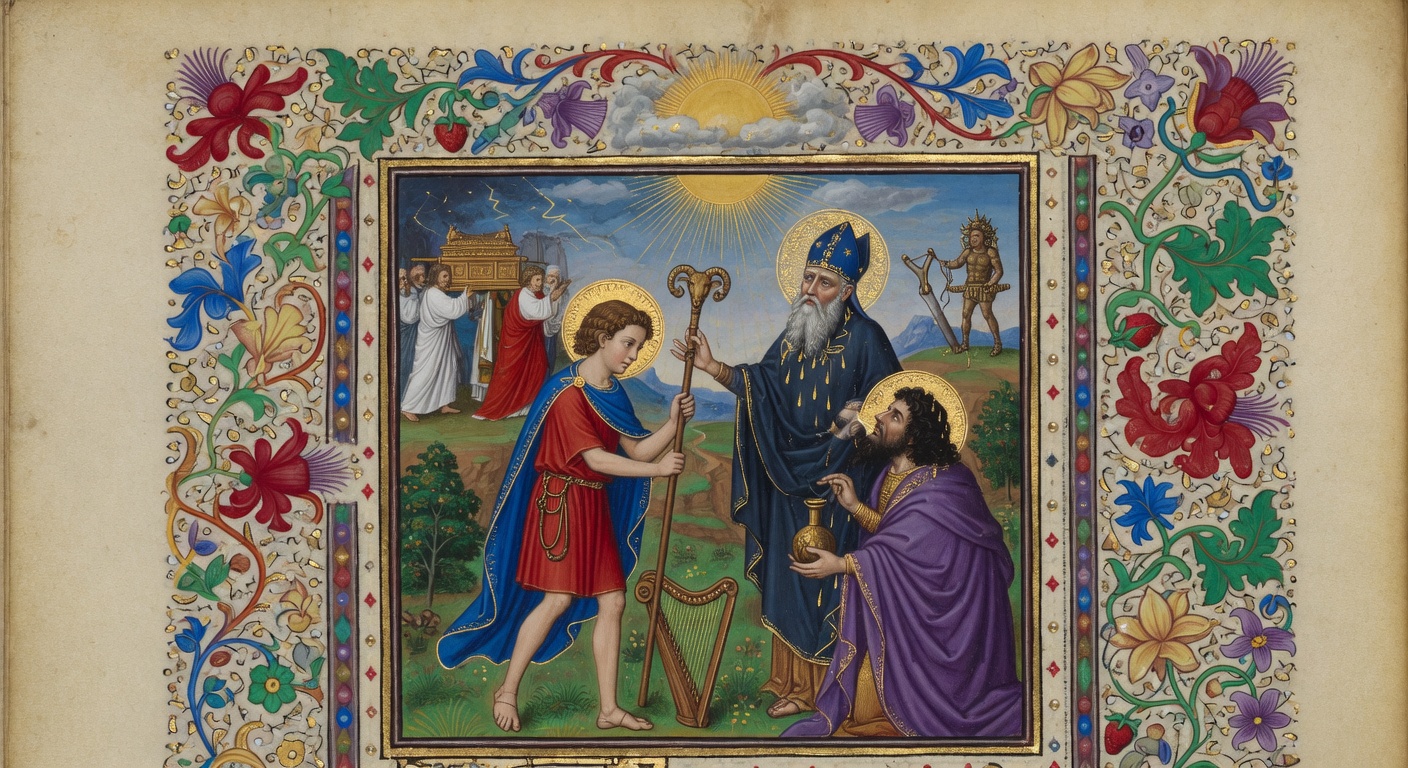
 1nd the men of Kirjathjearim came, and fetched up the ark of the LORD, and brought it into the house of Abinadab in the hill, and sanctified Eleazar his son to keep the ark of the LORD.
2 And it came to pass, while the ark abode in Kirjathjearim, that the time was long; for it was twenty years: and all the house of Israel lamented after the LORD.
3 And Samuel spake unto all the house of Israel, saying, If ye do return unto the LORD with all your hearts, then put away the strange gods and Ashtaroth from among you, and prepare your hearts unto the LORD, and serve him only: and he will deliver you out of the hand of the Philistines.
4 Then the children of Israel did put away Baalim and Ashtaroth, and served the LORD only.
5 And Samuel said, Gather all Israel to Mizpeh, and I will pray for you unto the LORD.
6 And they gathered together to Mizpeh, and drew water, and poured it out before the LORD, and fasted on that day, and said there, We have sinned against the LORD. And Samuel judged the children of Israel in Mizpeh.
7 And when the Philistines heard that the children of Israel were gathered together to Mizpeh, the lords of the Philistines went up against Israel. And when the children of Israel heard it, they were afraid of the Philistines.
8 And the children of Israel said to Samuel, Cease not to cry unto the LORD our God for us, that he will save us out of the hand of the Philistines.
9 And Samuel took a sucking lamb, and offered it for a burnt offering wholly unto the LORD: and Samuel cried unto the LORD for Israel; and the LORD heard him.
10 And as Samuel was offering up the burnt offering, the Philistines drew near to battle against Israel: but the LORD thundered with a great thunder on that day upon the Philistines, and discomfited them; and they were smitten before Israel.
11 And the men of Israel went out of Mizpeh, and pursued the Philistines, and smote them, until they came under Bethcar.
12 Then Samuel took a stone, and set it between Mizpeh and Shen, and called the name of it Ebenezer, saying, Hitherto hath the LORD helped us.
13 So the Philistines were subdued, and they came no more into the coast of Israel: and the hand of the LORD was against the Philistines all the days of Samuel.
14 And the cities which the Philistines had taken from Israel were restored to Israel, from Ekron even unto Gath; and the coasts thereof did Israel deliver out of the hands of the Philistines. And there was peace between Israel and the Amorites.
15 And Samuel judged Israel all the days of his life.
16 And he went from year to year in circuit to Bethel, and Gilgal, and Mizpeh, and judged Israel in all those places.
17 And his return was to Ramah; for there was his house; and there he judged Israel; and there he built an altar unto the LORD.
← → arrow keys to navigate chapters · spacebar to play/pause audio
Did You Know?
The reversal at Mizpah directly inverts the earlier defeat at Ebenezer in chapter 4, transforming the site of the Ark's capture into the location of a commemorative victory stone that redefines Israel's relationship with YHWH.
Samuel's burnt offering of a single suckling lamb functions as an intercessory act that merges prophetic and priestly roles during a pre-monarchic transition, evoking atonement imagery without requiring Aaronic lineage.
The specific command to discard Baalim and Ashtaroth targets the syncretistic worship patterns that persisted after the Exodus, framing national repentance as a deliberate rejection of Canaanite fertility cults rather than generic idolatry.
The thunder theophany at Mizpah echoes Sinai's divine voice while serving as a direct counter to Philistine military technology, portraying YHWH's intervention as both covenant renewal and cosmic warfare.
Samuel's judicial circuit through Bethel, Gilgal, and Mizpah establishes decentralized sacral centers that prefigure later tensions between northern and southern cultic sites, underscoring the fragility of unity under prophetic rather than royal authority.
Samuel organized formal companies of prophets at Ramah, Naioth, Bethel, and Gilgal that trained disciples in music, ecstatic utterance, and Torah study, creating institutional structures later used by Elijah and Elisha.
Saul erected Israel's first recorded royal altar after his victory over the Philistines at Michmash, yet this act of devotion contrasted sharply with his later failure to fully execute the ban on Amalek, revealing inconsistencies in his religious observance.
Jonathan sealed his covenant with David by giving him his royal robe, armor, sword, bow, and belt, ritually transferring symbols of kingship despite being Saul's heir.
In sealing their covenant, Jonathan removed his royal robe, armor, sword, bow, and belt to give them to David, a deliberate symbolic transfer acknowledging David's future kingship over Israel.
The prophet Samuel summoned the Israelites there to fast, confess their sins, and renew their covenant with God, while also exercising his role in judging the nation.
Samuel lived there after his service at Shiloh, built an altar to the Lord, and judged Israel from Ramah during the period of transition from tribal leadership to monarchy.
David later came here to bring the ark to Jerusalem.
Commentary & Study Notes Jamieson-Fausset-Brown (1871) · Public Domain the men of Kirjath-jearim — "the city of woods," also Kirjath-baal (Jos 15:60; 18:14; 1Ch 13:5, 6). It was the nearest town to Beth-shemesh and stood on a hill. This was the reason…
Classic verse-by-verse commentary on 1 Samuel 7 from Jamieson, Fausset & Brown (1871). Covers: The ark at kirjath-jearim; The israelites, through samuel's influence, solemnly repent at mizpeh; While samuel prays, the philistines are discomfited.
- 1
- the men of Kirjath-jearim — "the city of woods," also Kirjath-baal (Jos 15:60; 18:14; 1Ch 13:5, 6). It was the nearest town to Beth-shemesh and stood on a hill. This was the reason of the message (1Sa 6:21), and why this was chosen for the convenience of people turning their faces to the ark (1Ki 8:29-35; Ps 28:2; Da 6:10). brought it into the house of Abinadab in the hill — Why it was not transported at once to Shiloh where the tabernacle and sacred vessels were remaining, is difficult to conjecture. sanctified... his son — He was not a Levite, and was therefore only set apart or appointed to be keeper of the place.
- 2
- the ark abode in Kirjath-jearim... twenty years — It appears, in the subsequent history, that a much longer period elapsed before its final removal from Kirjath-jearim (2Sa 6:1-19; 1Ch 13:1-14). But that length of time had passed when the Israelites began to revive from their sad state of religious decline. The capture of the ark had produced a general indifference either as to its loss or its recovery. all the house of Israel lamented after the Lord — They were then brought, doubtless by the influence of Samuel's exhortations, to renounce idolatry, and to return to the national worship of the true God.
Read all 6 notes on 1 Samuel 7 →