1 Timothy 6 KJV
Godliness with Contentment
Godliness with Contentment
The chapter's use of 'paratheke' (deposit) in verse 20 frames Timothy's guardianship of doctrine as a sacred trust akin to a banker's fiduciary duty, a term Paul repeats in 2 Timothy to underscore apostolic succession amid Ephesian heresies.
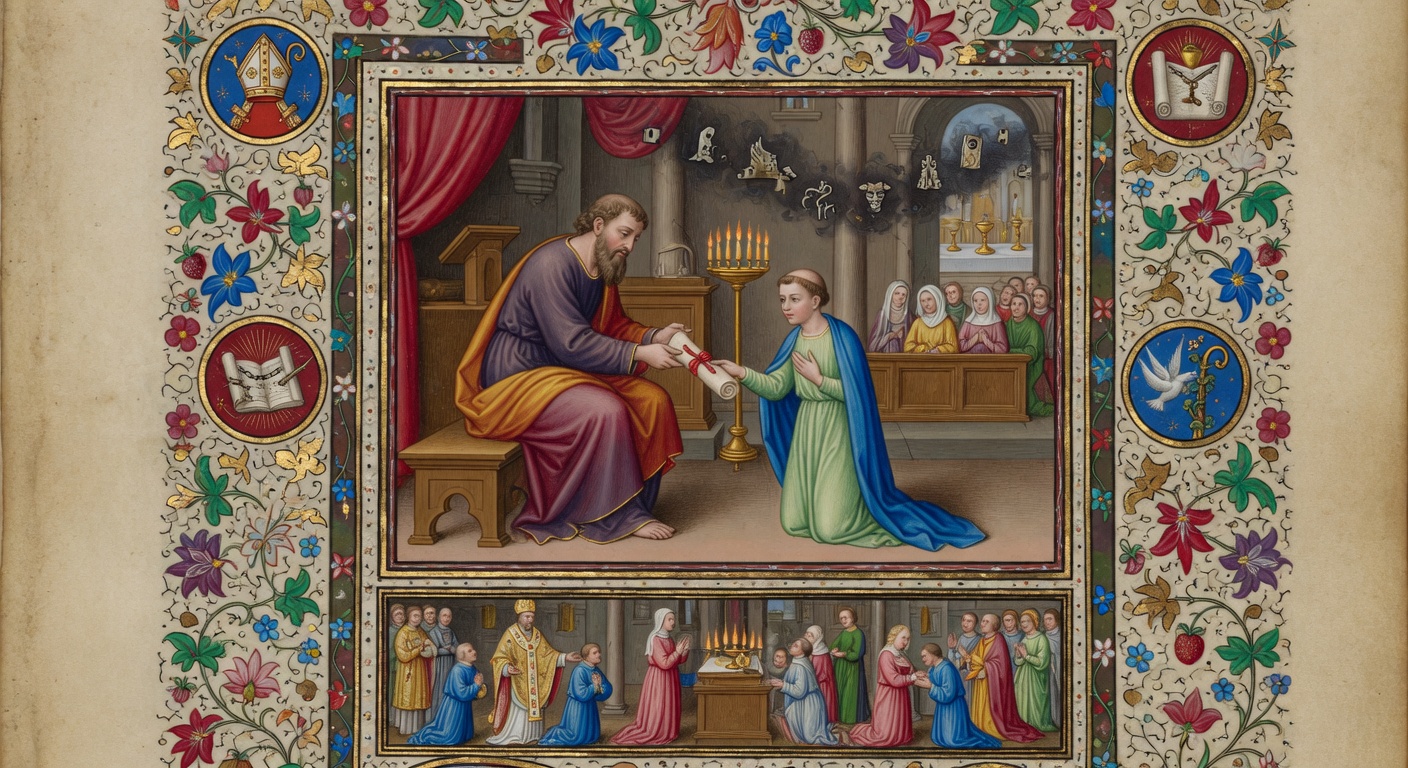
 1et as many servants as are under the yoke count their own masters worthy of all honour, that the name of God and his doctrine be not blasphemed.
2 And they that have believing masters, let them not despise them, because they are brethren; but rather do them service, because they are faithful and beloved, partakers of the benefit. These things teach and exhort.
3 If any man teach otherwise, and consent not to wholesome words, even the words of our Lord Jesus Christ, and to the doctrine which is according to godliness;
4 He is proud, knowing nothing, but doting about questions and strifes of words, whereof cometh envy, strife, railings, evil surmisings,
5 Perverse disputings of men of corrupt minds, and destitute of the truth, supposing that gain is godliness: from such withdraw thyself.
6 But godliness with contentment is great gain.
7 For we brought nothing into this world, and it is certain we can carry nothing out.
8 And having food and raiment let us be therewith content.
9 But they that will be rich fall into temptation and a snare, and into many foolish and hurtful lusts, which drown men in destruction and perdition.
10 For the love of money is the root of all evil: which while some coveted after, they have erred from the faith, and pierced themselves through with many sorrows.
11 But thou, O man of God, flee these things; and follow after righteousness, godliness, faith, love, patience, meekness.
12 Fight the good fight of faith, lay hold on eternal life, whereunto thou art also called, and hast professed a good profession before many witnesses.
13 I give thee charge in the sight of God, who quickeneth all things, and before Christ Jesus, who before Pontius Pilate witnessed a good confession;
14 That thou keep this commandment without spot, unrebukeable, until the appearing of our Lord Jesus Christ:
15 Which in his times he shall shew, who is the blessed and only Potentate, the King of kings, and Lord of lords;
16 Who only hath immortality, dwelling in the light which no man can approach unto; whom no man hath seen, nor can see: to whom be honour and power everlasting. Amen.
17 Charge them that are rich in this world, that they be not highminded, nor trust in uncertain riches, but in the living God, who giveth us richly all things to enjoy;
18 That they do good, that they be rich in good works, ready to distribute, willing to communicate;
19 Laying up in store for themselves a good foundation against the time to come, that they may lay hold on eternal life.
20 O Timothy, keep that which is committed to thy trust, avoiding profane and vain babblings, and oppositions of science falsely so called:
21 Which some professing have erred concerning the faith. Grace be with thee. Amen.
← → arrow keys to navigate chapters · spacebar to play/pause audio
Did You Know?
The chapter's use of 'paratheke' (deposit) in verse 20 frames Timothy's guardianship of doctrine as a sacred trust akin to a banker's fiduciary duty, a term Paul repeats in 2 Timothy to underscore apostolic succession amid Ephesian heresies.
Paul's allusion to Christ's 'good confession' before Pilate in verse 13 draws on the Roman legal concept of a formal testimony under oath, positioning Christian witness as a counter-claim to imperial authority rather than mere personal belief.
The warning against 'oppositions of science falsely so called' in verse 20 targets early Gnostic dualism by co-opting their term 'gnosis' while rejecting it as antithetical to the 'sound words' of the faith, prefiguring second-century anti-heretical rhetoric.
Verses 17-19 invert Greco-Roman euergetism by urging the wealthy not to seek honor through public benefaction but to pursue 'treasures' stored in the eschatological future, subverting patronage systems prevalent in Ephesus.
The doxology in verses 15-16 applies 'King of kings, and Lord of lords' to God the Father using liturgical phrasing drawn from Hellenistic ruler cults and Daniel 2:47, creating a theocentric counter to imperial acclamations before its later Christological adaptation in Revelation.
While supporting his missionary work, Paul practiced the trade of tentmaking alongside Priscilla and Aquila in Corinth, a skill he leveraged to remain financially independent from many churches and avoid charges of exploiting converts for money.
Timothy's mixed heritage. Jewish mother Eunice and Greek father. Made him uniquely positioned to bridge cultural divides in the early church, a detail Paul leveraged for effective evangelism among both groups.
The Temple of Artemis in Ephesus was four times larger than the Parthenon in Athens.
Commentary & Study Notes Jamieson-Fausset-Brown (1871) · Public Domain servants — to be taken as predicated thus, "Let as many as are under the yoke (as) slaves" (Tit 2:9). The exhortation is natural as there was a danger of Christian slaves inwardly…
Classic verse-by-verse commentary on 1 Timothy 6 from Jamieson, Fausset & Brown (1871). Covers: Exhortations as to distinctions of civil rank; The duty of slaves, in opposition to the false teachings of gain-seekers; Timothy's pursuit is to be godliness, which is an everlasting possession: solemn adjuration to do so against Christ's coming; Charge to be given to the rich. Concluding exhortation.
- 1
- servants — to be taken as predicated thus, "Let as many as are under the yoke (as) slaves" (Tit 2:9). The exhortation is natural as there was a danger of Christian slaves inwardly feeling above their heathen masters. their own masters — The phrase "their own," is an argument for submissiveness; it is not strangers, but their own masters whom they are required to respect. all honour — all possible and fitting honor; not merely outward subjection, but that inward honor from which will flow spontaneously right outward conduct (see on Eph 5:22). that the name of God — by which Christians are called. blasphemed — Heathen masters would say, What kind of a God must be the God of the Christians, when such are the fruits of His worship (Ro 2:24; Tit 2:5, 10)?
- 2
- And — rather, "But." The opposition is between those Christian slaves under the yoke of heathen, and those that have believing masters (he does not use the phrase "under the yoke" in the latter case, for service under believers is not a yoke). Connect the following words thus, "Let them (the slaves) not, because they (the masters) are brethren (and so equals, masters and slaves alike being Christians), despise them (the masters)." but rather, &c. — "but all the more (so much the more: with the greater good will) do them service because they (the masters) are faithful (that is, believers) and beloved who receive (in the mutual interchange of relative duties between master and servant; so the Greek) the benefit" (English Version violates Greek grammar). This latter clause is parallel to, "because they are brethren"; which proves that "they" refers to the masters, not the servants, as TITTMANN takes it, explaining the verb in the common sense (Lu 1:54; Ac 20:35), "who sedulously labor for their (masters') benefit." The very term "benefit" delicately implies service done with the right motive, Christian "good will" (Eph 6:7). If the common sense of the Greek verb be urged, the sense must be, "Because they (the masters) are faithful and beloved who are sedulously intent on the benefiting" of their servants. But PORPHYRY [On Abstinence, 1.46] justifies the sense of the Greek verb given above, which also better accords with the context; for otherwise, the article "the," will have nothing in the preceding words to explain it, whereas in my explanation above "the benefit" will be that of the slaves' service. These things teach — (1Ti 4:11; Tit 2:15).
Read all 23 notes on 1 Timothy 6 →