2 Chronicles 1 KJV
Solomon Asks for Wisdom
Solomon Asks for Wisdom
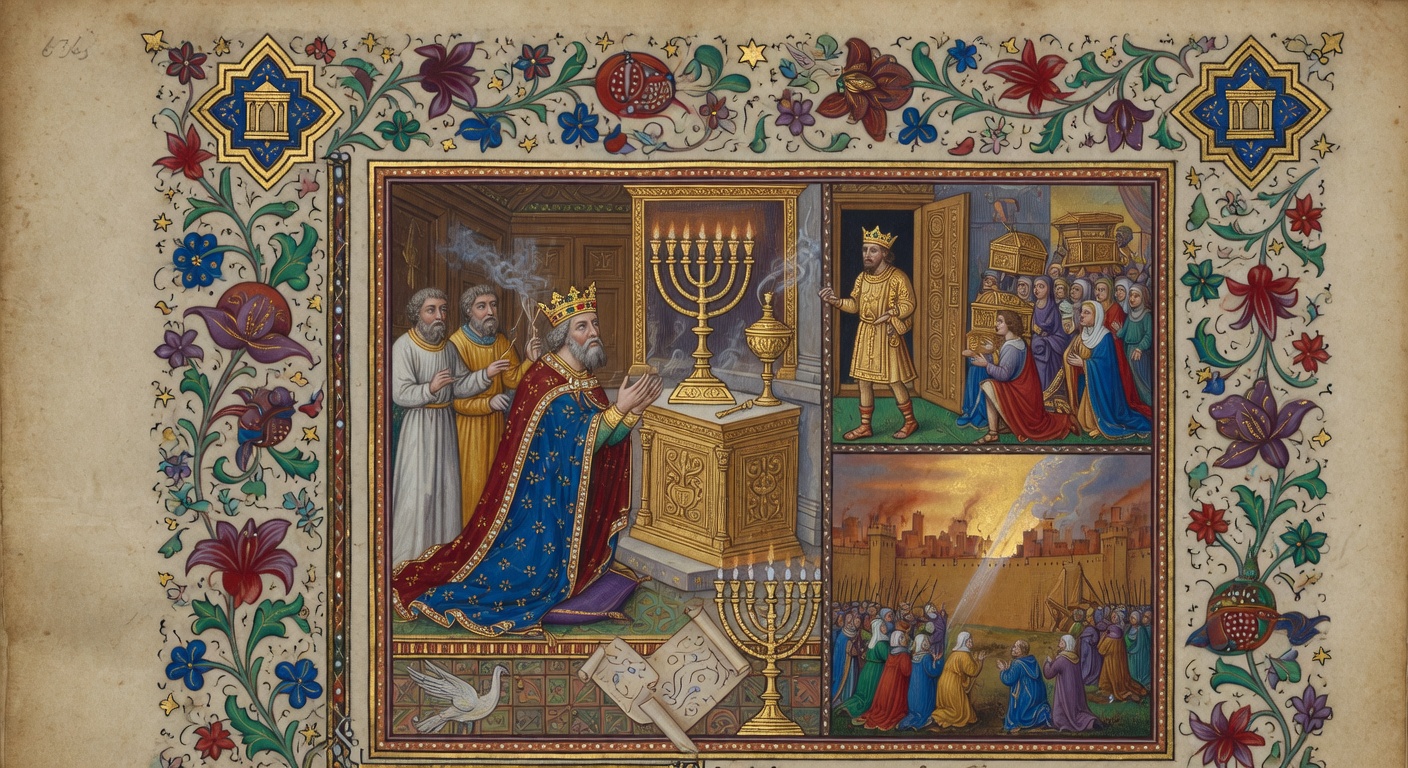
The chapter stresses continuity with the Mosaic era by locating the theophany at Gibeon, where the original tabernacle and Bezalel’s bronze altar still stood, even though David had already moved the ark to Jerusalem, thereby validating pre-temple worship as legitimate.
 1nd Solomon the son of David was strengthened in his kingdom, and the LORD his God was with him, and magnified him exceedingly.
2 Then Solomon spake unto all Israel, to the captains of thousands and of hundreds, and to the judges, and to every governor in all Israel, the chief of the fathers.
3 So Solomon, and all the congregation with him, went to the high place that was at Gibeon; for there was the tabernacle of the congregation of God, which Moses the servant of the LORD had made in the wilderness.
4 But the ark of God had David brought up from Kirjathjearim to the place which David had prepared for it: for he had pitched a tent for it at Jerusalem.
5 Moreover the brasen altar, that Bezaleel the son of Uri, the son of Hur, had made, he put before the tabernacle of the LORD: and Solomon and the congregation sought unto it.
6 And Solomon went up thither to the brasen altar before the LORD, which was at the tabernacle of the congregation, and offered a thousand burnt offerings upon it.
7 In that night did God appear unto Solomon, and said unto him, Ask what I shall give thee.
8 And Solomon said unto God, Thou hast shewed great mercy unto David my father, and hast made me to reign in his stead.
9 Now, O LORD God, let thy promise unto David my father be established: for thou hast made me king over a people like the dust of the earth in multitude.
10 Give me now wisdom and knowledge, that I may go out and come in before this people: for who can judge this thy people, that is so great?
11 And God said to Solomon, Because this was in thine heart, and thou hast not asked riches, wealth, or honour, nor the life of thine enemies, neither yet hast asked long life; but hast asked wisdom and knowledge for thyself, that thou mayest judge my people, over whom I have made thee king:
12 Wisdom and knowledge is granted unto thee; and I will give thee riches, and wealth, and honour, such as none of the kings have had that have been before thee, neither shall there any after thee have the like.
13 Then Solomon came from his journey to the high place that was at Gibeon to Jerusalem, from before the tabernacle of the congregation, and reigned over Israel.
14 And Solomon gathered chariots and horsemen: and he had a thousand and four hundred chariots, and twelve thousand horsemen, which he placed in the chariot cities, and with the king at Jerusalem.
15 And the king made silver and gold at Jerusalem as plenteous as stones, and cedar trees made he as the sycomore trees that are in the vale for abundance.
16 And Solomon had horses brought out of Egypt, and linen yarn: the king’s merchants received the linen yarn at a price.
17 And they fetched up, and brought forth out of Egypt a chariot for six hundred shekels of silver, and an horse for an hundred and fifty: and so brought they out horses for all the kings of the Hittites, and for the kings of Syria, by their means.
← → arrow keys to navigate chapters · spacebar to play/pause audio
Did You Know?
The chapter stresses continuity with the Mosaic era by locating the theophany at Gibeon, where the original tabernacle and Bezalel’s bronze altar still stood, even though David had already moved the ark to Jerusalem, thereby validating pre-temple worship as legitimate.
Solomon’s extravagant thousand burnt offerings are presented as the catalyst for the dream revelation, portraying sacrificial excess as the human precondition for divine encounter rather than the request itself.
God’s unrequested addition of riches and honor to the gift of wisdom quietly fulfills the Deuteronomic ideal of a king who seeks Torah above power, while also anticipating later tensions over royal accumulation of horses and wealth.
The brief closing notice that Solomon imported horses and chariots from Egypt and Kue subtly invokes the Deuteronomic prohibition against multiplying horses, creating an early hint of the future critique leveled against the monarchy.
Chronicles alone records that the bronze altar proved too small for the offerings, underscoring the inadequacy of wilderness-era furnishings for the scale of Solomonic devotion and signaling the imminent need for the temple.
Biblical tradition attributes 3,000 proverbs and 1,005 songs to Solomon, along with expertise in botany and zoology covering everything from cedar trees to hyssop and from livestock to birds, fish, and reptiles, yet only fragments survive in Proverbs, Ecclesiastes, and Song of Songs.
To withstand Sennacherib's siege, Hezekiah commissioned a 533-meter tunnel carved through bedrock to channel the Gihon Spring inside Jerusalem's walls, an engineering project whose original Hebrew inscription was recovered in 1880 and confirms the biblical account in 2 Kings 20.
The scroll discovered by high priest Hilkiah during temple repairs prompted Josiah to consult the prophetess Huldah rather than any male prophet, and her oracle both confirmed coming judgment on Judah and promised Josiah a peaceful death because of his responsive humility.
Before facing a coalition of Moabite, Ammonite, and Meunite forces, he positioned temple singers at the head of his army; as they sang, the enemy coalition turned on itself, leaving the Judahites to collect the spoils without combat.
The city has been destroyed at least twice, besieged 23 times, and captured 44 times.
In the prophetic writings it stands as the center of God's redemptive plan, embodying covenant faithfulness and the expectation of a coming Messiah who would rule from Zion in justice and peace.
Babylon's walls were reportedly wide enough for two chariots to pass side by side.
Commentary & Study Notes Jamieson-Fausset-Brown (1871) · Public Domain Then Solomon spake unto all Israel — The heads, or leading officers, who are afterwards specified, were summoned to attend their sovereign in a solemn religious procession. The dat…
Classic verse-by-verse commentary on 2 Chronicles 1 from Jamieson, Fausset & Brown (1871). Covers: Solemn offering of solomon at gibeon; His choice of wisdom is blessed by God; His strength and wealth.
- 2-5
- Then Solomon spake unto all Israel — The heads, or leading officers, who are afterwards specified, were summoned to attend their sovereign in a solemn religious procession. The date of this occurrence was the second year of Solomon's reign, and the high place at Gibeon was chosen for the performance of the sacred rites, because the tabernacle and all the ancient furniture connected with the national worship were deposited there. Zadok was the officiating high priest (1Ch 16:39). It is true that the ark had been removed and placed in a new tent which David had made for it at Jerusalem [2Ch 1:4]. But the brazen altar, "before the tabernacle of the Lord," on which the burnt offerings were appointed by the law to be made, was at Gibeon. And although David had been led by extraordinary events and tokens of the divine presence to sacrifice on the threshing-floor of Araunah, Solomon considered it his duty to present his offerings on the legally appointed spot "before the tabernacle," and on the time-honored altar prepared by the skill of Bezaleel in the wilderness (Ex 38:1).
- 6
- offered a thousand burnt offerings — This holocaust he offered, of course, by the hands of the priests. The magnitude of the oblation became the rank of the offerer on this occasion of national solemnity.
Read all 4 notes on 2 Chronicles 1 →