2 Kings 20 KJV
Hezekiah's Illness
Hezekiah's Illness
The reversal of the sun's shadow on Ahaz's dial deliberately echoes Joshua's long day at Gibeon, positioning Hezekiah as a new conqueror whose personal deliverance mirrors national victory over Assyria.
 1n those days was Hezekiah sick unto death. And the prophet Isaiah the son of Amoz came to him, and said unto him, Thus saith the LORD, Set thine house in order; for thou shalt die, and not live.
2 Then he turned his face to the wall, and prayed unto the LORD, saying,
3 I beseech thee, O LORD, remember now how I have walked before thee in truth and with a perfect heart, and have done that which is good in thy sight. And Hezekiah wept sore.
4 And it came to pass, afore Isaiah was gone out into the middle court, that the word of the LORD came to him, saying,
5 Turn again, and tell Hezekiah the captain of my people, Thus saith the LORD, the God of David thy father, I have heard thy prayer, I have seen thy tears: behold, I will heal thee: on the third day thou shalt go up unto the house of the LORD.
6 And I will add unto thy days fifteen years; and I will deliver thee and this city out of the hand of the king of Assyria; and I will defend this city for mine own sake, and for my servant David’s sake.
7 And Isaiah said, Take a lump of figs. And they took and laid it on the boil, and he recovered.
8 And Hezekiah said unto Isaiah, What shall be the sign that the LORD will heal me, and that I shall go up into the house of the LORD the third day?
9 And Isaiah said, This sign shalt thou have of the LORD, that the LORD will do the thing that he hath spoken: shall the shadow go forward ten degrees, or go back ten degrees?
10 And Hezekiah answered, It is a light thing for the shadow to go down ten degrees: nay, but let the shadow return backward ten degrees.
11 And Isaiah the prophet cried unto the LORD: and he brought the shadow ten degrees backward, by which it had gone down in the dial of Ahaz.
12 At that time Berodachbaladan, the son of Baladan, king of Babylon, sent letters and a present unto Hezekiah: for he had heard that Hezekiah had been sick.
13 And Hezekiah hearkened unto them, and shewed them all the house of his precious things, the silver, and the gold, and the spices, and the precious ointment, and all the house of his armour, and all that was found in his treasures: there was nothing in his house, nor in all his dominion, that Hezekiah shewed them not.
14 Then came Isaiah the prophet unto king Hezekiah, and said unto him, What said these men? and from whence came they unto thee? And Hezekiah said, They are come from a far country, even from Babylon.
15 And he said, What have they seen in thine house? And Hezekiah answered, All the things that are in mine house have they seen: there is nothing among my treasures that I have not shewed them.
16 And Isaiah said unto Hezekiah, Hear the word of the LORD.
17 Behold, the days come, that all that is in thine house, and that which thy fathers have laid up in store unto this day, shall be carried into Babylon: nothing shall be left, saith the LORD.
18 And of thy sons that shall issue from thee, which thou shalt beget, shall they take away; and they shall be eunuchs in the palace of the king of Babylon.
19 Then said Hezekiah unto Isaiah, Good is the word of the LORD which thou hast spoken. And he said, Is it not good, if peace and truth be in my days?
20 And the rest of the acts of Hezekiah, and all his might, and how he made a pool, and a conduit, and brought water into the city, are they not written in the book of the chronicles of the kings of Judah?
21 And Hezekiah slept with his fathers: and Manasseh his son reigned in his stead.
← → arrow keys to navigate chapters · spacebar to play/pause audio
Did You Know?
The reversal of the sun's shadow on Ahaz's dial deliberately echoes Joshua's long day at Gibeon, positioning Hezekiah as a new conqueror whose personal deliverance mirrors national victory over Assyria.
Merodach-baladan's embassy is the only direct contact between a Davidic king and a future Babylonian ruler recorded in Kings, functioning as a narrative hinge that transfers the threat of exile from Assyria to Babylon.
Hezekiah's boastful display of temple treasures to the envoys inverts the earlier account of his stripping those same treasures to pay Sennacherib, revealing a swift relapse from humility to royal pride.
The fig poultice is the sole medical remedy prescribed by a prophet in Kings, yet the text immediately subordinates it to God's direct action, underscoring that healing remains a sovereign decree rather than a natural process.
The fifteen-year extension of Hezekiah's life results in the birth of Manasseh, whose fifty-five-year reign becomes the most idolatrous in Judah's history, illustrating how an answered prayer can introduce long-term judgment on the nation.
Hezekiah destroyed the bronze serpent Moses had crafted in the wilderness because the Israelites had turned it into an object of incense-burning worship, an act of reform that set him apart from most Judahite kings who tolerated such syncretism.
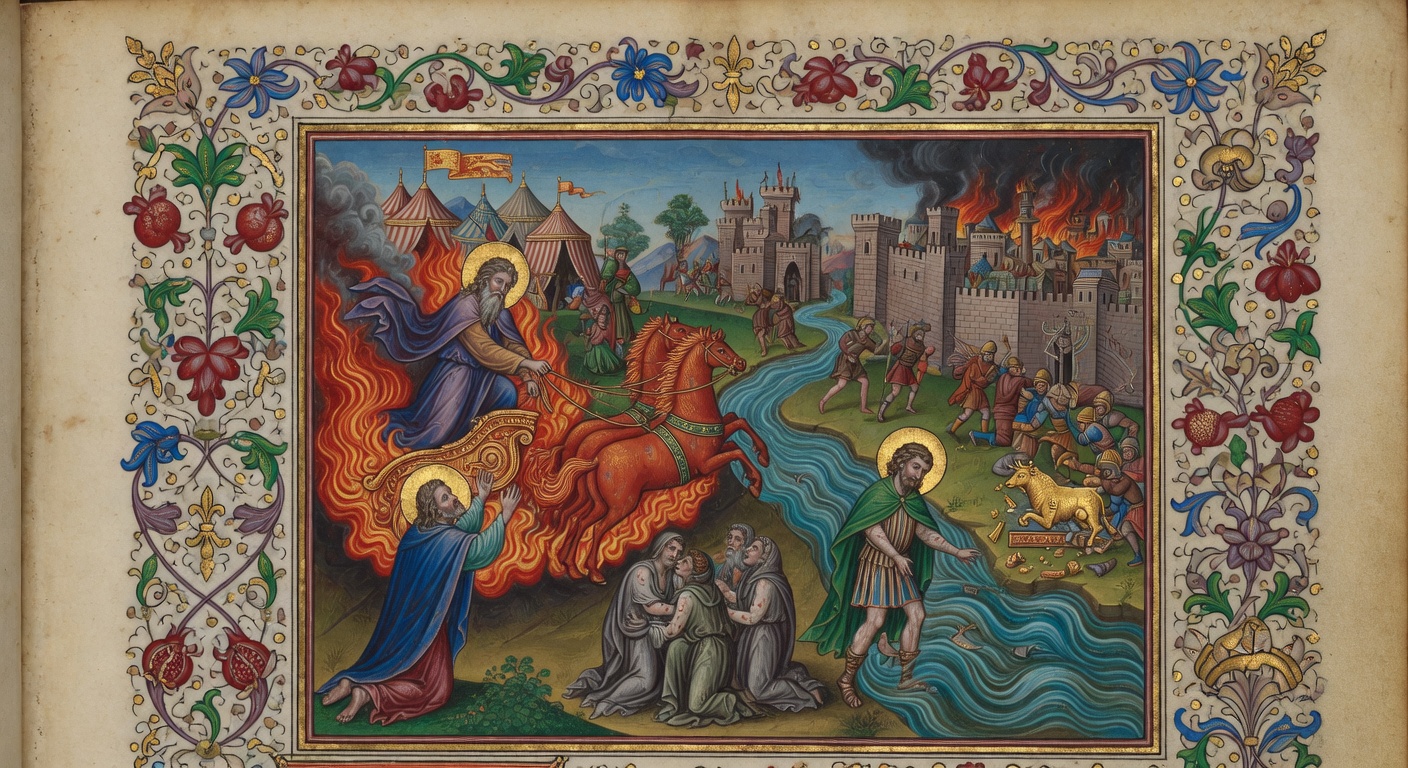
Elisha requested a double portion of Elijah's prophetic spirit before his ascension, a request granted only after he witnessed the chariot of fire, leading to roughly twice as many recorded miracles as his predecessor in the biblical accounts.
Elijah's name, meaning "Yahweh is my God," directly challenged the Baal cult promoted by Queen Jezebel during the Omride dynasty's alliance with Phoenician interests in the mid-9th century BC.
Naaman, the Aramean commander, first learned of Elisha's prophetic power through an unnamed Israelite girl captured in a raid and enslaved in his household, illustrating how wartime captives could reshape the religious trajectory of foreign elites around 850 BC.
Longstanding ethnic and religious tensions led Jews to avoid travel through Samaria and to view its inhabitants with hostility and suspicion.
Jerusalem is mentioned over 800 times in the Bible. More than any other city.
The city fell to Persia in 539 BC exactly as Daniel prophesied. Conquered without a battle.
Commentary & Study Notes Jamieson-Fausset-Brown (1871) · Public Domain In those days was Hezekiah sick — As his reign lasted twenty-nine years (2Ki 18:2), and his kingdom was invaded in the fourteenth (2Ki 18:13), it is evident that this sudden and se…
Classic verse-by-verse commentary on 2 Kings 20 from Jamieson, Fausset & Brown (1871). Covers: Hezekiah's life lengthened; The sun goes ten degrees backward.
- 1
- In those days was Hezekiah sick — As his reign lasted twenty-nine years (2Ki 18:2), and his kingdom was invaded in the fourteenth (2Ki 18:13), it is evident that this sudden and severe illness must have occurred in the very year of the Syrian invasion. Between the threatened attack and the actual appearance of the enemy, this incident in Hezekiah's history must have taken place. But according to the usage of the sacred historian, the story of Sennacherib is completed before entering on what was personal to the king of Judah (see also Isa 37:36-38:1). Set thine house in order — Isaiah, being of the blood royal, might have access to the king's private house. But since the prophet was commissioned to make this announcement, the message must be considered as referring to matters of higher importance than the settlement of the king's domestic and private affairs. It must have related chiefly to the state of his kingdom, he having not as yet any son (compare 2Ki 20:6 with 2Ki 21:1). for thou shall die, and not live — The disease was of a malignant character and would be mortal in its effects, unless the healing power of God should miraculously interpose.
- 2
- he turned his face to the wall — not like Ahab (1Ki 21:4), in fretful discontent, but in order to secure a better opportunity for prayer.
Read all 10 notes on 2 Kings 20 →