2 Samuel 11 KJV
David and Bathsheba
David and Bathsheba
The chapter opens by noting kings customarily go to battle in spring, yet David stays in Jerusalem, inverting the expected royal role and positioning his idleness as the narrative trigger for moral collapse rather than external temptation.
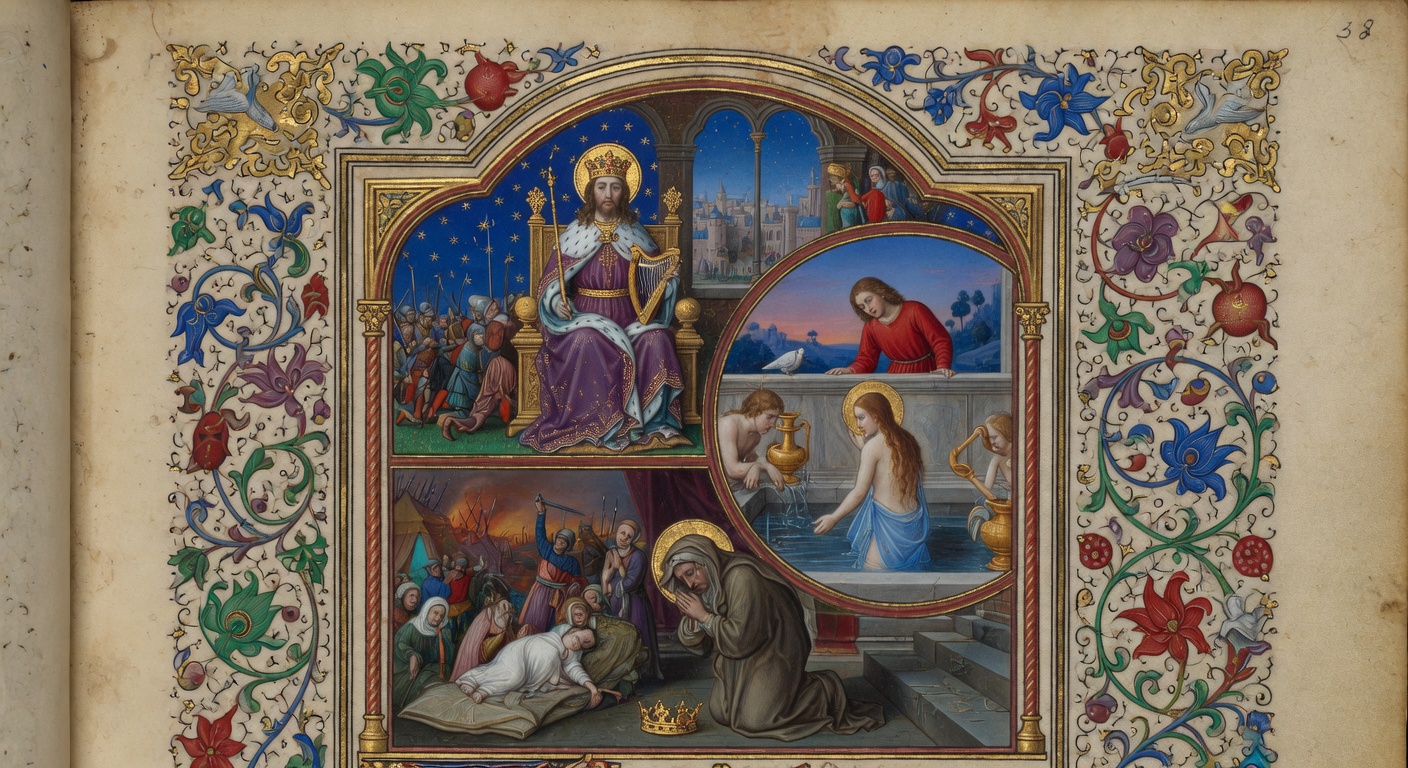
 1nd it came to pass, after the year was expired, at the time when kings go forth to battle, that David sent Joab, and his servants with him, and all Israel; and they destroyed the children of Ammon, and besieged Rabbah. But David tarried still at Jerusalem.
2 And it came to pass in an eveningtide, that David arose from off his bed, and walked upon the roof of the king’s house: and from the roof he saw a woman washing herself; and the woman was very beautiful to look upon.
3 And David sent and enquired after the woman. And one said, Is not this Bathsheba, the daughter of Eliam, the wife of Uriah the Hittite?
4 And David sent messengers, and took her; and she came in unto him, and he lay with her; for she was purified from her uncleanness: and she returned unto her house.
5 And the woman conceived, and sent and told David, and said, I am with child.
6 And David sent to Joab, saying, Send me Uriah the Hittite. And Joab sent Uriah to David.
7 And when Uriah was come unto him, David demanded of him how Joab did, and how the people did, and how the war prospered.
8 And David said to Uriah, Go down to thy house, and wash thy feet. And Uriah departed out of the king’s house, and there followed him a mess of meat from the king.
9 But Uriah slept at the door of the king’s house with all the servants of his lord, and went not down to his house.
10 And when they had told David, saying, Uriah went not down unto his house, David said unto Uriah, Camest thou not from thy journey? why then didst thou not go down unto thine house?
11 And Uriah said unto David, The ark, and Israel, and Judah, abide in tents; and my lord Joab, and the servants of my lord, are encamped in the open fields; shall I then go into mine house, to eat and to drink, and to lie with my wife? as thou livest, and as thy soul liveth, I will not do this thing.
12 And David said to Uriah, Tarry here to day also, and to morrow I will let thee depart. So Uriah abode in Jerusalem that day, and the morrow.
13 And when David had called him, he did eat and drink before him; and he made him drunk: and at even he went out to lie on his bed with the servants of his lord, but went not down to his house.
14 And it came to pass in the morning, that David wrote a letter to Joab, and sent it by the hand of Uriah.
15 And he wrote in the letter, saying, Set ye Uriah in the forefront of the hottest battle, and retire ye from him, that he may be smitten, and die.
16 And it came to pass, when Joab observed the city, that he assigned Uriah unto a place where he knew that valiant men were.
17 And the men of the city went out, and fought with Joab: and there fell some of the people of the servants of David; and Uriah the Hittite died also.
18 Then Joab sent and told David all the things concerning the war;
19 And charged the messenger, saying, When thou hast made an end of telling the matters of the war unto the king,
20 And if so be that the king’s wrath arise, and he say unto thee, Wherefore approached ye so nigh unto the city when ye did fight? knew ye not that they would shoot from the wall?
21 Who smote Abimelech the son of Jerubbesheth? did not a woman cast a piece of a millstone upon him from the wall, that he died in Thebez? why went ye nigh the wall? then say thou, Thy servant Uriah the Hittite is dead also.
22 So the messenger went, and came and shewed David all that Joab had sent him for.
23 And the messenger said unto David, Surely the men prevailed against us, and came out unto us into the field, and we were upon them even unto the entering of the gate.
24 And the shooters shot from off the wall upon thy servants; and some of the king’s servants be dead, and thy servant Uriah the Hittite is dead also.
25 Then David said unto the messenger, Thus shalt thou say unto Joab, Let not this thing displease thee, for the sword devoureth one as well as another: make thy battle more strong against the city, and overthrow it: and encourage thou him.
26 And when the wife of Uriah heard that Uriah her husband was dead, she mourned for her husband.
27 And when the mourning was past, David sent and fetched her to his house, and she became his wife, and bare him a son. But the thing that David had done displeased the LORD.
← → arrow keys to navigate chapters · spacebar to play/pause audio
Did You Know?
The chapter opens by noting kings customarily go to battle in spring, yet David stays in Jerusalem, inverting the expected royal role and positioning his idleness as the narrative trigger for moral collapse rather than external temptation.
Uriah the Hittite, listed among David's mighty men, embodies ironic covenant loyalty by refusing to sleep with Bathsheba while the ark and troops camp in the field, mirroring David's earlier refusal to harm Saul and exposing the king's betrayal of his own former ideals.
David's repeated deployment of messengers to summon Bathsheba, recall Uriah, and deliver the fatal letter to Joab creates a chain of mediated commands that distances the king from direct action, illustrating how power enables indirect violence while preserving plausible deniability.
The failed attempt to intoxicate Uriah so he would go home to Bathsheba highlights the soldier's integrity over the king's scheme, reversing typical ancient Near Eastern expectations that a foreign mercenary would eagerly accept royal favors.
Bathsheba's pregnancy is reported in a terse clause that parallels birth announcements elsewhere in the David narrative, yet here it functions not as fulfillment of promise but as the irreversible evidence forcing David to escalate from adultery to murder.
After Uriah's death, Bathsheba mourned the loss of her first son with David as divine punishment, yet she later leveraged her position by allying with Nathan the prophet to secure Solomon's throne against Adonijah's claim in 1 Kings 1.
While on leave in Jerusalem, Uriah slept at the palace entrance rather than returning home to Bathsheba, declaring that the ark and Israel’s troops were encamped in the open field, thereby illustrating the strict wartime purity code he observed.
David purchased Araunah the Jebusite's threshing floor for fifty shekels of silver after the plague halted, establishing the exact site that later became the Temple Mount under Solomon.
He later named the second child Solomon and bestowed the additional name Jedidiah, meaning "beloved of Yahweh," at God's command.
Three major world religions consider Jerusalem a holy city.
David ruled from Hebron for 7.5 years before moving his capital to Jerusalem.
The New Testament further develops this imagery to portray the heavenly Jerusalem where believers gather to the living God.
Commentary & Study Notes Jamieson-Fausset-Brown (1871) · Public Domain 1. at the time when kings go forth to battle — The return of spring was the usual time of commencing military operations. This expedition took place the year following the war agai…
Classic verse-by-verse commentary on 2 Samuel 11 from Jamieson, Fausset & Brown (1871). Covers: Joab besieges rabbah; David commits adultery with bath-sheba; Uriah slain.
- 2
- it came to pass in an eveningtide, that David arose from off his bed — The Hebrews, like other Orientals, rose at daybreak, and always took a nap during the heat of the day. Afterwards they lounged in the cool of the evening on their flat-roofed terraces. It is probable that David had ascended to enjoy the open-air refreshment earlier than usual.
- 3
- one said — literally, "he said to himself," Is not this Bath-sheba? &c. — She seems to have been a celebrated beauty, whose renown had already reached the ears of David, as happens in the East, from reports carried by the women from harem to harem. Bath-sheba, the daughter of Eliam — or Ammiel (1Ch 3:5), one of David's worthies (2Sa 23:34), and son of Ahithophel.
Read all 6 notes on 2 Samuel 11 →