Acts 22 KJV
Paul's Defense Before the Crowd
Paul's Defense Before the Crowd
Paul's address in Hebrew (Aramaic) not only quiets the mob but positions him as an insider to Judaism before pivoting to his divine commission to the Gentiles, illustrating language as a theological bridge in the shift from particularism to universal mission.
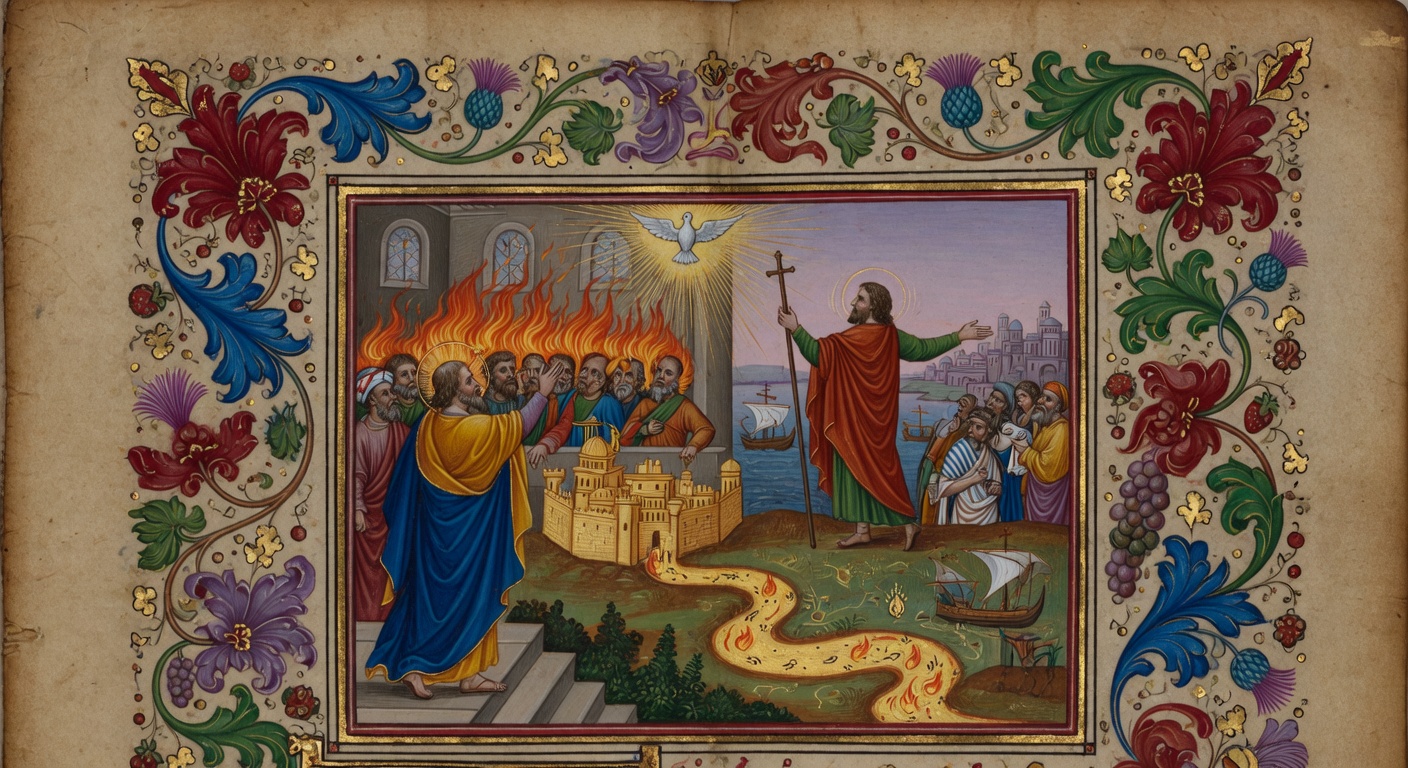
 1en, brethren, and fathers, hear ye my defence which I make now unto you.
2 (And when they heard that he spake in the Hebrew tongue to them, they kept the more silence: and he saith,)
3 I am verily a man which am a Jew, born in Tarsus, a city in Cilicia, yet brought up in this city at the feet of Gamaliel, and taught according to the perfect manner of the law of the fathers, and was zealous toward God, as ye all are this day.
4 And I persecuted this way unto the death, binding and delivering into prisons both men and women.
5 As also the high priest doth bear me witness, and all the estate of the elders: from whom also I received letters unto the brethren, and went to Damascus, to bring them which were there bound unto Jerusalem, for to be punished.
6 And it came to pass, that, as I made my journey, and was come nigh unto Damascus about noon, suddenly there shone from heaven a great light round about me.
7 And I fell unto the ground, and heard a voice saying unto me, Saul, Saul, why persecutest thou me?
8 And I answered, Who art thou, Lord? And he said unto me, I am Jesus of Nazareth, whom thou persecutest.
9 And they that were with me saw indeed the light, and were afraid; but they heard not the voice of him that spake to me.
10 And I said, What shall I do, LORD? And the Lord said unto me, Arise, and go into Damascus; and there it shall be told thee of all things which are appointed for thee to do.
11 And when I could not see for the glory of that light, being led by the hand of them that were with me, I came into Damascus.
12 And one Ananias, a devout man according to the law, having a good report of all the Jews which dwelt there,
13 Came unto me, and stood, and said unto me, Brother Saul, receive thy sight. And the same hour I looked up upon him.
14 And he said, The God of our fathers hath chosen thee, that thou shouldest know his will, and see that Just One, and shouldest hear the voice of his mouth.
15 For thou shalt be his witness unto all men of what thou hast seen and heard.
16 And now why tarriest thou? arise, and be baptized, and wash away thy sins, calling on the name of the Lord.
17 And it came to pass, that, when I was come again to Jerusalem, even while I prayed in the temple, I was in a trance;
18 And saw him saying unto me, Make haste, and get thee quickly out of Jerusalem: for they will not receive thy testimony concerning me.
19 And I said, Lord, they know that I imprisoned and beat in every synagogue them that believed on thee:
20 And when the blood of thy martyr Stephen was shed, I also was standing by, and consenting unto his death, and kept the raiment of them that slew him.
21 And he said unto me, Depart: for I will send thee far hence unto the Gentiles.
22 And they gave him audience unto this word, and then lifted up their voices, and said, Away with such a fellow from the earth: for it is not fit that he should live.
23 And as they cried out, and cast off their clothes, and threw dust into the air,
24 The chief captain commanded him to be brought into the castle, and bade that he should be examined by scourging; that he might know wherefore they cried so against him.
25 And as they bound him with thongs, Paul said unto the centurion that stood by, Is it lawful for you to scourge a man that is a Roman, and uncondemned?
26 When the centurion heard that, he went and told the chief captain, saying, Take heed what thou doest: for this man is a Roman.
27 Then the chief captain came, and said unto him, Tell me, art thou a Roman? He said, Yea.
28 And the chief captain answered, With a great sum obtained I this freedom. And Paul said, But I was free born.
29 Then straightway they departed from him which should have examined him: and the chief captain also was afraid, after he knew that he was a Roman, and because he had bound him.
30 On the morrow, because he would have known the certainty wherefore he was accused of the Jews, he loosed him from his bands, and commanded the chief priests and all their council to appear, and brought Paul down, and set him before them.
← → arrow keys to navigate chapters · spacebar to play/pause audio
Did You Know?
Paul's address in Hebrew (Aramaic) not only quiets the mob but positions him as an insider to Judaism before pivoting to his divine commission to the Gentiles, illustrating language as a theological bridge in the shift from particularism to universal mission.
The voice on the Damascus road asks 'Why persecutest thou me?' rather than naming the church, forging an explicit identification between the risen Christ and his persecuted followers that echoes Old Testament motifs of God identifying with Israel.
Ananias, a figure otherwise unknown outside Acts, is portrayed as a Torah-observant Jew with an impeccable reputation among his people, underscoring that the earliest Christian movement was still negotiating its identity within Second Temple Judaism rather than as a clean break.
Paul's assertion of Roman citizenship 'free born' while the tribune admits purchasing his own citizenship exposes the stratified legal privileges of the empire and explains why Paul can invoke protections unavailable to most provincial Jews or early Christians.
The narrative deliberately withholds any mention of Paul's encounter with the earthly Jesus in Jerusalem despite his training under Gamaliel there, creating a literary gap that emphasizes his apostleship as rooted solely in the post-resurrection Christophany.
In Paul’s later retelling before the Jerusalem crowd (Acts 22), Ananias is described as "a devout man according to the law" who enjoyed a favorable reputation among local Jews, revealing that he was a Torah-observant Jewish believer rather than a Gentile convert.
Paul explicitly identified Gamaliel as his teacher under whom he was trained in the strict ancestral law, indicating that the future apostle received elite Pharisaic education in Jerusalem before his conversion.
The Gospels note that Jesus healed Peter's mother-in-law of a fever, confirming that the apostle was married at the time of his calling.
Paul studied under the renowned Pharisee Gamaliel in Jerusalem, receiving advanced training in Jewish law that he later referenced when defending his background before the Sanhedrin and in his epistles.
Jerusalem sits at about 2,500 feet elevation. Higher than most surrounding areas.
Antioch was the third-largest city in the Roman Empire after Rome and Alexandria.
Paul spent more time in Ephesus (3 years) than any other city on his journeys.
Commentary & Study Notes Jamieson-Fausset-Brown (1871) · Public Domain when they heard... the Hebrew tongue — (See on Ac 21:40). they kept the more silence — They could have understood him in Greek, and doubtless fully expected the renegade to address…
Classic verse-by-verse commentary on Acts 22 from Jamieson, Fausset & Brown (1871). Covers: Paul's defense from the stairs of the fortress--the rage of the audience bursting forth, the commandant has him brought into the fort to be examined by scourging, but learning that he is a roman, he orders his release and commands the samhedrim to try him.
- 2
- when they heard... the Hebrew tongue — (See on Ac 21:40). they kept the more silence — They could have understood him in Greek, and doubtless fully expected the renegade to address them in that language, but the sound of their holy mother tongue awed them into deeper silence.
- 3
- a Jew of Tarsus, brought up in this city, at the feet — (See on Lu 10:39). of Gamaliel — (See on Ac 5:34); a fact of great importance in the apostle's history, standing in the same relation to his future career as Moses' education in the Egyptian court to the work for which he was destined. the perfect manner of the law of the fathers — the strictest form of traditional Judaism. zealous — "a zealot." toward God as ye all are this day — his own former murderous zeal against the disciples of the Lord Jesus being merely reflected in their present treatment of himself.
Read all 20 notes on Acts 22 →