Acts 6 KJV
The Choosing of the Seven
The Choosing of the Seven
The seven appointees all bear Greek names, a deliberate choice signaling the early church's recognition that ethnic favoritism in widow care required leadership drawn from the aggrieved Hellenistic faction itself.
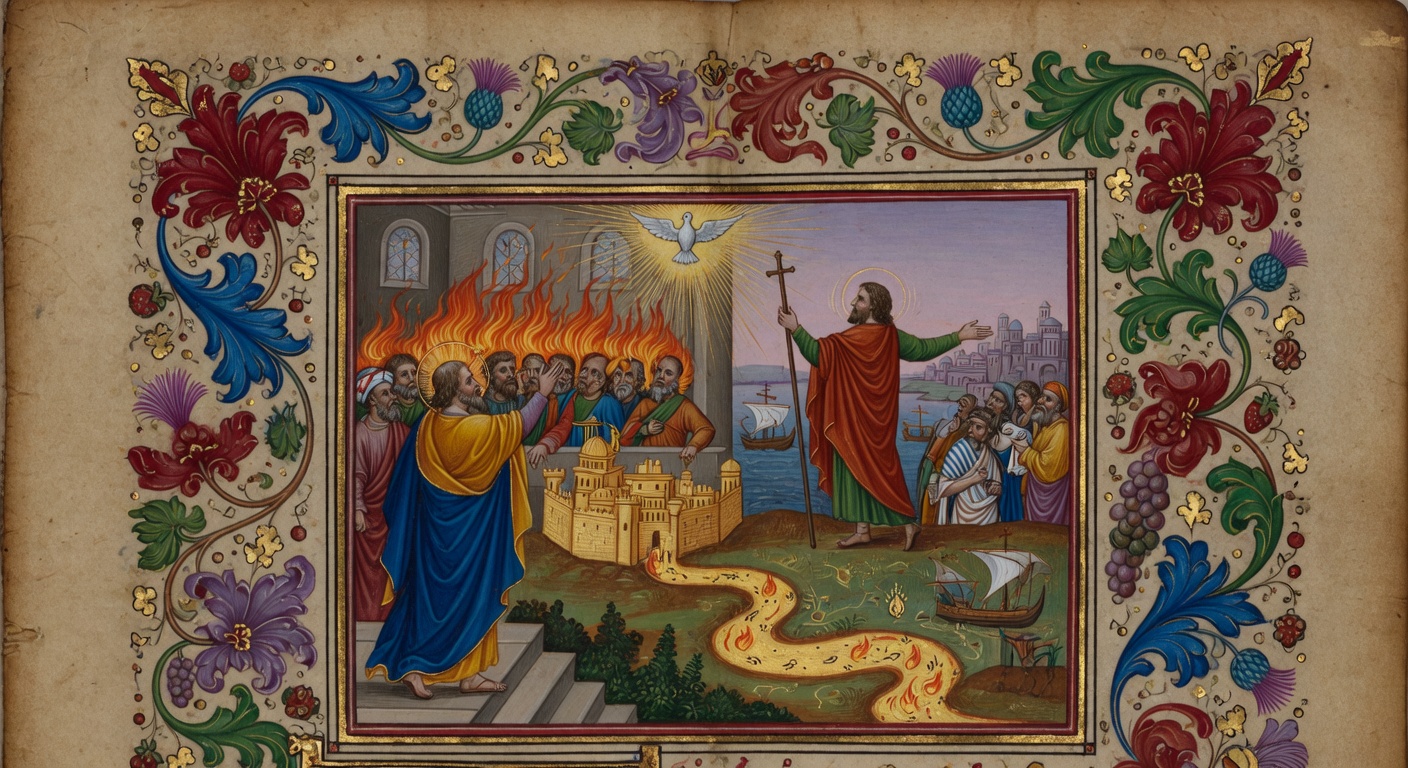
 1nd in those days, when the number of the disciples was multiplied, there arose a murmuring of the Grecians against the Hebrews, because their widows were neglected in the daily ministration.
2 Then the twelve called the multitude of the disciples unto them, and said, It is not reason that we should leave the word of God, and serve tables.
3 Wherefore, brethren, look ye out among you seven men of honest report, full of the Holy Ghost and wisdom, whom we may appoint over this business.
4 But we will give ourselves continually to prayer, and to the ministry of the word.
5 And the saying pleased the whole multitude: and they chose Stephen, a man full of faith and of the Holy Ghost, and Philip, and Prochorus, and Nicanor, and Timon, and Parmenas, and Nicolas a proselyte of Antioch:
6 Whom they set before the apostles: and when they had prayed, they laid their hands on them.
7 And the word of God increased; and the number of the disciples multiplied in Jerusalem greatly; and a great company of the priests were obedient to the faith.
8 And Stephen, full of faith and power, did great wonders and miracles among the people.
9 Then there arose certain of the synagogue, which is called the synagogue of the Libertines, and Cyrenians, and Alexandrians, and of them of Cilicia and of Asia, disputing with Stephen.
10 And they were not able to resist the wisdom and the spirit by which he spake.
11 Then they suborned men, which said, We have heard him speak blasphemous words against Moses, and against God.
12 And they stirred up the people, and the elders, and the scribes, and came upon him, and caught him, and brought him to the council,
13 And set up false witnesses, which said, This man ceaseth not to speak blasphemous words against this holy place, and the law:
14 For we have heard him say, that this Jesus of Nazareth shall destroy this place, and shall change the customs which Moses delivered us.
15 And all that sat in the council, looking stedfastly on him, saw his face as it had been the face of an angel.
← → arrow keys to navigate chapters · spacebar to play/pause audio
Did You Know?
The seven appointees all bear Greek names, a deliberate choice signaling the early church's recognition that ethnic favoritism in widow care required leadership drawn from the aggrieved Hellenistic faction itself.
Stephen's angelic face before the Sanhedrin (v. 15) deliberately echoes Moses' radiant countenance after Sinai, positioning the deacon as a new mediator whose subsequent speech will indict the temple cult as obsolete.
The synagogue of the Libertines mentioned in the dispute likely comprised descendants of Jews enslaved by Pompey in 63 BC and later freed, illustrating how Roman imperial history directly fueled opposition to the nascent Jesus movement.
By refusing to 'leave the word of God and serve tables,' the apostles implicitly create a division between prophetic proclamation and structured charity, yet immediately entrust the latter to men 'full of the Holy Ghost,' showing Spirit-empowerment is not limited to apostles.
The conversion of 'a great company of the priests' (v. 7) is striking because these same temple authorities had orchestrated Jesus' death; their obedience signals an internal fracture within Judaism's power structure triggered by the church's growth.
In his lengthy defense before the Sanhedrin, Stephen argued that God has never been confined to the Jerusalem temple, citing the mobile tabernacle and quoting Isaiah to show that 'the Most High does not dwell in houses made by hands.'
Though an uneducated fisherman, Peter delivered the Pentecost sermon in Acts that led to the baptism of about three thousand converts in a single day, marking the birth of the early church.
While supporting his missionary work, Paul practiced the trade of tentmaking alongside Priscilla and Aquila in Corinth, a skill he leveraged to remain financially independent from many churches and avoid charges of exploiting converts for money.
Barnabas single-handedly persuaded the suspicious Jerusalem apostles to accept the former persecutor Saul by recounting his Damascus road vision, effectively launching Paul's apostolic career years before their joint travels.
Jerusalem sits at about 2,500 feet elevation. Higher than most surrounding areas.
Believers were first called 'Christians' in Antioch (Acts 11:26).
The Temple of Artemis in Ephesus was four times larger than the Parthenon in Athens.
Commentary & Study Notes Jamieson-Fausset-Brown (1871) · Public Domain the Grecians — the Greek-speaking Jews, mostly born in the provinces. the Hebrews — those Jews born in Palestine who used their native tongue, and were wont to look down on the "Gr…
Classic verse-by-verse commentary on Acts 6 from Jamieson, Fausset & Brown (1871). Covers: First election of deacons; Stephen arraigned before the samhedrim.
- 1
- the Grecians — the Greek-speaking Jews, mostly born in the provinces. the Hebrews — those Jews born in Palestine who used their native tongue, and were wont to look down on the "Grecians" as an inferior class. were neglected — "overlooked" by those whom the apostles employed, and who were probably of the Hebrew class, as being the most numerous. The complaint was in all likelihood well founded, though we cannot suspect the distributors of intentional partiality. "It was really just an emulation of love, each party wishing to have their own poor taken care of in the best manner" [OLSHAUSEN]. the daily ministration — the daily distribution of alms or of food, probably the latter.
- 2-4
- the multitude — the general body of the disciples. It is not reason — The word expresses dislike; that is "We cannot submit." to leave the word of God — to have our time and attention withdrawn from preaching; which, it thus appears, they regarded as their primary duty. to serve tables — oversee the distribution of provisions.
Read all 12 notes on Acts 6 →