Amos 3 KJV
Witnesses Against Israel
Witnesses Against Israel
The declaration 'You only have I known of all the families of the earth' uses the covenantal verb 'yada' to signal intimate relational election, making Israel's coming punishment an expression of intensified accountability rather than divine rejection.
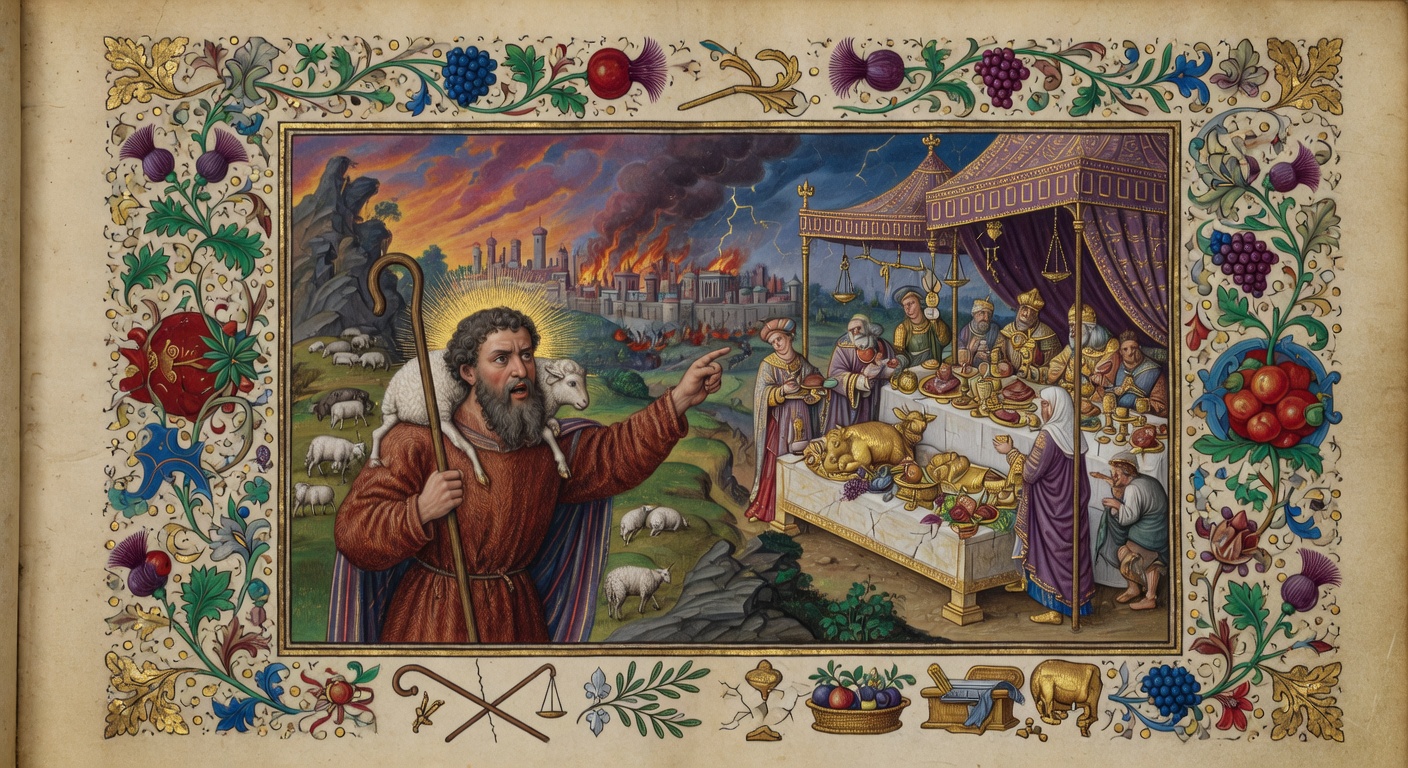
 1ear this word that the LORD hath spoken against you, O children of Israel, against the whole family which I brought up from the land of Egypt, saying,
2 You only have I known of all the families of the earth: therefore I will punish you for all your iniquities.
3 Can two walk together, except they be agreed?
4 Will a lion roar in the forest, when he hath no prey? will a young lion cry out of his den, if he have taken nothing?
5 Can a bird fall in a snare upon the earth, where no gin is for him? shall one take up a snare from the earth, and have taken nothing at all?
6 Shall a trumpet be blown in the city, and the people not be afraid? shall there be evil in a city, and the LORD hath not done it?
7 Surely the Lord GOD will do nothing, but he revealeth his secret unto his servants the prophets.
8 The lion hath roared, who will not fear? the Lord GOD hath spoken, who can but prophesy?
9 Publish in the palaces at Ashdod, and in the palaces in the land of Egypt, and say, Assemble yourselves upon the mountains of Samaria, and behold the great tumults in the midst thereof, and the oppressed in the midst thereof.
10 For they know not to do right, saith the LORD, who store up violence and robbery in their palaces.
11 Therefore thus saith the Lord GOD; An adversary there shall be even round about the land; and he shall bring down thy strength from thee, and thy palaces shall be spoiled.
12 Thus saith the LORD; As the shepherd taketh out of the mouth of the lion two legs, or a piece of an ear; so shall the children of Israel be taken out that dwell in Samaria in the corner of a bed, and in Damascus in a couch.
13 Hear ye, and testify in the house of Jacob, saith the Lord GOD, the God of hosts,
14 That in the day that I shall visit the transgressions of Israel upon him I will also visit the altars of Bethel: and the horns of the altar shall be cut off, and fall to the ground.
15 And I will smite the winter house with the summer house; and the houses of ivory shall perish, and the great houses shall have an end, saith the LORD.
← → arrow keys to navigate chapters · spacebar to play/pause audio
Did You Know?
The declaration 'You only have I known of all the families of the earth' uses the covenantal verb 'yada' to signal intimate relational election, making Israel's coming punishment an expression of intensified accountability rather than divine rejection.
The chain of seven unanswered rhetorical questions (vv. 3-6) functions as a forensic argument that disaster never occurs without prior prophetic disclosure, positioning Amos himself as the necessary 'lion's roar' that authenticates the oracle.
By summoning Ashdod and Egypt to assemble on Samaria's mountains and witness its 'tumults' and 'oppressions,' the text ironically enlists Israel's historic oppressors as courtroom observers of covenant breach, reversing their former roles.
The shepherd image of extracting 'two legs, or a piece of an ear' from a lion's mouth draws on ancient Near Eastern herding law (where such fragments proved predation), depicting Israel's survival as a pathetic legal remnant rather than glorious deliverance.
The targeted destruction of Bethel's altar horns alongside ivory-paneled houses fuses cultic and economic critique, exposing how Jeroboam-era syncretism and elite luxury together constitute the 'violence and robbery' stored in Israel's strongholds.
When the priest Amaziah ordered him to stop prophesying and flee to Judah, Amos replied that he had never belonged to any prophetic guild and was merely a herdsman whom God had seized, marking the first explicit clash between a temple official and an independent prophet.
This location became a significant center for worship and a symbol of God's covenant promises to the patriarchs.
This account illustrates Scripture’s emphasis on the extension of salvation beyond Jewish boundaries and Jesus’ willingness to cross social barriers to reveal truth.
Three major world religions consider Jerusalem a holy city.
Commentary & Study Notes Jamieson-Fausset-Brown (1871) · Public Domain children of Israel — not merely the ten tribes, but "the whole family brought up from Egypt"; all the descendants of Jacob, including Judah and Benjamin. Compare Jer 8:3, and Mic 2…
Classic verse-by-verse commentary on Amos 3 from Jamieson, Fausset & Brown (1871). Covers: God's extraordinary love, being repaid by Israel with ingratitude, of necessity calls for judgments, which the prophets announce, not at random, but by God's commission, which they cannot but fulfil. The oppression prevalent in Israel will bring down ruin on all save a small remnant.
- 1
- children of Israel — not merely the ten tribes, but "the whole family brought up from Egypt"; all the descendants of Jacob, including Judah and Benjamin. Compare Jer 8:3, and Mic 2:3, on "family" for the nation. However, as the prophecy following refers to the ten tribes, they must be chiefly, if not solely, meant: they were the majority of the nation; and so Amos concedes what they so often boasted, that they were the elect people of God [CALVIN], but implies that this only heightens their sins.
- 2
- You only have I known — that is, acknowledged as My people, and treated with peculiar favor (Ex 19:5; De 4:20). Compare the use of "know," Ps 1:6; 144:3; Joh 10:14; 2Ti 2:19. therefore I will punish — the greater the privileges, the heavier the punishment for the abuse of them; for to the other offenses there is added, in this case, ingratitude. When God's people do not glorify Him, He glorifies Himself by punishing them.
Read all 16 notes on Amos 3 →