Esther 4 KJV
Mordecai Persuades Esther
Mordecai Persuades Esther
Mordecai's insistence that deliverance for the Jews will arise 'from another place' if Esther refuses subtly invokes the Abrahamic covenant promises without naming God, framing her choice within an unbreakable divine plan rather than mere political risk.
 1hen Mordecai perceived all that was done, Mordecai rent his clothes, and put on sackcloth with ashes, and went out into the midst of the city, and cried with a loud and a bitter cry;
2 And came even before the king’s gate: for none might enter into the king’s gate clothed with sackcloth.
3 And in every province, whithersoever the king’s commandment and his decree came, there was great mourning among the Jews, and fasting, and weeping, and wailing; and many lay in sackcloth and ashes.
4 So Esther’s maids and her chamberlains came and told it her. Then was the queen exceedingly grieved; and she sent raiment to clothe Mordecai, and to take away his sackcloth from him: but he received it not.
5 Then called Esther for Hatach, one of the king’s chamberlains, whom he had appointed to attend upon her, and gave him a commandment to Mordecai, to know what it was, and why it was.
6 So Hatach went forth to Mordecai unto the street of the city, which was before the king’s gate.
7 And Mordecai told him of all that had happened unto him, and of the sum of the money that Haman had promised to pay to the king’s treasuries for the Jews, to destroy them.
8 Also he gave him the copy of the writing of the decree that was given at Shushan to destroy them, to shew it unto Esther, and to declare it unto her, and to charge her that she should go in unto the king, to make supplication unto him, and to make request before him for her people.
9 And Hatach came and told Esther the words of Mordecai.
10 Again Esther spake unto Hatach, and gave him commandment unto Mordecai;
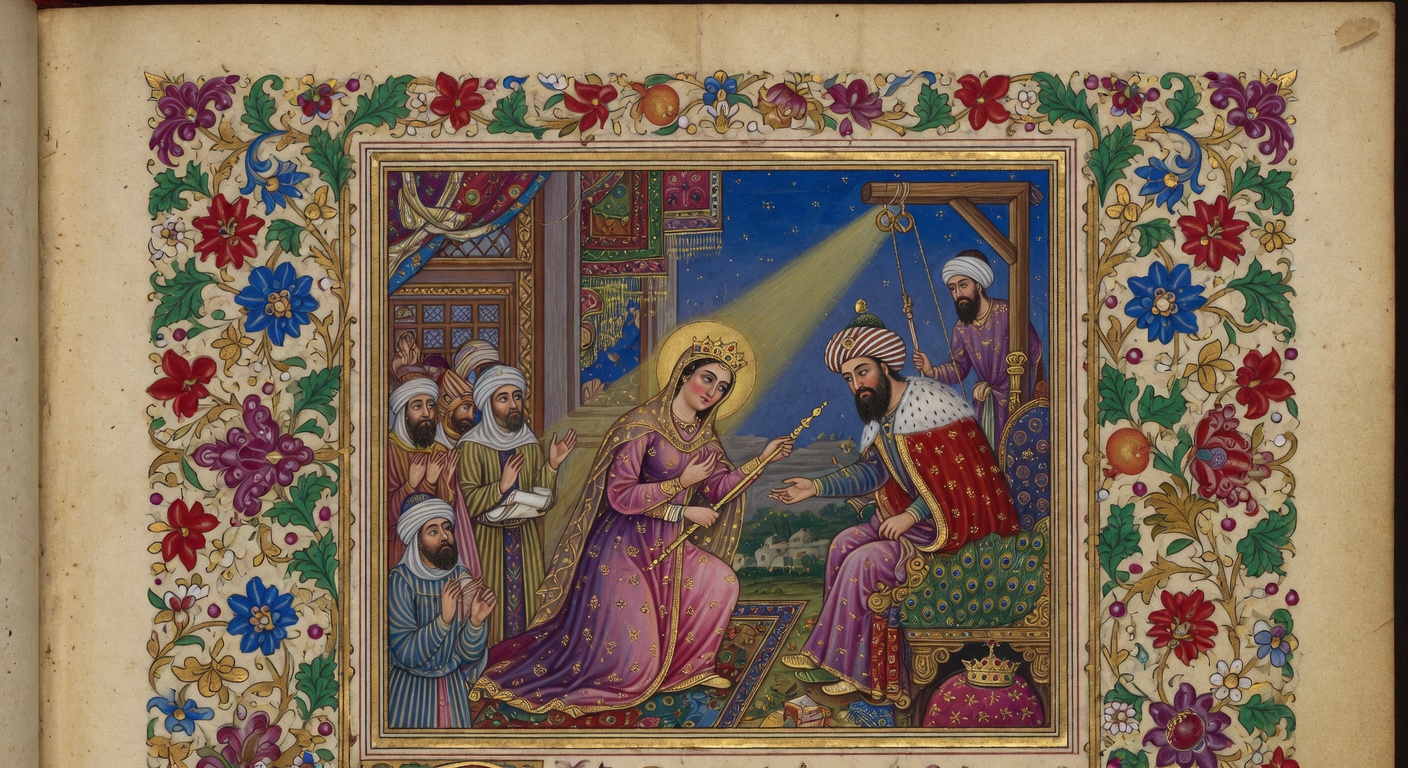
11 All the king’s servants, and the people of the king’s provinces, do know, that whosoever, whether man or woman, shall come unto the king into the inner court, who is not called, there is one law of his to put him to death, except such to whom the king shall hold out the golden sceptre, that he may live: but I have not been called to come in unto the king these thirty days.
12 And they told to Mordecai Esther’s words.
13 Then Mordecai commanded to answer Esther, Think not with thyself that thou shalt escape in the king’s house, more than all the Jews.
14 For if thou altogether holdest thy peace at this time, then shall there enlargement and deliverance arise to the Jews from another place; but thou and thy father’s house shall be destroyed: and who knoweth whether thou art come to the kingdom for such a time as this?
15 Then Esther bade them return Mordecai this answer,
16 Go, gather together all the Jews that are present in Shushan, and fast ye for me, and neither eat nor drink three days, night or day: I also and my maidens will fast likewise; and so will I go in unto the king, which is not according to the law: and if I perish, I perish.
17 So Mordecai went his way, and did according to all that Esther had commanded him.
← → arrow keys to navigate chapters · spacebar to play/pause audio
Did You Know?
Mordecai's insistence that deliverance for the Jews will arise 'from another place' if Esther refuses subtly invokes the Abrahamic covenant promises without naming God, framing her choice within an unbreakable divine plan rather than mere political risk.
Esther's order for a three-day fast across all Jews in Shushan before her unsummoned approach to the king deliberately echoes the preparatory fasts of Moses on Sinai and Daniel in Babylon, positioning her as a mediator figure who must first align with divine will amid Persian court danger.
The repeated emphasis on communication through the intermediary Hatach highlights the isolation of the harem and the bureaucratic layers of Achaemenid power, making Esther's eventual direct speech to the king a radical breach of protocol that the narrative presents as providentially timed.
Mordecai's public donning of sackcloth at the king's gate, while sending private garments to Esther, creates a literary contrast between visible Jewish lament and hidden royal identity, underscoring the theme of concealed heritage that must eventually surface for communal salvation.
Esther's final resolve 'if I perish, I perish' inverts the typical biblical call narrative by having the reluctant hero initiate the risk after receiving the call, transforming passive queenship into active agency and prefiguring later Jewish traditions of self-sacrificial intercession.
The festival of Purim, established directly by the events in Esther, requires the public reading of the entire scroll twice on the fourteenth of Adar and mandates sending food gifts to neighbors and charity to the poor, practices still observed in Jewish communities today.
Following Haman's downfall, Mordecai was appointed vizier and authorized to issue a counter-edict allowing Jews to defend themselves, which established the legal basis for the annual celebration of Purim still observed today.
The Hebrew text of Esther 9:7-9 spells out the names of Haman's ten executed sons with a notably small letter vav in the word vayzata, a scribal feature preserved in the Megillah that has prompted centuries of commentary on their collective downfall.
Historically identified with Xerxes I, Ahasuerus's reign saw the construction of gallows fifty cubits high for Mordecai, a detail highlighting the extreme vertical scale of Persian execution methods used to publicly deter rebellion.
In the unfolding of God's redemptive purposes, Persia rose as the empire that subdued Babylon and issued the decree enabling the Jewish exiles to return and rebuild the temple in Jerusalem.
Commentary & Study Notes Jamieson-Fausset-Brown (1871) · Public Domain When Mordecai perceived all that was done — Relying on the irrevocable nature of a Persian monarch's decree (Da 6:15), Hamman made it known as soon as the royal sanction had been o…
Classic verse-by-verse commentary on Esther 4 from Jamieson, Fausset & Brown (1871). Covers: Mordecai and the jews mourn.
- 1,2
- When Mordecai perceived all that was done — Relying on the irrevocable nature of a Persian monarch's decree (Da 6:15), Hamman made it known as soon as the royal sanction had been obtained; and Mordecai was, doubtless, among the first to hear of it. On his own account, as well as on that of his countrymen, this astounding decree must have been indescribably distressing. The acts described in this passage are, according to the Oriental fashion, expressive of the most poignant sorrow; and his approach to the gate of the palace, under the impulse of irrepressible emotions, was to make an earnest though vain appeal to the royal mercy. Access, however, to the king's presence was, to a person in his disfigured state, impossible: "for none might enter into the king's gate clothed with sackcloth." But he found means of conveying intelligence of the horrid plot to Queen Esther.
- 4
- Then was the queen... grieved; and... sent raiment to... Mordecai — Her object in doing so was either to qualify him for resuming his former office, or else, perhaps, of fitting him to come near enough to the palace to inform her of the cause of such sudden and extreme distress.
Read all 7 notes on Esther 4 →