Ezekiel 10 KJV
God's Glory Departs
God's Glory Departs
The specification in verse 14 of one face as 'the face of a cherub' rather than the ox of chapter 1 identifies these beings with the temple guardians over the mercy seat, collapsing the distinction between the visionary chariot and the ark's cherubim.
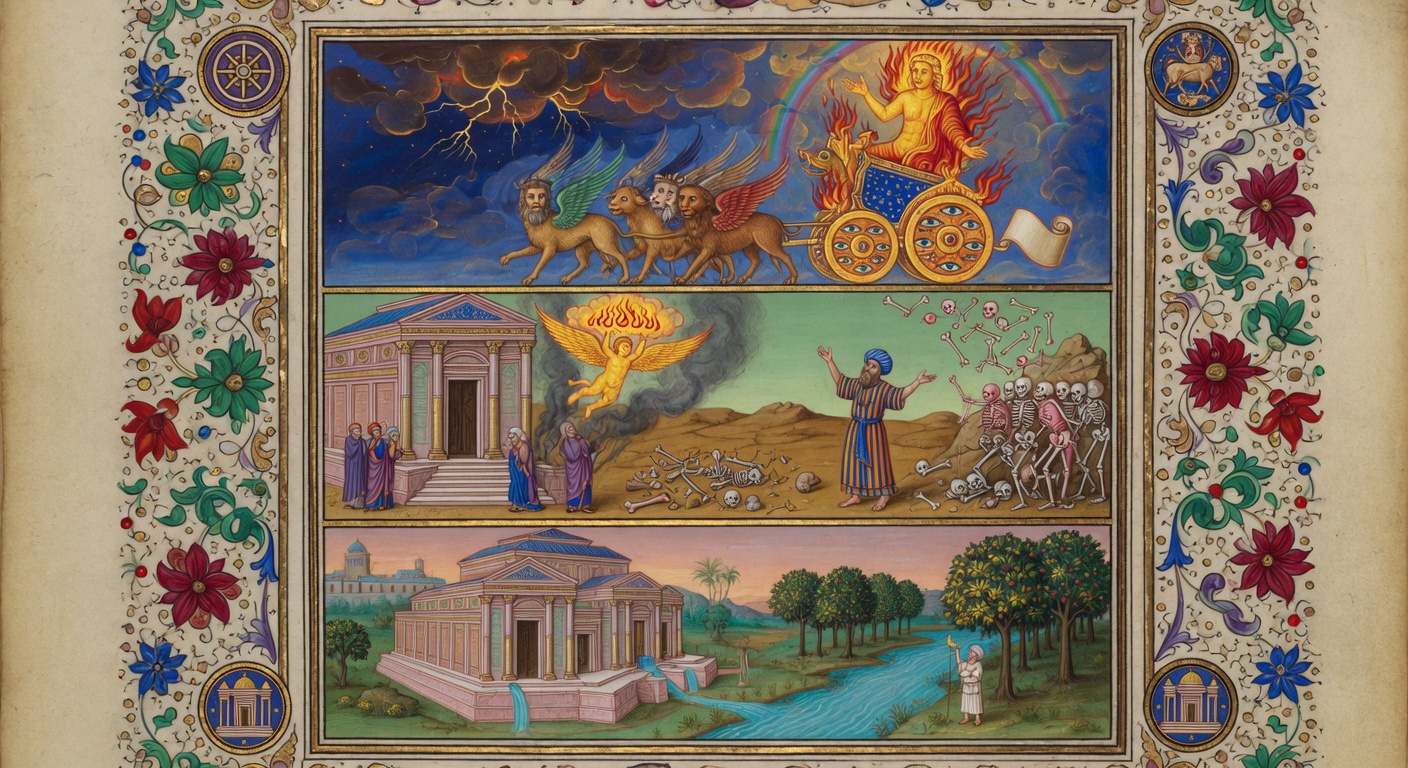
 1hen I looked, and, behold, in the firmament that was above the head of the cherubims there appeared over them as it were a sapphire stone, as the appearance of the likeness of a throne.
2 And he spake unto the man clothed with linen, and said, Go in between the wheels, even under the cherub, and fill thine hand with coals of fire from between the cherubims, and scatter them over the city. And he went in in my sight.
3 Now the cherubims stood on the right side of the house, when the man went in; and the cloud filled the inner court.
4 Then the glory of the LORD went up from the cherub, and stood over the threshold of the house; and the house was filled with the cloud, and the court was full of the brightness of the LORD’s glory.
5 And the sound of the cherubims’ wings was heard even to the outer court, as the voice of the Almighty God when he speaketh.
6 And it came to pass, that when he had commanded the man clothed with linen, saying, Take fire from between the wheels, from between the cherubims; then he went in, and stood beside the wheels.
7 And one cherub stretched forth his hand from between the cherubims unto the fire that was between the cherubims, and took thereof, and put it into the hands of him that was clothed with linen: who took it, and went out.
8 And there appeared in the cherubims the form of a man’s hand under their wings.
9 And when I looked, behold the four wheels by the cherubims, one wheel by one cherub, and another wheel by another cherub: and the appearance of the wheels was as the colour of a beryl stone.
10 And as for their appearances, they four had one likeness, as if a wheel had been in the midst of a wheel.
11 When they went, they went upon their four sides; they turned not as they went, but to the place whither the head looked they followed it; they turned not as they went.
12 And their whole body, and their backs, and their hands, and their wings, and the wheels, were full of eyes round about, even the wheels that they four had.
13 As for the wheels, it was cried unto them in my hearing, O wheel.
14 And every one had four faces: the first face was the face of a cherub, and the second face was the face of a man, and the third the face of a lion, and the fourth the face of an eagle.
15 And the cherubims were lifted up. This is the living creature that I saw by the river of Chebar.
16 And when the cherubims went, the wheels went by them: and when the cherubims lifted up their wings to mount up from the earth, the same wheels also turned not from beside them.
17 When they stood, these stood; and when they were lifted up, these lifted up themselves also: for the spirit of the living creature was in them.
18 Then the glory of the LORD departed from off the threshold of the house, and stood over the cherubims.
19 And the cherubims lifted up their wings, and mounted up from the earth in my sight: when they went out, the wheels also were beside them, and every one stood at the door of the east gate of the LORD’s house; and the glory of the God of Israel was over them above.
20 This is the living creature that I saw under the God of Israel by the river of Chebar; and I knew that they were the cherubims.
21 Every one had four faces apiece, and every one four wings; and the likeness of the hands of a man was under their wings.
22 And the likeness of their faces was the same faces which I saw by the river of Chebar, their appearances and themselves: they went every one straight forward.
← → arrow keys to navigate chapters · spacebar to play/pause audio
Did You Know?
The specification in verse 14 of one face as 'the face of a cherub' rather than the ox of chapter 1 identifies these beings with the temple guardians over the mercy seat, collapsing the distinction between the visionary chariot and the ark's cherubim.
Verse 13 records the heavenly command 'O wheel' (Hebrew galgal), evoking both the rolling motion and the whirlwind imagery of Ezekiel's inaugural vision while underscoring that the wheels obey a divine voice independent of the cherubim.
The coals taken from between the cherubim in verse 2 are not for atonement but explicitly for scattering over the city, transforming a temple ritual element into an instrument of fiery judgment that anticipates the burning of Jerusalem.
The glory's successive movements. From the cherubim to the threshold, then to the east gate. Trace an irreversible eastward exit that aligns with the direction of the Babylonian exiles and later Jewish traditions locating the Shekinah on the Mount of Olives.
By repeating the precise phrasing 'this is the living creature that I saw by the river of Chebar' (vv. 15, 20), the chapter insists that the enthroned deity abandoning the temple is identical to the one who appeared among the exiles, subverting any notion of a localized or defeated God.
Ezekiel was commanded to lie on his left side for 390 days and his right side for 40 days while bound with ropes, symbolically bearing the iniquity of Israel and Judah respectively during the Babylonian exile period.
Babylon's walls were reportedly wide enough for two chariots to pass side by side.
Jerusalem sits at about 2,500 feet elevation. Higher than most surrounding areas.
Commentary & Study Notes Jamieson-Fausset-Brown (1871) · Public Domain The throne of Jehovah appearing in the midst of the judgments implies that whatever intermediate agencies be employed, He controls them, and that the whole flows as a necessary con…
Classic verse-by-verse commentary on Ezekiel 10 from Jamieson, Fausset & Brown (1871). Covers: Vision of coals of fire scattered over the city: repetition of the vision of the cherubim.
- 1
- The throne of Jehovah appearing in the midst of the judgments implies that whatever intermediate agencies be employed, He controls them, and that the whole flows as a necessary consequence from His essential holiness (Eze 1:22, 26). cherubim — in Eze 1:5, called "living creatures." The repetition of the vision implies that the judgments are approaching nearer and nearer. These two visions of Deity were granted in the beginning of Ezekiel's career, to qualify him for witnessing to God's glory amidst his God-forgetting people and to stamp truth on his announcements; also to signify the removal of God's manifestation from the visible temple (Eze 10:18) for a long period (Eze 43:2). The feature (Eze 10:12) mentioned as to the cherubim that they were "full of eyes," though omitted in the former vision, is not a difference, but a more specific detail observed by Ezekiel now on closer inspection. Also, here, there is no rainbow (the symbol of mercy after the flood of wrath) as in the former; for here judgment is the prominent thought, though the marking of the remnant in Eze 9:4, 6 shows that there was mercy in the background. The cherubim, perhaps, represent redeemed humanity combining in and with itself the highest forms of subordinate creaturely life (compare Ro 8:20). Therefore they are associated with the twenty-four elders and are distinguished from the angels (Re 5:1-14). They stand on the mercy seat of the ark, and on that ground become the habitation of God from which His glory is to shine upon the world. The different forms symbolize the different phases of the Church. So the quadriform Gospel, in which the incarnate Saviour has lodged the revelation of Himself in a fourfold aspect, and from which His glory shines on the Christian world, answers to the emblematic throne from which He shone on the Jewish Church.
- 2
- he — Jehovah; He who sat on the "throne." the man — the Messenger of mercy becoming the Messenger of judgment (see on Eze 9:2). Human agents of destruction shall fulfil the will of "the Man," who is Lord of men. wheels — Hebrew, galgal, implying quick revolution; so the impetuous onset of the foe (compare Eze 23:24; 26:10); whereas "ophan," in Eze 1:15, 16 implies mere revolution. coals of fire — the wrath of God about to burn the city, as His sword had previously slain its guilty inhabitants. This "fire," how different from the fire on the altar never going out (Le 6:12, 13), whereby, in type, peace was made with God! Compare Isa 33:12,
Read all 22 notes on Ezekiel 10 →