Ezra 7 KJV
Ezra Comes to Jerusalem
Ezra Comes to Jerusalem
The Aramaic decree of Artaxerxes (vv. 12-26) not only funds the temple but empowers Ezra to appoint judges enforcing both Jewish law and royal statutes, revealing Persian willingness to delegate local governance to religious elites as a control mechanism.
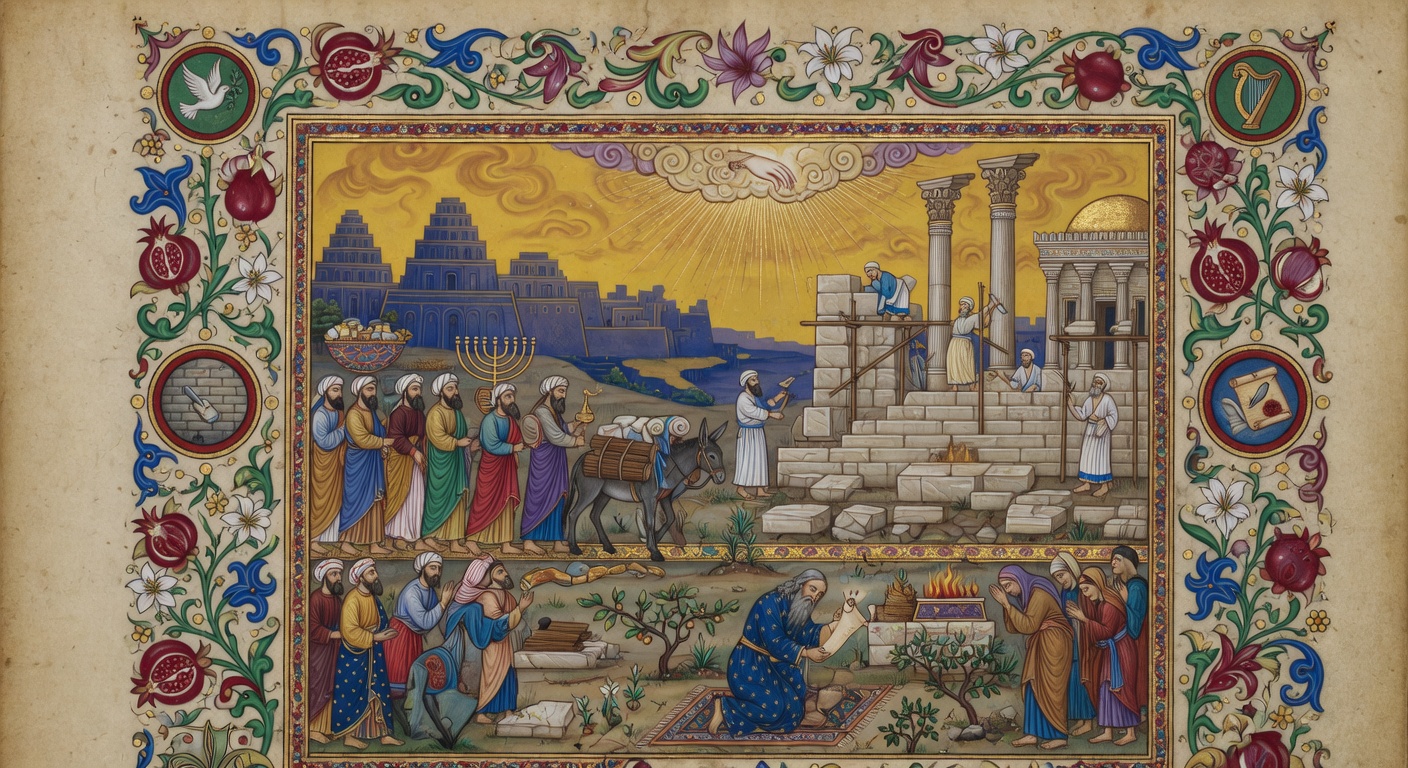
 1ow after these things, in the reign of Artaxerxes king of Persia, Ezra the son of Seraiah, the son of Azariah, the son of Hilkiah,
2 The son of Shallum, the son of Zadok, the son of Ahitub,
3 The son of Amariah, the son of Azariah, the son of Meraioth,
4 The son of Zerahiah, the son of Uzzi, the son of Bukki,
5 The son of Abishua, the son of Phinehas, the son of Eleazar, the son of Aaron the chief priest:
6 This Ezra went up from Babylon; and he was a ready scribe in the law of Moses, which the LORD God of Israel had given: and the king granted him all his request, according to the hand of the LORD his God upon him.
7 And there went up some of the children of Israel, and of the priests, and the Levites, and the singers, and the porters, and the Nethinims, unto Jerusalem, in the seventh year of Artaxerxes the king.
8 And he came to Jerusalem in the fifth month, which was in the seventh year of the king.
9 For upon the first day of the first month began he to go up from Babylon, and on the first day of the fifth month came he to Jerusalem, according to the good hand of his God upon him.
10 For Ezra had prepared his heart to seek the law of the LORD, and to do it, and to teach in Israel statutes and judgments.
11 Now this is the copy of the letter that the king Artaxerxes gave unto Ezra the priest, the scribe, even a scribe of the words of the commandments of the LORD, and of his statutes to Israel.
12 Artaxerxes, king of kings, unto Ezra the priest, a scribe of the law of the God of heaven, perfect peace, and at such a time.
13 I make a decree, that all they of the people of Israel, and of his priests and Levites, in my realm, which are minded of their own freewill to go up to Jerusalem, go with thee.
14 Forasmuch as thou art sent of the king, and of his seven counsellors, to enquire concerning Judah and Jerusalem, according to the law of thy God which is in thine hand;
15 And to carry the silver and gold, which the king and his counsellors have freely offered unto the God of Israel, whose habitation is in Jerusalem,
16 And all the silver and gold that thou canst find in all the province of Babylon, with the freewill offering of the people, and of the priests, offering willingly for the house of their God which is in Jerusalem:
17 That thou mayest buy speedily with this money bullocks, rams, lambs, with their meat offerings and their drink offerings, and offer them upon the altar of the house of your God which is in Jerusalem.
18 And whatsoever shall seem good to thee, and to thy brethren, to do with the rest of the silver and the gold, that do after the will of your God.
19 The vessels also that are given thee for the service of the house of thy God, those deliver thou before the God of Jerusalem.
20 And whatsoever more shall be needful for the house of thy God, which thou shalt have occasion to bestow, bestow it out of the king’s treasure house.
21 And I, even I Artaxerxes the king, do make a decree to all the treasurers which are beyond the river, that whatsoever Ezra the priest, the scribe of the law of the God of heaven, shall require of you, it be done speedily,
22 Unto an hundred talents of silver, and to an hundred measures of wheat, and to an hundred baths of wine, and to an hundred baths of oil, and salt without prescribing how much.
23 Whatsoever is commanded by the God of heaven, let it be diligently done for the house of the God of heaven: for why should there be wrath against the realm of the king and his sons?
24 Also we certify you, that touching any of the priests and Levites, singers, porters, Nethinims, or ministers of this house of God, it shall not be lawful to impose toll, tribute, or custom, upon them.
25 And thou, Ezra, after the wisdom of thy God, that is in thine hand, set magistrates and judges, which may judge all the people that are beyond the river, all such as know the laws of thy God; and teach ye them that know them not.
26 And whosoever will not do the law of thy God, and the law of the king, let judgment be executed speedily upon him, whether it be unto death, or to banishment, or to confiscation of goods, or to imprisonment.
27 Blessed be the LORD God of our fathers, which hath put such a thing as this in the king’s heart, to beautify the house of the LORD which is in Jerusalem:
28 And hath extended mercy unto me before the king, and his counsellors, and before all the king’s mighty princes. And I was strengthened as the hand of the LORD my God was upon me, and I gathered together out of Israel chief men to go up with me.
← → arrow keys to navigate chapters · spacebar to play/pause audio
Did You Know?
The Aramaic decree of Artaxerxes (vv. 12-26) not only funds the temple but empowers Ezra to appoint judges enforcing both Jewish law and royal statutes, revealing Persian willingness to delegate local governance to religious elites as a control mechanism.
Ezra's abbreviated genealogy (vv. 1-5) deliberately highlights descent from Aaron through Phinehas while omitting several generations, a literary device that legitimizes his scribal authority by evoking the zealous covenantal role of Phinehas in Numbers 25.
The repeated phrase 'the hand of the Lord his God upon him' (vv. 6, 9, 28) frames the entire chapter as an Exodus-like deliverance narrative, positioning Ezra as a new Moses leading a law-centered return from exile.
Artaxerxes addresses the decree to 'Ezra the priest, the scribe of the law of the God of heaven' (v. 12), using an imperial title that equates the Torah with other recognized divine laws of the empire, granting it official status within Persian multiculturalism.
Ezra's private preparation of the heart to seek, do, and teach the law (v. 10) precedes the royal commission, underscoring a theological sequence where individual devotion activates public reform rather than the decree itself initiating the mission.
After discovering extensive intermarriage with foreign women, Ezra remained in stunned silence until the evening sacrifice, then oversaw the divorce of 113 Israelite men from their non-Jewish wives in a public assembly.
As a royal cupbearer, Nehemiah held a position of extraordinary trust and access - responsible for the king's safety against poison - which is why Artaxerxes noticed his sadness and granted his bold request.
Isaiah 44:28 and 45:1 name Cyrus explicitly as the one who would order Jerusalem's rebuilding and the temple's foundation, a prophecy issued roughly 150 years before his birth during the late 8th century BC.
Zechariah 4 presents Zerubbabel as the one who will complete the temple 'not by might nor by power, but by my Spirit,' a message delivered amid Samaritan opposition that halted construction for over a decade.
Three major world religions consider Jerusalem a holy city.
Babylon's walls were reportedly wide enough for two chariots to pass side by side.
Through these accounts Persia reveals how the Lord sovereignly directs even mighty Gentile kingdoms to preserve his people and advance the promises of restoration.
Commentary & Study Notes Jamieson-Fausset-Brown (1871) · Public Domain in the reign of Artaxerxes — the Ahasuerus of Esther. Ezra the son of Seraiah — that is, grandson or great-grandson. Seraiah was the high priest put to death by Nebuchadnezzar at R…
Classic verse-by-verse commentary on Ezra 7 from Jamieson, Fausset & Brown (1871). Covers: Ezra goes up to Jerusalem; Gracious commission of artaxerxes; Ezra blesses God for this favor.
- 1,2
- in the reign of Artaxerxes — the Ahasuerus of Esther. Ezra the son of Seraiah — that is, grandson or great-grandson. Seraiah was the high priest put to death by Nebuchadnezzar at Riblah (2Ki 25:18). A period of one hundred thirty years had elapsed between that catastrophe and the journey of Ezra to Jerusalem. As a grandson of Seraiah, namely, Jeshua, who held the office of high priest, had accompanied Zerubbabel in the first caravan of returning exiles, Ezra must have been in all probability a grandson, descended, too, from a younger son, the older branch being in possession of the pontificate.
- 6
- This Ezra... was a ready scribe in the law of Moses — The term "scribe" does not mean merely a penman, nor even an attorney well versed in forms of law and skilled in the method of preparing public or private deeds. He was a rabbi, or doctor, learned in the Mosaic law, and in all that related to the civil and ecclesiastical polity and customs of the Hebrew people. Scribes of this description possessed great authority and influence (compare Mt 23:25; Mr 12:28). the king granted him all his request — left Babylon entrusted with an important commission to be executed in Jerusalem. The manner in which he obtained this office is minutely related in a subsequent passage. Here it is noticed, but with a pious acknowledgment of the divine grace and goodness which disposed the royal mind in favor of Ezra's patriotic objects. The Levites, &c., did not go at that time, but are mentioned here by anticipation.
Read all 8 notes on Ezra 7 →