Habakkuk 2 KJV
The Lord's Answer
Echoes & Connections 1 connections
The Lord's Answer
The command to write the vision 'plain upon tables' so 'he may run that readeth it' echoes the language of ancient royal proclamations and boundary stones, positioning the oracle as a public, unalterable decree rather than private counsel.
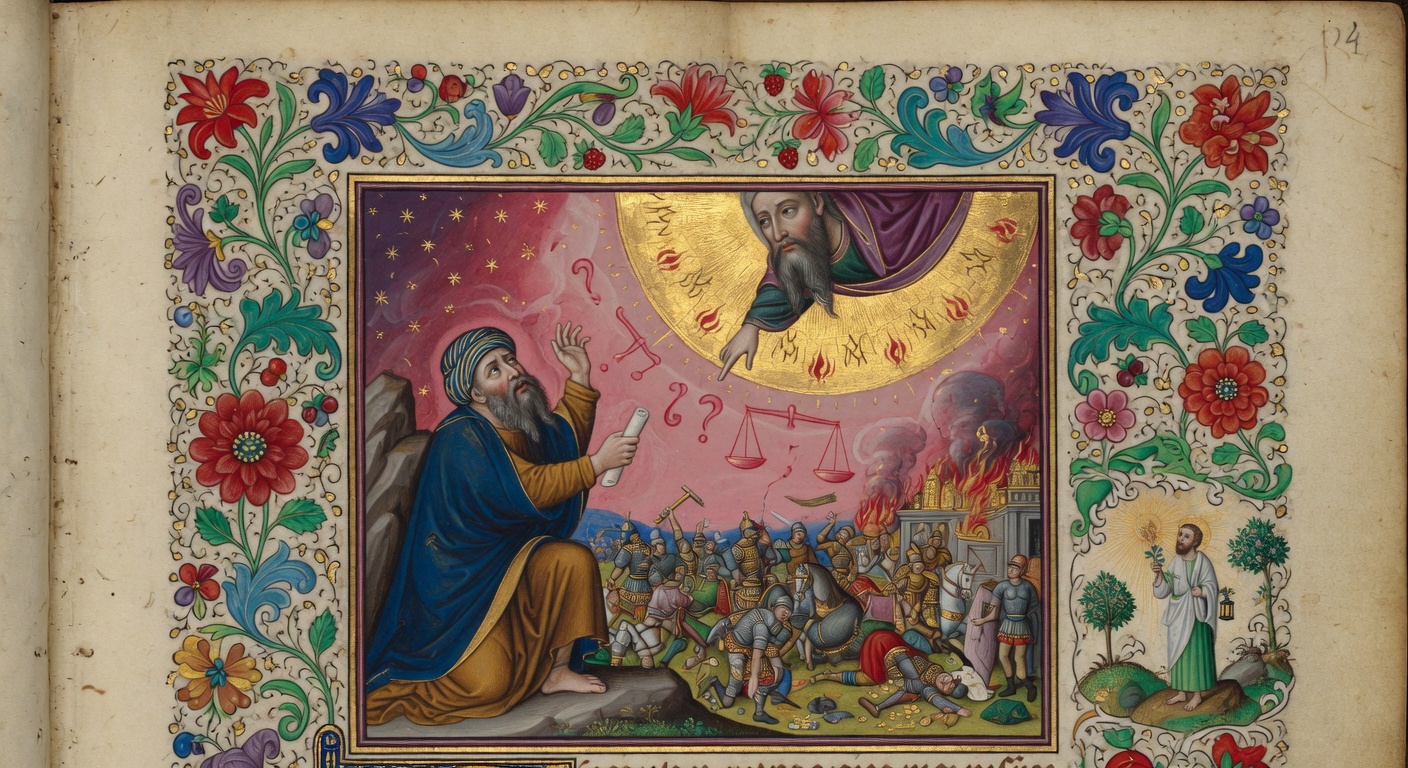
 1 will stand upon my watch, and set me upon the tower, and will watch to see what he will say unto me, and what I shall answer when I am reproved.
2 And the LORD answered me, and said, Write the vision, and make it plain upon tables, that he may run that readeth it.
3 For the vision is yet for an appointed time, but at the end it shall speak, and not lie: though it tarry, wait for it; because it will surely come, it will not tarry.
4 Behold, his soul which is lifted up is not upright in him: but the just shall live by his faith.
5 Yea also, because he transgresseth by wine, he is a proud man, neither keepeth at home, who enlargeth his desire as hell, and is as death, and cannot be satisfied, but gathereth unto him all nations, and heapeth unto him all people:
6 Shall not all these take up a parable against him, and a taunting proverb against him, and say, Woe to him that increaseth that which is not his! how long? and to him that ladeth himself with thick clay!
7 Shall they not rise up suddenly that shall bite thee, and awake that shall vex thee, and thou shalt be for booties unto them?
8 Because thou hast spoiled many nations, all the remnant of the people shall spoil thee; because of men’s blood, and for the violence of the land, of the city, and of all that dwell therein.
9 Woe to him that coveteth an evil covetousness to his house, that he may set his nest on high, that he may be delivered from the power of evil!
10 Thou hast consulted shame to thy house by cutting off many people, and hast sinned against thy soul.
11 For the stone shall cry out of the wall, and the beam out of the timber shall answer it.
12 Woe to him that buildeth a town with blood, and stablisheth a city by iniquity!
13 Behold, is it not of the LORD of hosts that the people shall labour in the very fire, and the people shall weary themselves for very vanity?
14 For the earth shall be filled with the knowledge of the glory of the LORD, as the waters cover the sea.
15 Woe unto him that giveth his neighbour drink, that puttest thy bottle to him, and makest him drunken also, that thou mayest look on their nakedness!
16 Thou art filled with shame for glory: drink thou also, and let thy foreskin be uncovered: the cup of the LORD’s right hand shall be turned unto thee, and shameful spewing shall be on thy glory.
17 For the violence of Lebanon shall cover thee, and the spoil of beasts, which made them afraid, because of men’s blood, and for the violence of the land, of the city, and of all that dwell therein.
18 What profiteth the graven image that the maker thereof hath graven it; the molten image, and a teacher of lies, that the maker of his work trusteth therein, to make dumb idols?
19 Woe unto him that saith to the wood, Awake; to the dumb stone, Arise, it shall teach! Behold, it is laid over with gold and silver, and there is no breath at all in the midst of it.
20 But the LORD is in his holy temple: let all the earth keep silence before him.
← → arrow keys to navigate chapters · spacebar to play/pause audio
Did You Know?
The command to write the vision 'plain upon tables' so 'he may run that readeth it' echoes the language of ancient royal proclamations and boundary stones, positioning the oracle as a public, unalterable decree rather than private counsel.
Verse 4's contrast between the Chaldean soul 'lifted up' and the just who 'shall live by his faith' employs a rare participial construction that later Jewish and Christian interpreters read as linking covenant fidelity to eschatological life, not mere survival.
The five woes deploy a tightly woven series of reversals where each crime (violence, covetousness, drunkenness, idolatry) recoils upon its perpetrator through the same instrument, a literary pattern that anticipates the talionic justice in apocalyptic texts like Revelation.
The stone 'cry[ing] out of the wall' and the beam 'answer[ing]' from timber draw directly on ancient Near Eastern curse formulas in which violated buildings testify against their builders, transforming a building metaphor into juridical testimony.
The final summons for all the earth to keep silence before the LORD in his holy temple deliberately echoes the theophanic hush at Solomon's temple dedication (1 Kings 8:10-11), framing Habakkuk's answer as a new cultic revelation rather than mere political prediction.
Habakkuk 2:4's declaration that "the righteous shall live by his faith" was cited by Paul in Romans and Galatians to articulate justification by faith, later becoming central to Reformation theology despite originating in a 7th-century BCE context.
The city fell to Persia in 539 BC exactly as Daniel prophesied. Conquered without a battle.
Jerusalem sits at about 2,500 feet elevation. Higher than most surrounding areas.
Commentary & Study Notes Jamieson-Fausset-Brown (1871) · Public Domain stand upon... watch — that is, watch-post. The prophets often compare themselves, awaiting the revelations of Jehovah with earnest patience, to watchmen on an eminence watching wit…
Classic verse-by-verse commentary on Habakkuk 2 from Jamieson, Fausset & Brown (1871). Covers: The prophet, waiting earnestly for an answer to his complaints (first chapter), receives a revelation, which is to be fulfilled, not immediately, yet in due time, and is therefore to be waited for in faith: the chaldeans shall be punished for their cruel rapacity, nor can their false gods avert the judgment of Jehovah, the only true God.
- 1
- stand upon... watch — that is, watch-post. The prophets often compare themselves, awaiting the revelations of Jehovah with earnest patience, to watchmen on an eminence watching with intent eye all that comes within their view (Isa 21:8, 11; Jer 6:17; Eze 3:17; 33:2, 3; compare Ps 5:3; 85:8). The "watch-post" is the withdrawal of the whole soul from earthly, and fixing it on heavenly, things. The accumulation of synonyms, "stand upon... watch... set me upon... tower... watch to see" implies persevering fixity of attention. what he will say unto me — in answer to my complaints (Hab 1:13). Literally, "in me," God speaking, not to the prophet's outward ear, but inwardly. When we have prayed to God, we must observe what answers God gives by His word, His Spirit, and His providences. what I shall answer when I am reproved — what answer I am to make to the reproof which I anticipate from God on account of the liberty of my expostulation with Him. MAURER translates, "What I am to answer in respect to my complaint against Jehovah" (Hab 1:12-17).
- 2
- Write the vision — which I am about to reveal to thee. make it plain — (De 27:8). In large legible characters. upon tables — boxwood tables covered with wax, on which national affairs were engraved with an iron pen, and then hung up in public, at the prophets' own houses, or at the temple, that those who passed might read them. Compare Lu 1:63, "writing table," that is, tablet. that he may run that readeth it — commonly explained, "so intelligible as to be easily read by any one running past"; but then it would be, "that he that runneth may read it." The true sense is, "so legible that whoever readeth it, may run to tell all whom he can the good news of the foe's coming doom, and Judah's deliverance." Compare Da 12:4, "many shall run to and fro," namely, with the explanation of the prophecy, then unsealed; also, Re 22:17, "let him that heareth (the good news) say (to every one within his reach), Come." "Run" is equivalent to announce the divine revelation (Jer 23:21); as everyone who becomes informed of a divine message is bound to run, that is, use all despatch to make it known to others [HENDERSON]. GROTIUS, LUDOVICUS DE DIEU, and MAURER interpret it: "Run" is not literal running, but "that he who reads it may run through it," that is, read it at once without difficulty.
Read all 20 notes on Habakkuk 2 →