Isaiah 12 KJV
Songs of Praise
Songs of Praise
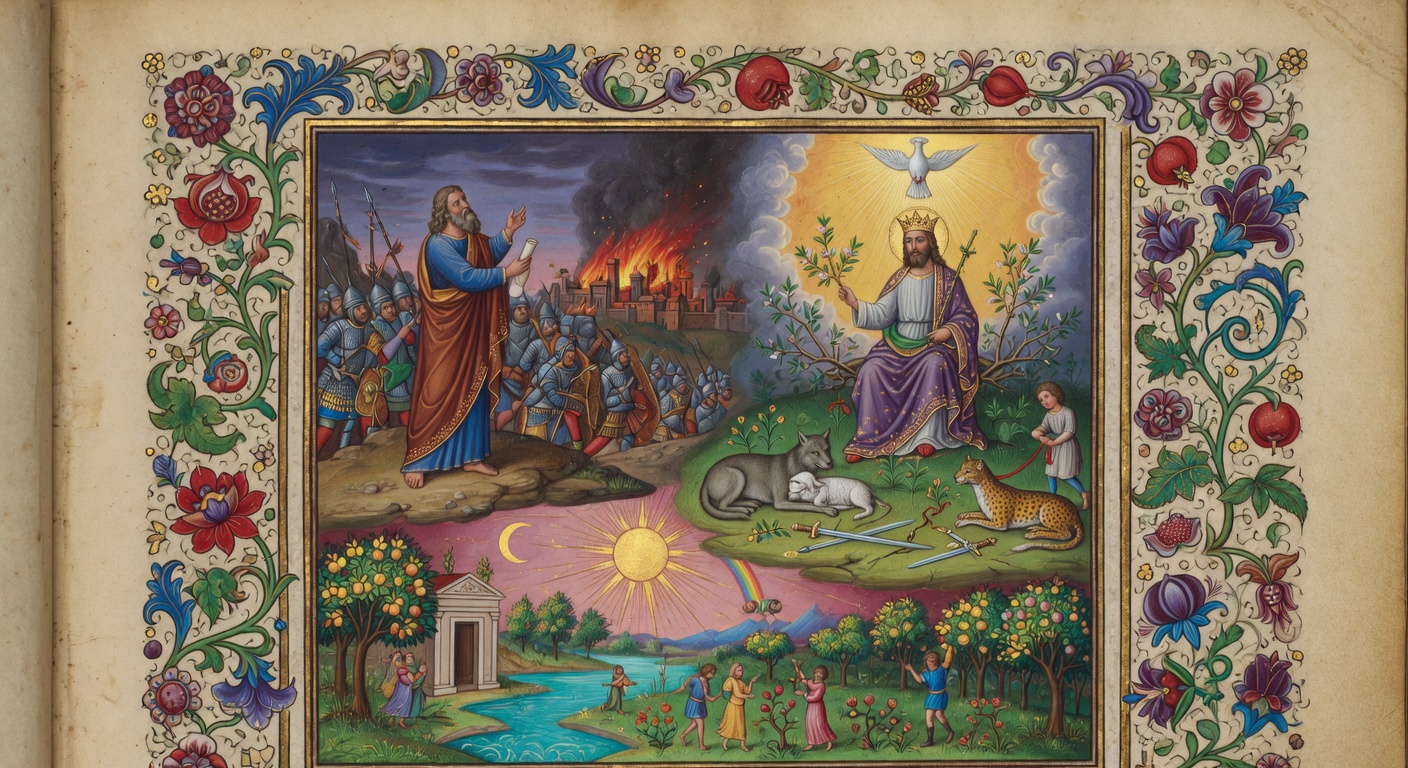
Isaiah 12 serves as the doxological conclusion to the first major division of the book (chs. 1-12), transforming earlier threats of judgment into a retrospective hymn that anticipates the remnant’s restoration after the Assyrian crisis.
 1nd in that day thou shalt say, O LORD, I will praise thee: though thou wast angry with me, thine anger is turned away, and thou comfortedst me.
2 Behold, God is my salvation; I will trust, and not be afraid: for the LORD JEHOVAH is my strength and my song; he also is become my salvation.
3 Therefore with joy shall ye draw water out of the wells of salvation.
4 And in that day shall ye say, Praise the LORD, call upon his name, declare his doings among the people, make mention that his name is exalted.
5 Sing unto the LORD; for he hath done excellent things: this is known in all the earth.
6 Cry out and shout, thou inhabitant of Zion: for great is the Holy One of Israel in the midst of thee.
← → arrow keys to navigate chapters · spacebar to play/pause audio
Did You Know?
Isaiah 12 serves as the doxological conclusion to the first major division of the book (chs. 1-12), transforming earlier threats of judgment into a retrospective hymn that anticipates the remnant’s restoration after the Assyrian crisis.
Verse 2’s declaration that “the LORD JEHOVAH is my strength and my song” is a deliberate echo of Exodus 15:2, recasting the Exodus victory song as a future eschatological experience rather than a past event.
The command in verse 3 to “draw water out of the wells of salvation” employs an image rooted in ancient Israelite water-drawing rituals at Sukkot, later interpreted in rabbinic and early Christian sources as an allusion to the gift of the Spirit.
Although the chapter is brief, it shifts from first-person singular confession (“I will praise thee”) to second-person plural imperatives (“declare his doings among the people”), modeling how personal deliverance expands into corporate witness to the nations.
The repeated title “Holy One of Israel” in verse 6 functions as an inclusio with Isaiah 6, bookending the opening section of the book by reaffirming that the same transcendent deity who commissioned the prophet will ultimately dwell “in the midst of thee” after judgment.
Jewish tradition preserved in the Babylonian Talmud and Ascension of Isaiah reports that the prophet was sawn in half under King Manasseh, an execution method possibly alluded to in the list of faithful sufferers in Hebrews 11:37.
After being told by Isaiah that he would die from his illness, Hezekiah prayed and received both a fifteen-year extension of life and the miraculous reversal of the sun's shadow on Ahaz's stairway as a divine sign, details recorded in both 2 Kings 20 and Isaiah 38.
Jesus exclusively taught the crowds in parables to fulfill Isaiah's prophecy of hearing without understanding, reserving explanations for his disciples alone as described in Mark 4.
Jerusalem is mentioned over 800 times in the Bible. More than any other city.
The Hanging Gardens of Babylon were one of the Seven Wonders of the Ancient World.
In this way, Assyria plays a pivotal role in the unfolding redemptive narrative, illustrating both the severity of divine judgment and the breadth of divine compassion.
Commentary & Study Notes Jamieson-Fausset-Brown (1871) · Public Domain Lord JEHOVAH — Jah, Jehovah. The repetition of the name denotes emphasis, and the unchangeableness of God's character. strength... song... salvation — derived from Ex 15:2; Ps 118:…
Classic verse-by-verse commentary on Isaiah 12 from Jamieson, Fausset & Brown (1871). Covers: Thanksgiving hymn of the restored and converted jews.
- 2
- Lord JEHOVAH — Jah, Jehovah. The repetition of the name denotes emphasis, and the unchangeableness of God's character. strength... song... salvation — derived from Ex 15:2; Ps 118:14. The idea of salvation was peculiarly associated with the feast of tabernacles (see Isa 12:3). Hence the cry "Hosanna," "Save, we beseech thee," that accompanied Jesus' triumphal entry into Jerusalem on that day (the fifteenth of the seventh month) (Mt 21:9; compare with Ps 118:25, 26); the earnest of the perfected "salvation" which He shall bring to His people at His glorious second appearance at Jerusalem (Heb 9:28). "He shall appear the second time without sin unto salvation." Compare Re 21:3, "The tabernacle of God is with men." Compare Lu 9:33, "three tabernacles: one for thee," &c. (the transfiguration being a pledge of the future kingdom), (Ps 118:15; Zec 14:16). As the Jew was reminded by the feast of tabernacles of his wanderings in tents in the wilderness, so the Jew-Gentile Church to come shall call to mind, with thanksgiving, the various past ways whereby God has at last brought them to the heavenly "city of habitation" (Ps 107:7).
- 3
- draw water... salvation — an expressive image in a hot country. On the last day of the feast of tabernacles the Jews used to bring water in a golden pitcher from the fountain of Siloam, and pour it, mingled with wine, on the sacrifice on the altar, with great rejoicing. This is the allusion in Jesus' words on "the last day of the feast" (Joh 7:2, 37-39). The pouring out of water indicated repentance (1Sa 7:6; compare, as to the Jews' repentance hereafter, Zec 12:10). There shall be a latter outpouring of the Spirit like the former one on pentecost (Joe 2:23). wells — not mere streams, which may run dry, but ever-flowing fountains (Joh 4:14; 7:38), "Out of his belly (that is, in and from himself) — living water" (Isa 42:18; Ps 84:6; Zec 13:1; Re 7:17).
Read all 5 notes on Isaiah 12 →