Isaiah 25 KJV
Praise for God's Salvation
Praise for God's Salvation
The chapter's depiction of a universal feast on Mount Zion (v.6) inverts ancient Near Eastern treaty meals where vassals ate before their suzerain, here positioning Yahweh as host to all peoples in an act of covenantal inclusion rather than domination.
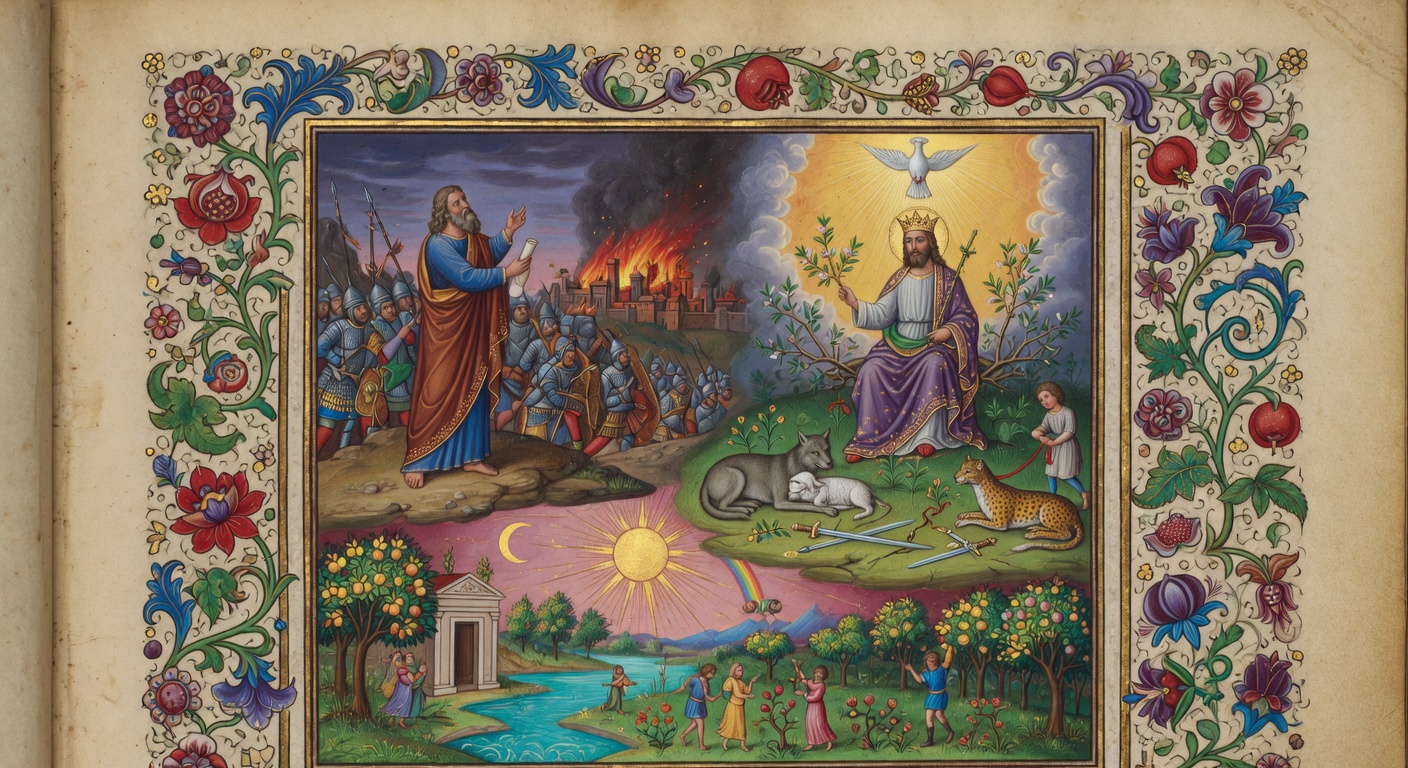
 1 Lord, thou art my God; I will exalt thee, I will praise thy name; for thou hast done wonderful things; thy counsels of old are faithfulness and truth.
2 For thou hast made of a city an heap; of a defenced city a ruin: a palace of strangers to be no city; it shall never be built.
3 Therefore shall the strong people glorify thee, the city of the terrible nations shall fear thee.
4 For thou hast been a strength to the poor, a strength to the needy in his distress, a refuge from the storm, a shadow from the heat, when the blast of the terrible ones is as a storm against the wall.
5 Thou shalt bring down the noise of strangers, as the heat in a dry place; even the heat with the shadow of a cloud: the branch of the terrible ones shall be brought low.
6 And in this mountain shall the LORD of hosts make unto all people a feast of fat things, a feast of wines on the lees, of fat things full of marrow, of wines on the lees well refined.
7 And he will destroy in this mountain the face of the covering cast over all people, and the vail that is spread over all nations.
8 He will swallow up death in victory; and the Lord GOD will wipe away tears from off all faces; and the rebuke of his people shall he take away from off all the earth: for the LORD hath spoken it.
9 And it shall be said in that day, Lo, this is our God; we have waited for him, and he will save us: this is the LORD; we have waited for him, we will be glad and rejoice in his salvation.
10 For in this mountain shall the hand of the LORD rest, and Moab shall be trodden down under him, even as straw is trodden down for the dunghill.
11 And he shall spread forth his hands in the midst of them, as he that swimmeth spreadeth forth his hands to swim: and he shall bring down their pride together with the spoils of their hands.
12 And the fortress of the high fort of thy walls shall he bring down, lay low, and bring to the ground, even to the dust.
← → arrow keys to navigate chapters · spacebar to play/pause audio
Did You Know?
The chapter's depiction of a universal feast on Mount Zion (v.6) inverts ancient Near Eastern treaty meals where vassals ate before their suzerain, here positioning Yahweh as host to all peoples in an act of covenantal inclusion rather than domination.
Verse 8's declaration that God will 'swallow up death in victory' employs the rare verb bala' (to engulf), echoing but subverting Ugaritic Baal myths of Mot devouring the storm god, recasting death itself as the defeated enemy in a monotheistic framework.
The reversal motif linking Isaiah 24's cosmic curses to chapter 25's blessings mirrors Deuteronomy 28's covenant structure, transforming famine and exile into abundance and restoration as a deliberate Deuteronomic echo within prophetic literature.
References to the 'city' being made a 'heap' (vv.2,12) likely allude to the 7th-century BCE destruction of Assyrian centers like Nineveh, yet the text's lack of specificity enables its reuse as a type for Rome in later Jewish and Christian apocalyptic readings.
The wiping away of tears in v.8 directly informs the Targum's interpretive expansion, where the Shekinah performs this act, bridging the Masoretic text to rabbinic traditions of divine compassion that later shape Christian liturgy for All Saints' Day.
Isaiah had direct access to Judah's royal court and confronted King Ahaz during the Syro-Ephraimite crisis of 734 BC, offering a sign involving the still-unborn Immanuel while the king refused to ask for one as instructed.
Hezekiah destroyed the bronze serpent Moses had crafted in the wilderness because the Israelites had turned it into an object of incense-burning worship, an act of reform that set him apart from most Judahite kings who tolerated such syncretism.
Jesus' genealogy in Matthew intentionally incorporates four Gentile women. Tamar, Rahab, Ruth, and Uriah's wife. Highlighting the inclusion of outsiders in the messianic lineage contrary to typical Jewish genealogical emphasis on purity.
The city has been destroyed at least twice, besieged 23 times, and captured 44 times.
Babylon's walls were reportedly wide enough for two chariots to pass side by side.
In this way, Assyria plays a pivotal role in the unfolding redemptive narrative, illustrating both the severity of divine judgment and the breadth of divine compassion.
Commentary & Study Notes Jamieson-Fausset-Brown (1871) · Public Domain wonderful — (Isa 9:6). counsels of old — (Isa 42:9; 46:10). Purposes planned long ago; here, as to the deliverance of His people. truth — Hebrew, Amen; covenant-keeping, faithful t…
Classic verse-by-verse commentary on Isaiah 25 from Jamieson, Fausset & Brown (1871). Covers: Continuation of the twenty-fourth chapter. Thanksgiving for the overthrow of the apostate faction, and the setting up of Jehovah's throne on Zion.
- 1
- wonderful — (Isa 9:6). counsels of old — (Isa 42:9; 46:10). Purposes planned long ago; here, as to the deliverance of His people. truth — Hebrew, Amen; covenant-keeping, faithful to promises; the peculiar characteristic of Jesus (Re 3:14).
- 2
- a city... heap — Babylon, type of the seat of Antichrist, to be destroyed in the last days (compare Jer 51:37, with Re 18:1-24, followed, as here, by the song of the saints' thanksgiving in Re 19:1-21). "Heaps" is a graphic picture of Babylon and Nineveh as they now are. palace — Babylon regarded, on account of its splendor, as a vast palace. But MAURER translates, "a citadel." of strangers — foreigners, whose capital pre-eminently Babylon was, the metropolis of the pagan world. "Aliens from the commonwealth of Israel, strangers from the covenants of promise" (Isa 29:5; Eph 2:12; see in contrast, Joe 3:17). never be built — (Isa 13:19, 20, &c.).
Read all 13 notes on Isaiah 25 →