Isaiah 27 KJV
Deliverance of Israel
Deliverance of Israel
The chapter repurposes the Canaanite chaos monster Lotan (Leviathan) from Ugaritic texts by applying three distinct epithets to a single creature, transforming polytheistic combat myths into a declaration of Yahweh's sole sovereignty over historical oppressors like Assyria.
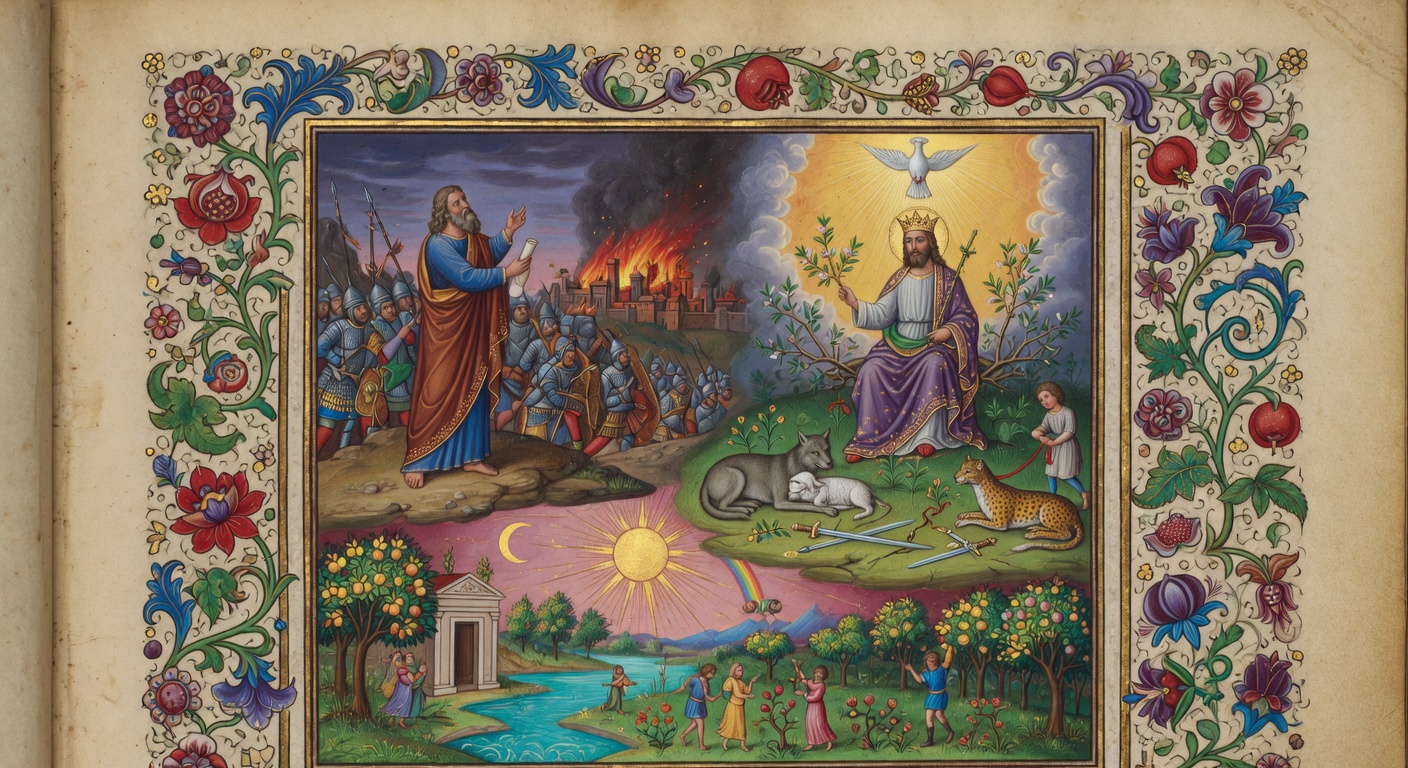
 1n that day the LORD with his sore and great and strong sword shall punish leviathan the piercing serpent, even leviathan that crooked serpent; and he shall slay the dragon that is in the sea.
2 In that day sing ye unto her, A vineyard of red wine.
3 I the LORD do keep it; I will water it every moment: lest any hurt it, I will keep it night and day.
4 Fury is not in me: who would set the briers and thorns against me in battle? I would go through them, I would burn them together.
5 Or let him take hold of my strength, that he may make peace with me; and he shall make peace with me.
6 He shall cause them that come of Jacob to take root: Israel shall blossom and bud, and fill the face of the world with fruit.
7 Hath he smitten him, as he smote those that smote him? or is he slain according to the slaughter of them that are slain by him?
8 In measure, when it shooteth forth, thou wilt debate with it: he stayeth his rough wind in the day of the east wind.
9 By this therefore shall the iniquity of Jacob be purged; and this is all the fruit to take away his sin; when he maketh all the stones of the altar as chalkstones that are beaten in sunder, the groves and images shall not stand up.
10 Yet the defenced city shall be desolate, and the habitation forsaken, and left like a wilderness: there shall the calf feed, and there shall he lie down, and consume the branches thereof.
11 When the boughs thereof are withered, they shall be broken off: the women come, and set them on fire: for it is a people of no understanding: therefore he that made them will not have mercy on them, and he that formed them will shew them no favour.
12 And it shall come to pass in that day, that the LORD shall beat off from the channel of the river unto the stream of Egypt, and ye shall be gathered one by one, O ye children of Israel.
13 And it shall come to pass in that day, that the great trumpet shall be blown, and they shall come which were ready to perish in the land of Assyria, and the outcasts in the land of Egypt, and shall worship the LORD in the holy mount at Jerusalem.
← → arrow keys to navigate chapters · spacebar to play/pause audio
Did You Know?
The chapter repurposes the Canaanite chaos monster Lotan (Leviathan) from Ugaritic texts by applying three distinct epithets to a single creature, transforming polytheistic combat myths into a declaration of Yahweh's sole sovereignty over historical oppressors like Assyria.
Verses 2-5 deliberately invert the 'song of the vineyard' from Isaiah 5 by shifting from destruction due to wild grapes to promises of protection and future fruitfulness, signaling a theological transition from judgment to eschatological restoration for Jacob.
The 'great trumpet' in verse 13 echoes Jubilee legislation in Leviticus 25 while anticipating its use in later apocalyptic texts, functioning here as a signal for the ingathering of exiles from Egypt and Assyria rather than a call for land redemption.
Verse 9's command to pulverize altar stones 'as chalkstones' alludes to the specific reforms attributed to Hezekiah in 2 Kings 18, linking the chapter's purification imagery to concrete 8th-century Judahite cultic centralization rather than generic polemic.
The contrast in verses 7-8 between Israel's measured punishment and the total annihilation of its enemies draws on the 'remnant' theology developed earlier in Isaiah, underscoring a unique covenantal discipline that preserves a seed for future renewal unlike surrounding nations.
Jewish tradition preserved in the Babylonian Talmud and Ascension of Isaiah reports that the prophet was sawn in half under King Manasseh, an execution method possibly alluded to in the list of faithful sufferers in Hebrews 11:37.
After being told by Isaiah that he would die from his illness, Hezekiah prayed and received both a fifteen-year extension of life and the miraculous reversal of the sun's shadow on Ahaz's stairway as a divine sign, details recorded in both 2 Kings 20 and Isaiah 38.
Jesus exclusively taught the crowds in parables to fulfill Isaiah's prophecy of hearing without understanding, reserving explanations for his disciples alone as described in Mark 4.
Three major world religions consider Jerusalem a holy city.
The Hanging Gardens of Babylon were one of the Seven Wonders of the Ancient World.
In this way, Assyria plays a pivotal role in the unfolding redemptive narrative, illustrating both the severity of divine judgment and the breadth of divine compassion.
Commentary & Study Notes Jamieson-Fausset-Brown (1871) · Public Domain sore — rather, "hard," "well-tempered." leviathan — literally, in Arabic, "the twisted animal," applicable to every great tenant of the waters, sea-serpents, crocodiles, &c. In…
Classic verse-by-verse commentary on Isaiah 27 from Jamieson, Fausset & Brown (1871). Covers: Continuation of the twenty-fourth, twenty-fifth, and twenty-sixth chapters.
- 1
- sore — rather, "hard," "well-tempered." leviathan — literally, in Arabic, "the twisted animal," applicable to every great tenant of the waters, sea-serpents, crocodiles, &c. In Eze 29:3; 32:2; Da 7:1, &c. Re 12:3, &c., potentates hostile to Israel are similarly described; antitypically and ultimately Satan is intended (Re 20:10). piercing — rigid [LOWTH]. Flying [MAURER and Septuagint]. Long, extended, namely, as the crocodile which cannot readily bend back its body [HOUBIGANT]. crooked — winding. dragon — Hebrew, tenin; the crocodile. sea — the Euphrates, or the expansion of it near Babylon.
- 2
- In that day when leviathan shall be destroyed, the vineyard (Ps 80:8), the Church of God, purged of its blemishes, shall be lovely in God's eyes; to bring out this sense the better, LOWTH, by changing a Hebrew letter, reads "pleasant," "lovely," for "red wine." sing — a responsive song [LOWTH]. unto her — rather, "concerning her" (see on Isa 5:1); namely, the Jewish state [MAURER].
Read all 13 notes on Isaiah 27 →