Isaiah 38 KJV
Hezekiah's Illness and Recovery
Hezekiah's Illness and Recovery
The sundial sign to Hezekiah echoes the earlier offer of a celestial sign to his father Ahaz in Isaiah 7, linking two generations of the Davidic line through God's willingness to confirm his word via astronomical reversal.
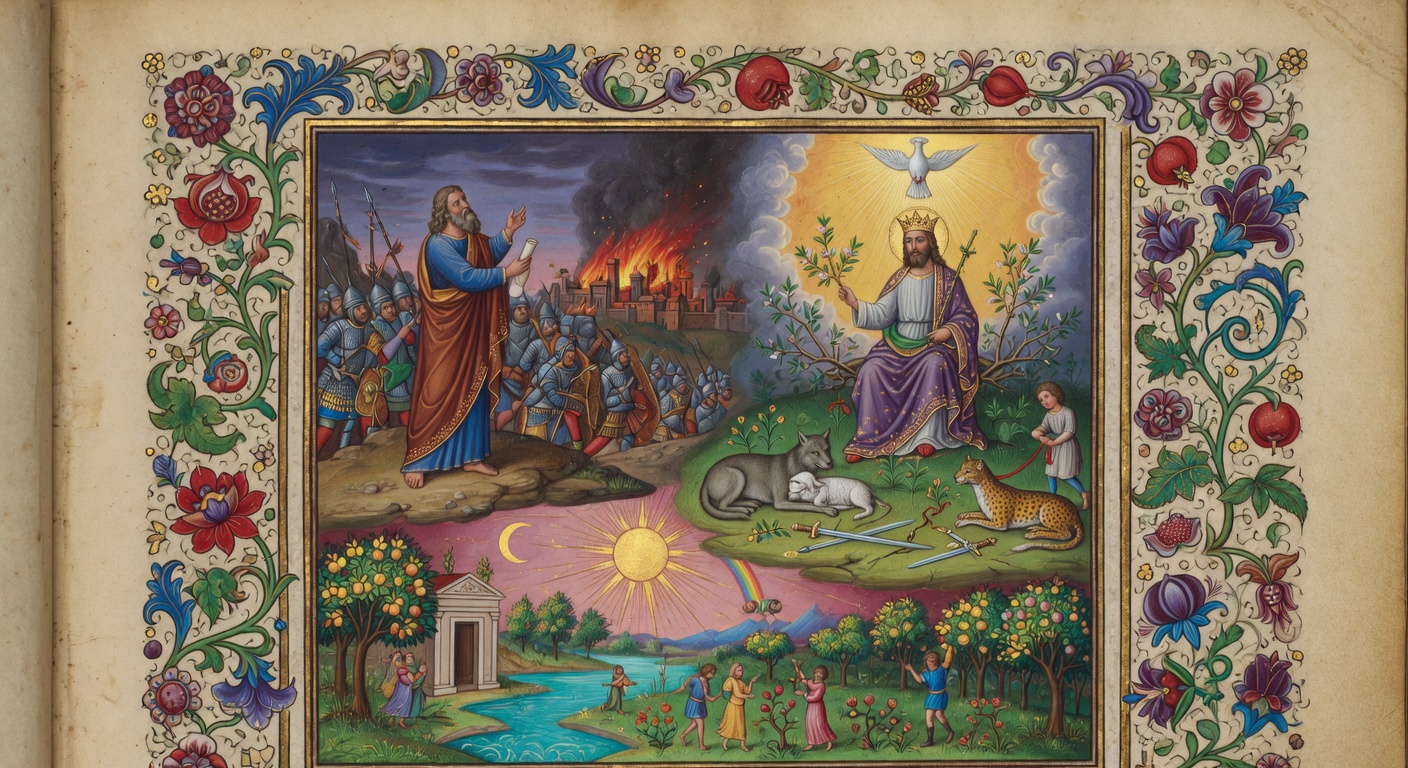
 1n those days was Hezekiah sick unto death. And Isaiah the prophet the son of Amoz came unto him, and said unto him, Thus saith the LORD, Set thine house in order: for thou shalt die, and not live.
2 Then Hezekiah turned his face toward the wall, and prayed unto the LORD,
3 And said, Remember now, O LORD, I beseech thee, how I have walked before thee in truth and with a perfect heart, and have done that which is good in thy sight. And Hezekiah wept sore.
4 Then came the word of the LORD to Isaiah, saying,
5 Go, and say to Hezekiah, Thus saith the LORD, the God of David thy father, I have heard thy prayer, I have seen thy tears: behold, I will add unto thy days fifteen years.
6 And I will deliver thee and this city out of the hand of the king of Assyria: and I will defend this city.
7 And this shall be a sign unto thee from the LORD, that the LORD will do this thing that he hath spoken;
8 Behold, I will bring again the shadow of the degrees, which is gone down in the sun dial of Ahaz, ten degrees backward. So the sun returned ten degrees, by which degrees it was gone down.
9 The writing of Hezekiah king of Judah, when he had been sick, and was recovered of his sickness:
10 I said in the cutting off of my days, I shall go to the gates of the grave: I am deprived of the residue of my years.
11 I said, I shall not see the LORD, even the LORD, in the land of the living: I shall behold man no more with the inhabitants of the world.
12 Mine age is departed, and is removed from me as a shepherd’s tent: I have cut off like a weaver my life: he will cut me off with pining sickness: from day even to night wilt thou make an end of me.
13 I reckoned till morning, that, as a lion, so will he break all my bones: from day even to night wilt thou make an end of me.
14 Like a crane or a swallow, so did I chatter: I did mourn as a dove: mine eyes fail with looking upward: O LORD, I am oppressed; undertake for me.
15 What shall I say? he hath both spoken unto me, and himself hath done it: I shall go softly all my years in the bitterness of my soul.
16 O LORD, by these things men live, and in all these things is the life of my spirit: so wilt thou recover me, and make me to live.
17 Behold, for peace I had great bitterness: but thou hast in love to my soul delivered it from the pit of corruption: for thou hast cast all my sins behind thy back.
18 For the grave cannot praise thee, death can not celebrate thee: they that go down into the pit cannot hope for thy truth.
19 The living, the living, he shall praise thee, as I do this day: the father to the children shall make known thy truth.
20 The LORD was ready to save me: therefore we will sing my songs to the stringed instruments all the days of our life in the house of the LORD.
21 For Isaiah had said, Let them take a lump of figs, and lay it for a plaister upon the boil, and he shall recover.
22 Hezekiah also had said, What is the sign that I shall go up to the house of the LORD?
← → arrow keys to navigate chapters · spacebar to play/pause audio
Did You Know?
The sundial sign to Hezekiah echoes the earlier offer of a celestial sign to his father Ahaz in Isaiah 7, linking two generations of the Davidic line through God's willingness to confirm his word via astronomical reversal.
Hezekiah's inserted psalm (vv. 9-20) employs the rare 'writing' (miktab) superscription otherwise found only in Habakkuk 3, framing personal recovery as a liturgical composition meant for temple use after deliverance.
Isaiah's initial death sentence is explicitly revoked after intercession, illustrating that even irrevocable-sounding prophetic oracles remain open to revision when met with fervent royal prayer, a dynamic rarely narrated elsewhere in the prophetic corpus.
Hezekiah's lament contrasts the silence of Sheol with continued praise 'in the land of the living,' preserving one of the clearest pre-exilic expressions of the theological necessity of earthly worship before fuller resurrection hope emerges.
The fifteen-year extension immediately precedes the Babylonian envoy visit of chapter 39, transforming a private healing into the chronological trigger for the announcement of future exile, thus binding individual lifespan to national destiny.
The Dead Sea Scroll 1QIsa^a, copied around 125 BC, contains the entire book of Isaiah with only minor variants from the later Masoretic Text, providing the oldest complete witness to any biblical book and demonstrating extraordinary textual stability.
Hezekiah dispatched couriers throughout the former northern kingdom to summon survivors to an unprecedented Passover in Jerusalem, resulting in such a large attendance that the Levites had to assist with sacrifices because many participants had not properly consecrated themselves.
Jesus appeared to over five hundred people at one time after his resurrection, a mass sighting noted by Paul in 1 Corinthians 15 that provides early corroboration beyond the Gospel accounts.
Jerusalem sits at about 2,500 feet elevation. Higher than most surrounding areas.
The city fell to Persia in 539 BC exactly as Daniel prophesied. Conquered without a battle.
In this way, Assyria plays a pivotal role in the unfolding redemptive narrative, illustrating both the severity of divine judgment and the breadth of divine compassion.
Commentary & Study Notes Jamieson-Fausset-Brown (1871) · Public Domain Set... house in order — Make arrangement as to the succession to the throne; for he had then no son; and as to thy other concerns. thou shall die — speaking according to the ordina…
Classic verse-by-verse commentary on Isaiah 38 from Jamieson, Fausset & Brown (1871). Covers: Hezekiah's sickness; Perhaps connected with the plague or blast whereby the assyrian army had been destroyed.
- 1
- Set... house in order — Make arrangement as to the succession to the throne; for he had then no son; and as to thy other concerns. thou shall die — speaking according to the ordinary course of the disease. His being spared fifteen years was not a change in God's mind, but an illustration of God's dealings being unchangeably regulated by the state of man in relation to Him.
- 2
- The couches in the East run along the walls of houses. He turned away from the spectators to hide his emotion and collect his thoughts for prayer.
Read all 21 notes on Isaiah 38 →