Isaiah 61 KJV
The Year of the Lord's Favor
Echoes & Connections 1 connections
The Year of the Lord's Favor
The opening anointing in verse 1 extends the Spirit's role beyond prophetic speech to encompass economic reversal through Jubilee motifs from Leviticus 25, framing liberty as both release from debt and cosmic restoration.
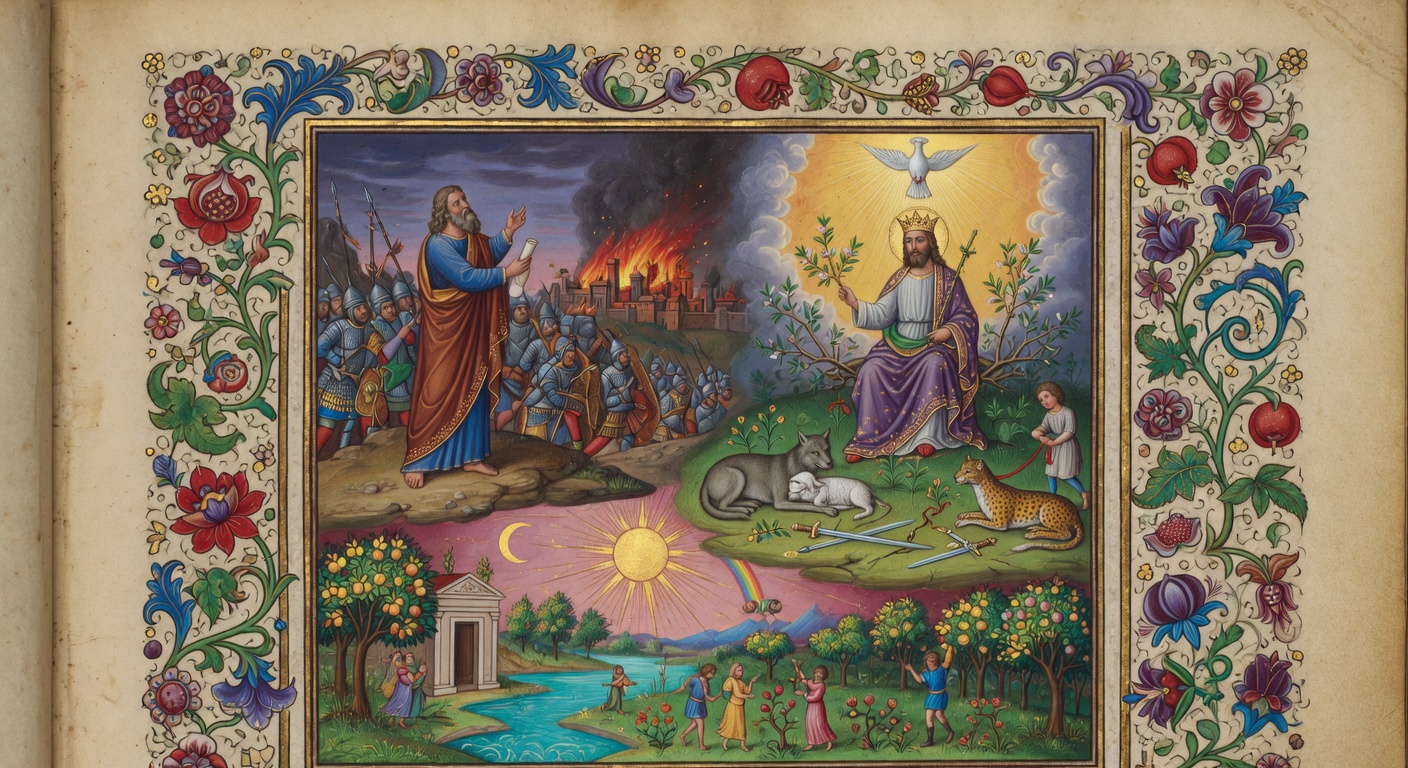
 1he Spirit of the Lord GOD is upon me; because the LORD hath anointed me to preach good tidings unto the meek; he hath sent me to bind up the brokenhearted, to proclaim liberty to the captives, and the opening of the prison to them that are bound;
2 To proclaim the acceptable year of the LORD, and the day of vengeance of our God; to comfort all that mourn;
3 To appoint unto them that mourn in Zion, to give unto them beauty for ashes, the oil of joy for mourning, the garment of praise for the spirit of heaviness; that they might be called trees of righteousness, the planting of the LORD, that he might be glorified.
4 And they shall build the old wastes, they shall raise up the former desolations, and they shall repair the waste cities, the desolations of many generations.
5 And strangers shall stand and feed your flocks, and the sons of the alien shall be your plowmen and your vinedressers.
6 But ye shall be named the Priests of the LORD: men shall call you the Ministers of our God: ye shall eat the riches of the Gentiles, and in their glory shall ye boast yourselves.
7 For your shame ye shall have double; and for confusion they shall rejoice in their portion: therefore in their land they shall possess the double: everlasting joy shall be unto them.
8 For I the LORD love judgment, I hate robbery for burnt offering; and I will direct their work in truth, and I will make an everlasting covenant with them.
9 And their seed shall be known among the Gentiles, and their offspring among the people: all that see them shall acknowledge them, that they are the seed which the LORD hath blessed.
10 I will greatly rejoice in the LORD, my soul shall be joyful in my God; for he hath clothed me with the garments of salvation, he hath covered me with the robe of righteousness, as a bridegroom decketh himself with ornaments, and as a bride adorneth herself with her jewels.
11 For as the earth bringeth forth her bud, and as the garden causeth the things that are sown in it to spring forth; so the Lord GOD will cause righteousness and praise to spring forth before all the nations.
← → arrow keys to navigate chapters · spacebar to play/pause audio
Did You Know?
The opening anointing in verse 1 extends the Spirit's role beyond prophetic speech to encompass economic reversal through Jubilee motifs from Leviticus 25, framing liberty as both release from debt and cosmic restoration.
Verse 6's elevation of the entire community to priestly status subverts the Aaronic monopoly, prefiguring the New Testament's royal priesthood while echoing Exodus 19:6's original Sinai intent for all Israel.
The Hebrew wordplay between 'pa'er' (beauty) and 'epher' (ashes) in verse 3 exploits consonantal similarity to transform mourning rites into eschatological reversal, a literary device the KJV preserves through its rhythmic phrasing.
Verse 8's pairing of divine love for 'judgment' with hatred of 'robbery for burnt offering' critiques post-exilic sacrificial corruption, aligning Isaiah with Hosea's and Micah's insistence that ethics validate cultic acts.
The closing 'everlasting covenant' in verse 8 fuses Davidic kingship promises with Abrahamic seed blessings, positioning the chapter as a bridge between 2 Samuel 7 and the new covenant language later developed in Jeremiah 31.
In Isaiah 20 the prophet walked naked and barefoot for three years as a living sign-act foretelling the humiliation of Egypt and Cush by Assyria, exemplifying the embodied performance aspect of eighth-century prophecy.
To withstand Sennacherib's siege, Hezekiah commissioned a 533-meter tunnel carved through bedrock to channel the Gihon Spring inside Jerusalem's walls, an engineering project whose original Hebrew inscription was recovered in 1880 and confirms the biblical account in 2 Kings 20.
Jesus paid the annual temple tax by instructing Peter to catch a fish whose mouth contained the exact coin needed, a detail unique to Matthew 17 that blends miracle with practical provision in first-century Jewish life.
The city has been destroyed at least twice, besieged 23 times, and captured 44 times.
Babylon's walls were reportedly wide enough for two chariots to pass side by side.
In this way, Assyria plays a pivotal role in the unfolding redemptive narrative, illustrating both the severity of divine judgment and the breadth of divine compassion.
Commentary & Study Notes Jamieson-Fausset-Brown (1871) · Public Domain is upon me; because... hath anointed me — quoted by Jesus as His credentials in preaching (Lu 4:18-21). The Spirit is upon Me in preaching, because Jehovah hath anointed Me from th…
Classic verse-by-verse commentary on Isaiah 61 from Jamieson, Fausset & Brown (1871). Covers: Messiah's offices: restoration of Israel.
- 1
- is upon me; because... hath anointed me — quoted by Jesus as His credentials in preaching (Lu 4:18-21). The Spirit is upon Me in preaching, because Jehovah hath anointed Me from the womb (Lu 1:35), and at baptism, with the Spirit "without measure," and permanently "abiding" on Me (Isa 11:2; Joh 1:32; 3:34; Ps 45:7; with which compare 1Ki 1:39, 40; 19:16; Ex 29:7). "Anointed" as Messiah, Prophet, Priest, and King. good tidings — as the word "gospel" means. the meek — rather, "the poor," as Lu 4:18 has it; that is, those afflicted with calamity, poor in circumstances and in spirit (Mt 11:5). proclaim liberty — (Joh 8:31-36). Language drawn from the deliverance of the Babylonian captives, to describe the deliverance from sin and death (Heb 2:15); also from the "liberty proclaimed" to all bond-servants in the year of jubilee (Isa 61:2; Le 25:10; Jer 34:8, 9). opening of the prison — The Hebrew rather is, "the most complete opening," namely, of the eyes to them that are bound, that is, deliverance from prison, for captives are as it were blind in the darkness of prison (Isa 14:17; 35:5; 42:7) [EWALD]. So Lu 4:18 and the Septuagint interpret it; Lu 4:18, under inspiration, adds to this, for the fuller explanation of the single clause in the Hebrew, "to set at liberty them that are bruised"; thus expressing the double "opening" implied; namely, that of the eyes (Joh 9:39), and that of the prison (Ro 6:18; 7:24, 25; Heb 2:15). His miracles were acted parables.
- 2
- acceptable year — the year of jubilee on which "liberty was proclaimed to the captives" (Isa 61:1; 2Co 6:2). day of vengeance — The "acceptable time of grace" is a "year"; the time of "vengeance" but "a day" (so Isa 34:8; 63:4; Mal 4:1). Jesus (Lu 4:20, 21) "closed the book" before this clause; for the interval from His first to His second coming is "the acceptable year"; the day of vengeance" will not be till He comes again (2Th 1:7-9). our God — The saints call Him "our God"; for He cometh to "avenge" them (Re 6:10; 19:2). all that mourn — The "all" seems to include the spiritual Israelite mourners, as well as the literal, who are in Isa 61:3 called "them that mourn in Zion," and to whom Isa 57:18 refers.
Read all 11 notes on Isaiah 61 →