Isaiah 64 KJV
A Prayer for Mercy
A Prayer for Mercy
The chapter's plea to 'rend the heavens' (v.1) inverts the Sinai theophany by longing for a cataclysmic divine descent that would make nations tremble, framing Israel's post-exilic despair as a reversal of exodus glory.
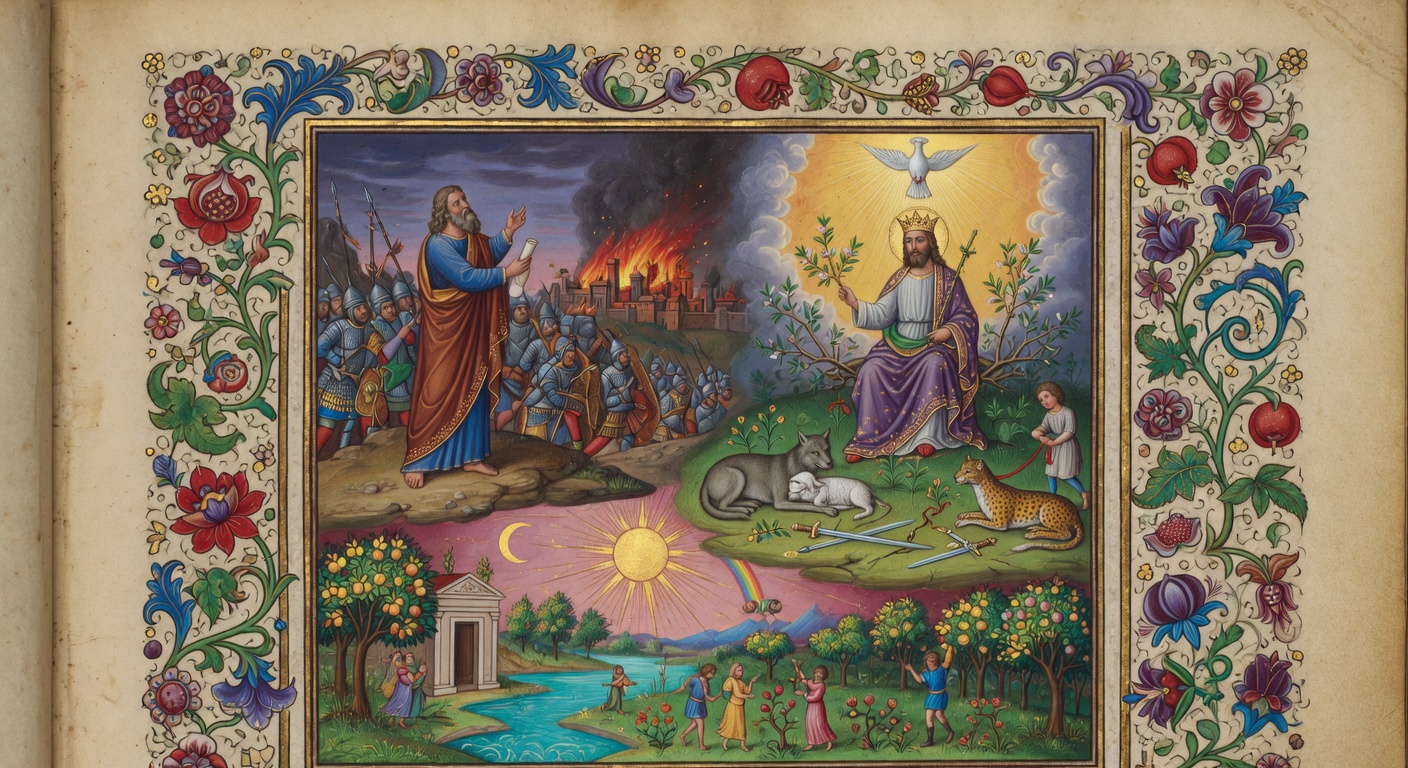
 1h that thou wouldest rend the heavens, that thou wouldest come down, that the mountains might flow down at thy presence,
2 As when the melting fire burneth, the fire causeth the waters to boil, to make thy name known to thine adversaries, that the nations may tremble at thy presence!
3 When thou didst terrible things which we looked not for, thou camest down, the mountains flowed down at thy presence.
4 For since the beginning of the world men have not heard, nor perceived by the ear, neither hath the eye seen, O God, beside thee, what he hath prepared for him that waiteth for him.
5 Thou meetest him that rejoiceth and worketh righteousness, those that remember thee in thy ways: behold, thou art wroth; for we have sinned: in those is continuance, and we shall be saved.
6 But we are all as an unclean thing, and all our righteousnesses are as filthy rags; and we all do fade as a leaf; and our iniquities, like the wind, have taken us away.
7 And there is none that calleth upon thy name, that stirreth up himself to take hold of thee: for thou hast hid thy face from us, and hast consumed us, because of our iniquities.
8 But now, O LORD, thou art our father; we are the clay, and thou our potter; and we all are the work of thy hand.
9 Be not wroth very sore, O LORD, neither remember iniquity for ever: behold, see, we beseech thee, we are all thy people.
10 Thy holy cities are a wilderness, Zion is a wilderness, Jerusalem a desolation.
11 Our holy and our beautiful house, where our fathers praised thee, is burned up with fire: and all our pleasant things are laid waste.
12 Wilt thou refrain thyself for these things, O LORD? wilt thou hold thy peace, and afflict us very sore?
← → arrow keys to navigate chapters · spacebar to play/pause audio
Did You Know?
The chapter's plea to 'rend the heavens' (v.1) inverts the Sinai theophany by longing for a cataclysmic divine descent that would make nations tremble, framing Israel's post-exilic despair as a reversal of exodus glory.
Verse 6's 'filthy rags' renders the Hebrew 'beged iddim,' evoking menstrual cloths and thus equating Israel's best deeds with sources of ritual defilement under Levitical law.
The potter-clay image (v.8) is not merely about creation but about God's right to reshape a marred covenant people, anticipating its reuse in Romans 9 while rooted in ancient Near Eastern royal potter metaphors for sovereignty.
Verse 11's lament over the 'holy and beautiful house' burned with fire supplies a precise historical anchor to the 586 BCE destruction of the First Temple, turning the prayer into eyewitness communal trauma rather than generic lament.
The final question whether God will 'afflict us very sore' (v.12) echoes the 'measure for measure' principle of prophetic justice yet appeals to the unmerited fatherhood of God, creating a theological tension between wrath and mercy unresolved within the chapter itself.
Isaiah's two named sons, Shear-Jashub and Maher-Shalal-Hash-Baz, bore symbolic names given as divine oracles predicting both a surviving remnant and the swift plunder of Damascus and Samaria by Assyria.
When Sennacherib's threatening letter arrived, Hezekiah carried it into the temple and spread it before the Lord, prompting Isaiah to prophesy that not a single arrow would be shot against the city, a prediction fulfilled when an angel struck down 185,000 Assyrian troops overnight.
Jesus had female disciples who traveled with and financially supported his ministry, an uncommon practice in first-century Judaism detailed in Luke 8:2-3 with specific names like Joanna and Susanna.
Jerusalem is mentioned over 800 times in the Bible. More than any other city.
Babylon's walls were reportedly wide enough for two chariots to pass side by side.
In this way, Assyria plays a pivotal role in the unfolding redemptive narrative, illustrating both the severity of divine judgment and the breadth of divine compassion.
Commentary & Study Notes Jamieson-Fausset-Brown (1871) · Public Domain rend... heavens — bursting forth to execute vengeance, suddenly descending on Thy people's foe (Ps 18:9; 144:5; Hab 3:5, 6). flow down — (Jud 5:5; Mic 1:4).
Classic verse-by-verse commentary on Isaiah 64 from Jamieson, Fausset & Brown (1871). Covers: Transition from complaint to prayer.
- 1
- rend... heavens — bursting forth to execute vengeance, suddenly descending on Thy people's foe (Ps 18:9; 144:5; Hab 3:5, 6). flow down — (Jud 5:5; Mic 1:4).
- 2
- Oh, that Thy wrath would consume Thy foes as the fire. Rather, "as the fire burneth the dry brushwood" [GESENIUS].
Read all 12 notes on Isaiah 64 →