Isaiah 8 KJV
The Coming Assyrian Invasion
Echoes & Connections 1 connections
The Coming Assyrian Invasion
Isaiah 8:16's command to bind up the testimony and seal the law among disciples implies an intentional scribal community preserving oracles during national crisis, anticipating later Jewish textual traditions of guarded prophecy.
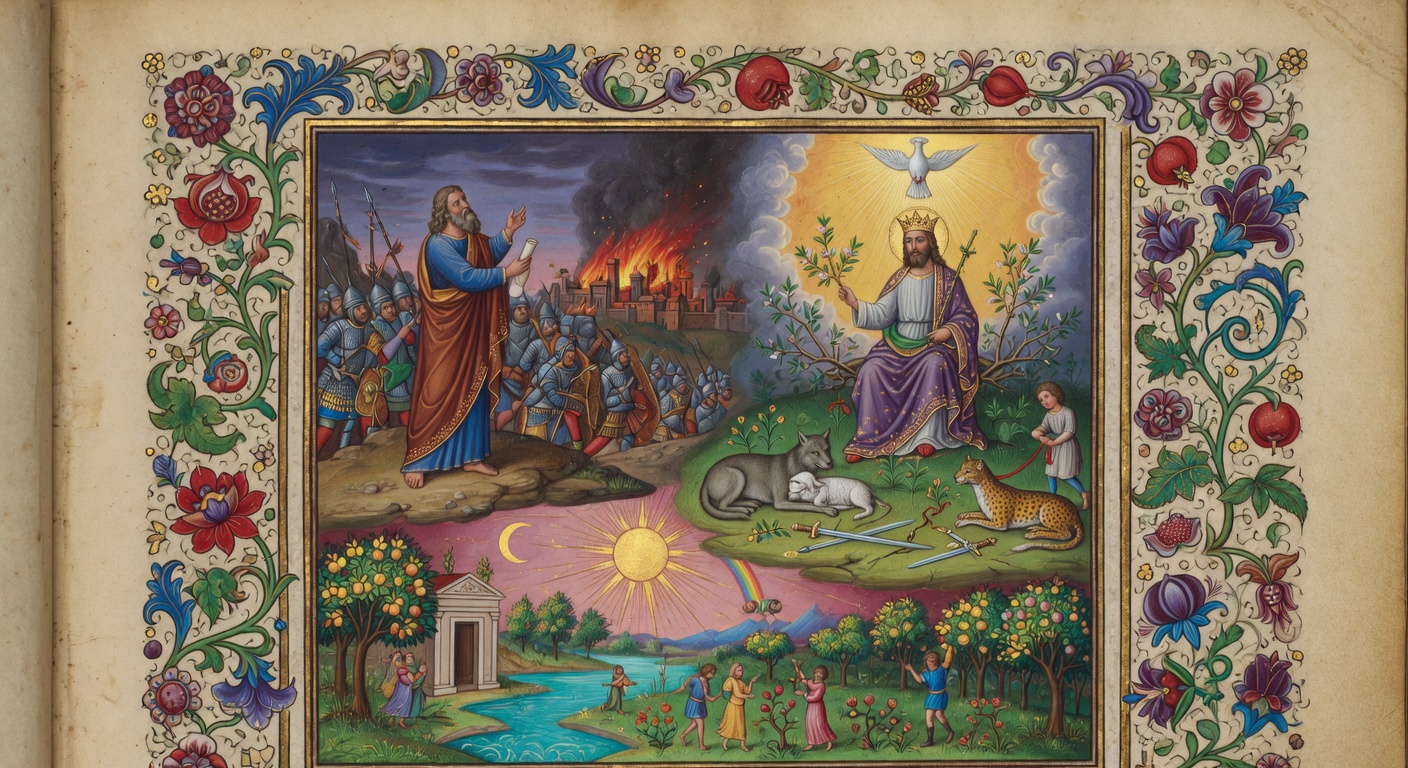
 1oreover the LORD said unto me, Take thee a great roll, and write in it with a man’s pen concerning Mahershalalhashbaz.
2 And I took unto me faithful witnesses to record, Uriah the priest, and Zechariah the son of Jeberechiah.
3 And I went unto the prophetess; and she conceived, and bare a son. Then said the LORD to me, Call his name Mahershalalhashbaz.
4 For before the child shall have knowledge to cry, My father, and my mother, the riches of Damascus and the spoil of Samaria shall be taken away before the king of Assyria.
5 The LORD spake also unto me again, saying,
6 Forasmuch as this people refuseth the waters of Shiloah that go softly, and rejoice in Rezin and Remaliah’s son;
7 Now therefore, behold, the Lord bringeth up upon them the waters of the river, strong and many, even the king of Assyria, and all his glory: and he shall come up over all his channels, and go over all his banks:
8 And he shall pass through Judah; he shall overflow and go over, he shall reach even to the neck; and the stretching out of his wings shall fill the breadth of thy land, O Immanuel.
9 Associate yourselves, O ye people, and ye shall be broken in pieces; and give ear, all ye of far countries: gird yourselves, and ye shall be broken in pieces; gird yourselves, and ye shall be broken in pieces.
10 Take counsel together, and it shall come to nought; speak the word, and it shall not stand: for God is with us.
11 For the LORD spake thus to me with a strong hand, and instructed me that I should not walk in the way of this people, saying,
12 Say ye not, A confederacy, to all them to whom this people shall say, A confederacy; neither fear ye their fear, nor be afraid.
13 Sanctify the LORD of hosts himself; and let him be your fear, and let him be your dread.
14 And he shall be for a sanctuary; but for a stone of stumbling and for a rock of offence to both the houses of Israel, for a gin and for a snare to the inhabitants of Jerusalem.
15 And many among them shall stumble, and fall, and be broken, and be snared, and be taken.
16 Bind up the testimony, seal the law among my disciples.
17 And I will wait upon the LORD, that hideth his face from the house of Jacob, and I will look for him.
18 Behold, I and the children whom the LORD hath given me are for signs and for wonders in Israel from the LORD of hosts, which dwelleth in mount Zion.
19 And when they shall say unto you, Seek unto them that have familiar spirits, and unto wizards that peep, and that mutter: should not a people seek unto their God? for the living to the dead?
20 To the law and to the testimony: if they speak not according to this word, it is because there is no light in them.
21 And they shall pass through it, hardly bestead and hungry: and it shall come to pass, that when they shall be hungry, they shall fret themselves, and curse their king and their God, and look upward.
22 And they shall look unto the earth; and behold trouble and darkness, dimness of anguish; and they shall be driven to darkness.
← → arrow keys to navigate chapters · spacebar to play/pause audio
Did You Know?
Isaiah 8:16's command to bind up the testimony and seal the law among disciples implies an intentional scribal community preserving oracles during national crisis, anticipating later Jewish textual traditions of guarded prophecy.
The rejection of Shiloah's gentle waters (v.6) functions as a theological critique of Judah's political reliance on human power rather than Zion's quiet divine provision, directly triggering the Euphrates flood metaphor for Assyrian invasion.
By naming his son Maher-shalal-hash-baz yet also presenting Immanuel (v.8,10) as the ultimate sign, Isaiah juxtaposes immediate historical judgment with an enduring divine presence that outlasts the Assyrian threat.
Verses 14-15's dual portrayal of Yahweh as both sanctuary and stumbling stone for the houses of Israel and Judah supplies the earliest biblical foundation for the 'stone of offense' motif later applied to Christ in Romans 9 and 1 Peter 2.
The chapter's closing condemnation of necromancy (v.19) contrasts the living God's word with futile consultation of the dead, framing apostasy as a reversal where the living seek guidance from the deceased rather than the law and testimony.
The Dead Sea Scroll 1QIsa^a, copied around 125 BC, contains the entire book of Isaiah with only minor variants from the later Masoretic Text, providing the oldest complete witness to any biblical book and demonstrating extraordinary textual stability.
Hezekiah dispatched couriers throughout the former northern kingdom to summon survivors to an unprecedented Passover in Jerusalem, resulting in such a large attendance that the Levites had to assist with sacrifices because many participants had not properly consecrated themselves.
Jesus appeared to over five hundred people at one time after his resurrection, a mass sighting noted by Paul in 1 Corinthians 15 that provides early corroboration beyond the Gospel accounts.
Jerusalem is mentioned over 800 times in the Bible. More than any other city.
The city fell to Persia in 539 BC exactly as Daniel prophesied. Conquered without a battle.
In this way, Assyria plays a pivotal role in the unfolding redemptive narrative, illustrating both the severity of divine judgment and the breadth of divine compassion.