Jonah 4 KJV
Jonah's Anger and God's Mercy
Jonah's Anger and God's Mercy
Jonah's selective quotation of Exodus 34:6-7 in verse 2 deliberately drops the clause about forgiving iniquity, exposing his theological distortion to resist Gentile inclusion in divine mercy.
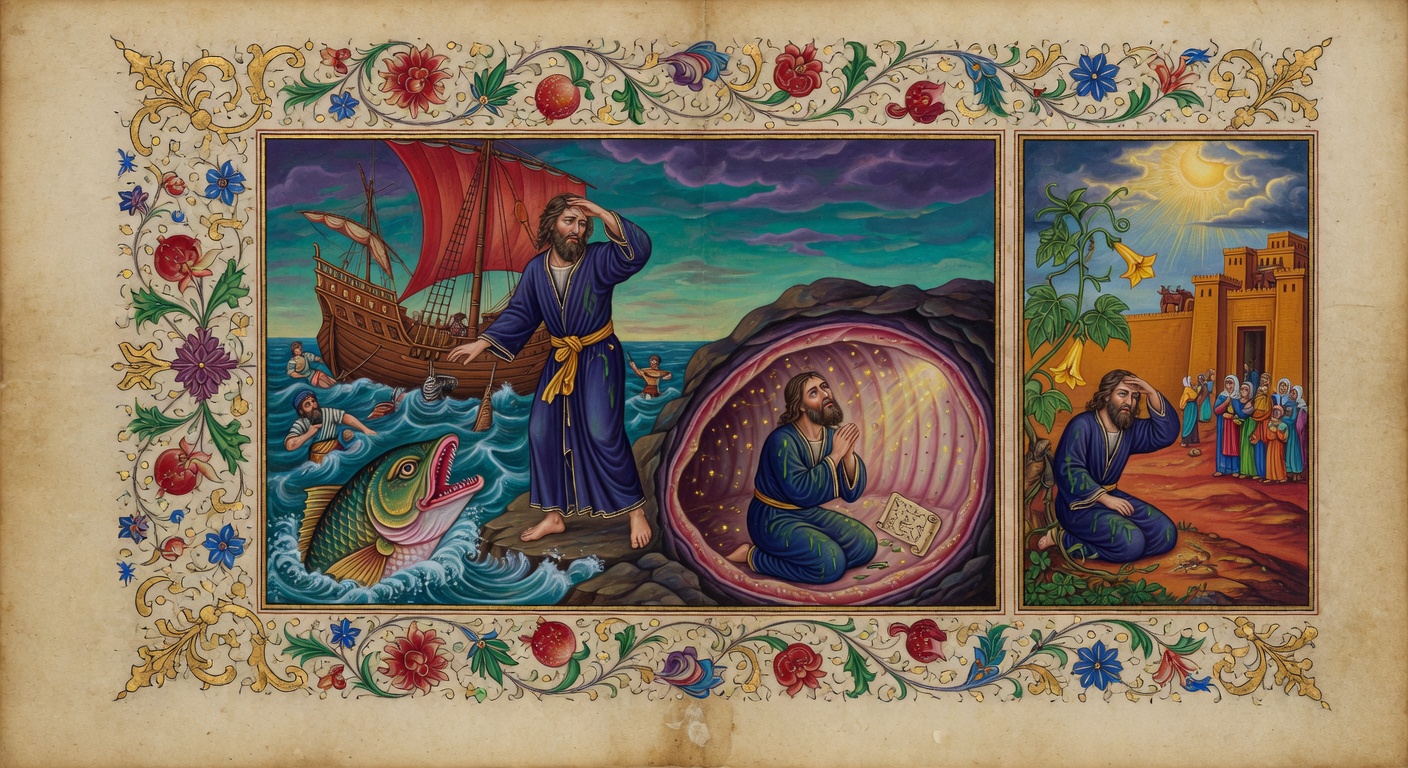
 1ut it displeased Jonah exceedingly, and he was very angry.
2 And he prayed unto the LORD, and said, I pray thee, O LORD, was not this my saying, when I was yet in my country? Therefore I fled before unto Tarshish: for I knew that thou art a gracious God, and merciful, slow to anger, and of great kindness, and repentest thee of the evil.
3 Therefore now, O LORD, take, I beseech thee, my life from me; for it is better for me to die than to live.
4 Then said the LORD, Doest thou well to be angry?
5 So Jonah went out of the city, and sat on the east side of the city, and there made him a booth, and sat under it in the shadow, till he might see what would become of the city.
6 And the LORD God prepared a gourd, and made it to come up over Jonah, that it might be a shadow over his head, to deliver him from his grief. So Jonah was exceeding glad of the gourd.
7 But God prepared a worm when the morning rose the next day, and it smote the gourd that it withered.
8 And it came to pass, when the sun did arise, that God prepared a vehement east wind; and the sun beat upon the head of Jonah, that he fainted, and wished in himself to die, and said, It is better for me to die than to live.
9 And God said to Jonah, Doest thou well to be angry for the gourd? And he said, I do well to be angry, even unto death.
10 Then said the LORD, Thou hast had pity on the gourd, for the which thou hast not laboured, neither madest it grow; which came up in a night, and perished in a night:
11 And should not I spare Nineveh, that great city, wherein are more than sixscore thousand persons that cannot discern between their right hand and their left hand; and also much cattle?
← → arrow keys to navigate chapters · spacebar to play/pause audio
Did You Know?
Jonah's selective quotation of Exodus 34:6-7 in verse 2 deliberately drops the clause about forgiving iniquity, exposing his theological distortion to resist Gentile inclusion in divine mercy.
The double death wish in verses 3 and 8 parallels Elijah's despair in 1 Kings 19 after his victory over Baal, linking both prophets' crises to encounters with pagan powers and divine compassion overriding judgment.
God's progression of object lessons. The plant, worm, and scorching wind. Forms a miniature creation-uncreation sequence that mirrors the flood narrative, teaching Jonah about sovereignty over both nature and nations.
The phrase 'cannot discern between their right hand and their left' in verse 11 points specifically to infants and toddlers, framing Nineveh's repentance as including the vulnerable and subverting Assyrian imperial propaganda of unassailable strength.
The chapter's abrupt close with an unanswered divine question leaves the reader implicated in Jonah's dilemma, prefiguring later biblical tensions over Israel's mission to the Gentiles as seen in Acts and Romans.
Jonah's psalm inside the fish (Jonah 2) weaves together verbatim phrases from Psalms 3, 5, 18, 31, 42, 69, 120, and 142, indicating the author crafted it as a pastiche of existing temple liturgy rather than an original composition.
The city walls were 7.5 miles in circumference with 15 gates.
Scripture also links Tarshish to King Solomon's trading fleets, which brought wealth to Israel, and to prophetic visions of distant nations acknowledging God's rule.
In the book of Acts, the apostle Peter traveled to Joppa where he miraculously raised a disciple named Dorcas, also known as Tabitha, from the dead after she had fallen ill and passed away.
Commentary & Study Notes Jamieson-Fausset-Brown (1871) · Public Domain angry — literally, "hot," probably, with grief or vexation, rather than anger [FAIRBAIRN]. How sad the contrast between God's feeling on the repentance of Nineveh towards Him, and…
Classic verse-by-verse commentary on Jonah 4 from Jamieson, Fausset & Brown (1871). Covers: Jonah frets at God's mercy to nineveh: is reproved by the type of a gourd.
- 1
- angry — literally, "hot," probably, with grief or vexation, rather than anger [FAIRBAIRN]. How sad the contrast between God's feeling on the repentance of Nineveh towards Him, and Jonah's feeling on the repentance of God towards Nineveh. Strange in one who was himself a monument of mercy on his repentance! We all, like him, need the lesson taught in the parable of the unforgiving, though forgiven, debtor (Mt 18:23-35). Jonah was grieved because Nineveh's preservation, after his denunciation, made him seem a false prophet [CALVIN]. But it would make Jonah a demon, not a man, to have preferred the destruction of six hundred thousand men rather than that his prophecy should be set aside through God's mercy triumphing over judgment. And God in that case would have severely chastised, whereas he only expostulates mildly with him, and by a mode of dealing, at once gentle and condescending, tries to show him his error. Moreover, Jonah himself, in apologizing for his vexation, does not mention the failure of his prediction as the cause: but solely the thought of God's slowness to anger. This was what led him to flee to Tarshish at his first commission; not the likelihood then of his prediction being falsified; for in fact his commission then was not to foretell Nineveh's downfall, but simply to "cry against" Nineveh's "wickedness" as having "come up before God." Jonah could hardly have been so vexed for the letter of his prediction failing, when the end of his commission had virtually been gained in leading Nineveh to repentance. This then cannot have been regarded by Jonah as the ultimate end of his commission. If Nineveh had been the prominent object with him, he would have rejoiced at the result of his mission. But Israel was the prominent aim of Jonah, as a prophet of the elect people. Probably then he regarded the destruction of Nineveh as fitted to be an example of God's judgment at last suspending His long forbearance so as to startle Israel from its desperate degeneracy, heightened by its new prosperity under Jeroboam II at that very time, in a way that all other means had failed to do. Jonah, despairing of anything effectual being done for God in Israel, unless there were first given a striking example of severity, thought when he proclaimed the downfall of Nineveh in forty days, that now at last God is about to give such an example; so when this means of awakening Israel was set aside by God's mercy on Nineveh's repentance, he was bitterly disappointed, not from pride or mercilessness, but from hopelessness as to anything being possible for the reformation of Israel, now that his cherished hope is baffled. But GOD'S plan was to teach Israel, by the example of Nineveh, how inexcusable is their own impenitence, and how inevitable their ruin if they persevere. Repenting Nineveh has proved herself more worthy of God's favor than apostate Israel; the children of the covenant have not only fallen down to, but actually below, the level of a heathen people; Israel, therefore, must go down, and the heathen rise above her. Jonah did not know the important lessons of hope to the penitent, and condemnation to those amidst outward privileges impenitent, which Nineveh's preservation on repentance was to have for aftertimes, and to all ages. He could not foresee that Messiah Himself was thus to apply that history. A lesson to us that if we could in any particular alter the plan of Providence, it would not be for the better, but for the worse [FAIRBAIRN].
- 2
- my saying — my thought, or feeling. fled before — I anticipated by fleeing, the disappointment of my design through Thy long-suffering mercy. gracious... and merciful, &c. — Jonah here has before his mind Ex 34:6; as Joel (Joe 2:13) in his turn quotes from Jonah.
Read all 11 notes on Jonah 4 →