Lamentations 5 KJV
A Prayer for Restoration
A Prayer for Restoration
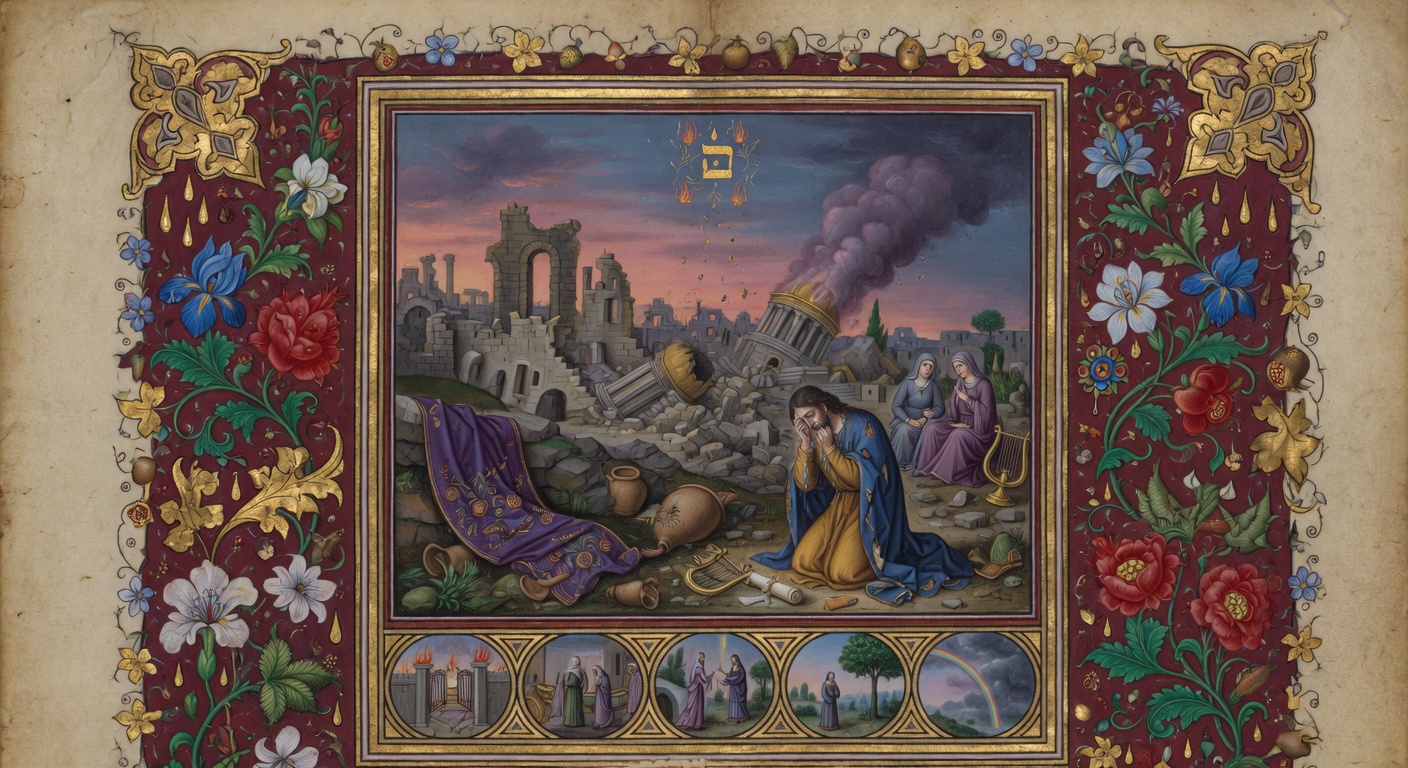
The chapter's closing verses deliberately echo the language of covenant renewal in Deuteronomy 30 while withholding any divine response, leaving the community in a state of suspended repentance that underscores the unresolved nature of divine wrath.
 1emember, O LORD, what is come upon us: consider, and behold our reproach.
2 Our inheritance is turned to strangers, our houses to aliens.
3 We are orphans and fatherless, our mothers are as widows.
4 We have drunken our water for money; our wood is sold unto us.
5 Our necks are under persecution: we labour, and have no rest.
6 We have given the hand to the Egyptians, and to the Assyrians, to be satisfied with bread.
7 Our fathers have sinned, and are not; and we have borne their iniquities.
8 Servants have ruled over us: there is none that doth deliver us out of their hand.
9 We gat our bread with the peril of our lives because of the sword of the wilderness.
10 Our skin was black like an oven because of the terrible famine.
11 They ravished the women in Zion, and the maids in the cities of Judah.
12 Princes are hanged up by their hand: the faces of elders were not honoured.
13 They took the young men to grind, and the children fell under the wood.
14 The elders have ceased from the gate, the young men from their musick.
15 The joy of our heart is ceased; our dance is turned into mourning.
16 The crown is fallen from our head: woe unto us, that we have sinned!
17 For this our heart is faint; for these things our eyes are dim.
18 Because of the mountain of Zion, which is desolate, the foxes walk upon it.
19 Thou, O LORD, remainest for ever; thy throne from generation to generation.
20 Wherefore dost thou forget us for ever, and forsake us so long time?
21 Turn thou us unto thee, O LORD, and we shall be turned; renew our days as of old.
22 But thou hast utterly rejected us; thou art very wroth against us.
← → arrow keys to navigate chapters · spacebar to play/pause audio
Did You Know?
The chapter's closing verses deliberately echo the language of covenant renewal in Deuteronomy 30 while withholding any divine response, leaving the community in a state of suspended repentance that underscores the unresolved nature of divine wrath.
Verse 7's admission that 'our fathers have sinned, and are not; and we have borne their iniquities' introduces a rare collective acknowledgment of intergenerational guilt that contrasts with Ezekiel's contemporary rejection of such inherited punishment.
The invocation of God's eternal enthronement in verse 19 draws on ancient Near Eastern royal court imagery to assert divine sovereignty even over a destroyed temple, functioning as a theological counter to Babylonian claims of Marduk's victory.
Specific social reversals, such as princes being hung up by their hands and elders sitting in the dust, mirror documented Neo-Babylonian punitive practices against defeated royalty and mirror the covenant curses of Deuteronomy 28 in precise detail.
Unlike the alphabetic acrostics of chapters 1-4, the absence of any letter sequence here, despite retaining exactly 22 verses, enacts a formal breakdown that theologically mirrors the collapse of ordered worship and kingship after 586 BCE.
Jeremiah was forbidden by God from marrying or having children, a living sign that the coming Babylonian invasion would bring death and exile to entire families across Judah.
The city has been destroyed at least twice, besieged 23 times, and captured 44 times.
The city fell to Persia in 539 BC exactly as Daniel prophesied. Conquered without a battle.