Leviticus 10 KJV
The Death of Nadab and Abihu
The Death of Nadab and Abihu
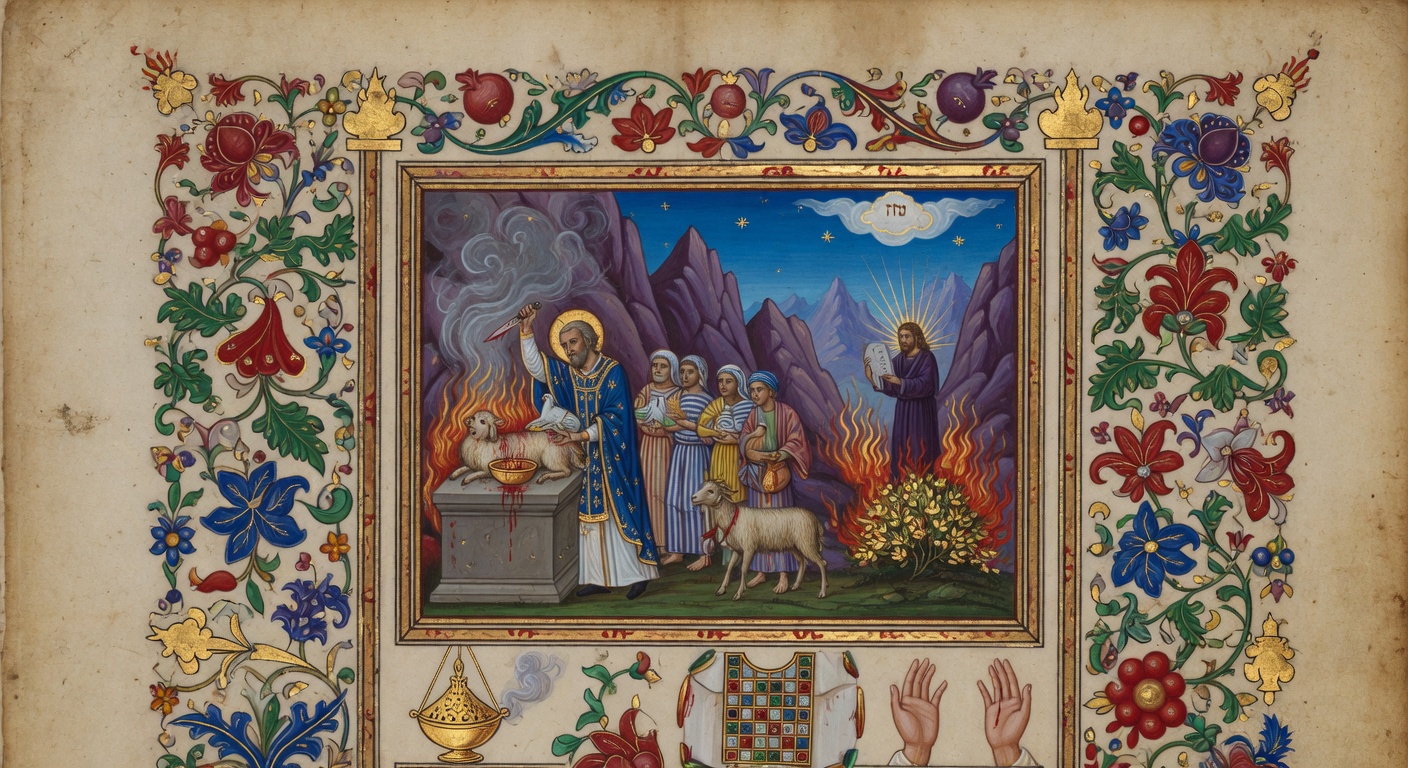
The divine fire that consumes Nadab and Abihu in verse 2 is the same fire that had just accepted Aaron's inaugural sacrifice in 9:24, transforming an instrument of consecration into one of immediate judgment and underscoring the volatility of unmediated holiness at the tabernacle's threshold.
 1nd Nadab and Abihu, the sons of Aaron, took either of them his censer, and put fire therein, and put incense thereon, and offered strange fire before the LORD, which he commanded them not.
2 And there went out fire from the LORD, and devoured them, and they died before the LORD.
3 Then Moses said unto Aaron, This is it that the LORD spake, saying, I will be sanctified in them that come nigh me, and before all the people I will be glorified. And Aaron held his peace.
4 And Moses called Mishael and Elzaphan, the sons of Uzziel the uncle of Aaron, and said unto them, Come near, carry your brethren from before the sanctuary out of the camp.
5 So they went near, and carried them in their coats out of the camp; as Moses had said.
6 And Moses said unto Aaron, and unto Eleazar and unto Ithamar, his sons, Uncover not your heads, neither rend your clothes; lest ye die, and lest wrath come upon all the people: but let your brethren, the whole house of Israel, bewail the burning which the LORD hath kindled.
7 And ye shall not go out from the door of the tabernacle of the congregation, lest ye die: for the anointing oil of the LORD is upon you. And they did according to the word of Moses.
8 And the LORD spake unto Aaron, saying,
9 Do not drink wine nor strong drink, thou, nor thy sons with thee, when ye go into the tabernacle of the congregation, lest ye die: it shall be a statute for ever throughout your generations:
10 And that ye may put difference between holy and unholy, and between unclean and clean;
11 And that ye may teach the children of Israel all the statutes which the LORD hath spoken unto them by the hand of Moses.
12 And Moses spake unto Aaron, and unto Eleazar and unto Ithamar, his sons that were left, Take the meat offering that remaineth of the offerings of the LORD made by fire, and eat it without leaven beside the altar: for it is most holy:
13 And ye shall eat it in the holy place, because it is thy due, and thy sons’ due, of the sacrifices of the LORD made by fire: for so I am commanded.
14 And the wave breast and heave shoulder shall ye eat in a clean place; thou, and thy sons, and thy daughters with thee: for they be thy due, and thy sons’ due, which are given out of the sacrifices of peace offerings of the children of Israel.
15 The heave shoulder and the wave breast shall they bring with the offerings made by fire of the fat, to wave it for a wave offering before the LORD; and it shall be thine, and thy sons’ with thee, by a statute for ever; as the LORD hath commanded.
16 And Moses diligently sought the goat of the sin offering, and, behold, it was burnt: and he was angry with Eleazar and Ithamar, the sons of Aaron which were left alive, saying,
17 Wherefore have ye not eaten the sin offering in the holy place, seeing it is most holy, and God hath given it you to bear the iniquity of the congregation, to make atonement for them before the LORD?
18 Behold, the blood of it was not brought in within the holy place: ye should indeed have eaten it in the holy place, as I commanded.
19 And Aaron said unto Moses, Behold, this day have they offered their sin offering and their burnt offering before the LORD; and such things have befallen me: and if I had eaten the sin offering to day, should it have been accepted in the sight of the LORD?
20 And when Moses heard that, he was content.
← → arrow keys to navigate chapters · spacebar to play/pause audio
Did You Know?
The divine fire that consumes Nadab and Abihu in verse 2 is the same fire that had just accepted Aaron's inaugural sacrifice in 9:24, transforming an instrument of consecration into one of immediate judgment and underscoring the volatility of unmediated holiness at the tabernacle's threshold.
Aaron's enforced silence in verse 3 echoes the theophanic muting of Ezekiel and others, functioning less as personal grief suppression and more as a public acknowledgment that priestly intercession yields to Yahweh's self-vindication when his 'sanctuary' is profaned.
The sudden prohibition on wine or strong drink for officiating priests in verse 9, placed immediately after the deaths, implies a possible link to impaired discernment during sacred service, aligning with ancient Near Eastern priestly codes that regulated intoxication to preserve ritual precision.
Moses' rebuke of Eleazar and Ithamar in verses 16-18 for failing to eat the sin offering's flesh reveals that even after the brothers' fiery deaths, the remaining priests are still held to exacting standards of consumption, demonstrating that divine judgment does not suspend but intensifies ongoing cultic accountability.
The detail that Nadab and Abihu's bodies were carried out still wearing their tunics (verse 5) indicates the fire targeted only the men themselves, preserving the consecrated garments and thereby affirming that the priesthood's vestments retained sanctity even as their wearers were removed from the camp.
Nadab joined Moses, Aaron, and seventy elders in ascending Mount Sinai to eat and drink in God's presence after beholding a vision of the divine, an event recorded in Exodus 24 that underscores his elite status before his later transgression.
Abihu joined his brother Nadab in ascending Mount Sinai with Moses, Aaron, and seventy elders, where they ate and drank in the presence of God without harm before their later fatal mistake.
Although the Bible explains Moses' name through a Hebrew etymology as "drawn out" of the water, it closely matches the Egyptian term for "son" found in royal names like Thutmose, reflecting his adoption into Pharaoh's household during the New Kingdom period.
Aaron's budding rod was not only a sign during Korah's rebellion but was later stored in the Ark of the Covenant alongside the stone tablets and a jar of manna, serving as an enduring witness to God's choice of the Aaronic priesthood.
The exact location of Mount Sinai is still debated among scholars.
Commentary & Study Notes Jamieson-Fausset-Brown (1871) · Public Domain the sons of Aaron, &c. — If this incident occurred at the solemn period of the consecrating and dedicating the altar, these young men assumed an office which had been committed…
Classic verse-by-verse commentary on Leviticus 10 from Jamieson, Fausset & Brown (1871). Covers: Nadab and abihu burnt.
- 1
- the sons of Aaron, &c. — If this incident occurred at the solemn period of the consecrating and dedicating the altar, these young men assumed an office which had been committed to Moses; or if it were some time after, it was an encroachment on duties which devolved on their father alone as the high priest. But the offense was of a far more aggravated nature than such a mere informality would imply. It consisted not only in their venturing unauthorized to perform the incense service — the highest and most solemn of the priestly offices — not only in their engaging together in a work which was the duty only of one, but in their presuming to intrude into the holy of holies, to which access was denied to all but the high priest alone. In this respect, "they offered strange fire before the Lord"; they were guilty of a presumptuous and unwarranted intrusion into a sacred office which did not belong to them. But their offense was more aggravated still; for instead of taking the fire which was put into their censers from the brazen altar, they seem to have been content with common fire and thus perpetrated an act which, considering the descent of the miraculous fire they had so recently witnessed and the solemn obligation under which they were laid to make use of that which was specially appropriated to the service of the altars, they betrayed a carelessness, an irreverence, a want of faith, most surprising and lamentable. A precedent of such evil tendency was dangerous, and it was imperatively necessary, therefore, as well for the priests themselves as for the sacred things, that a marked expression of the divine displeasure should be given for doing that which "God commanded them not."
- 2
- there went out fire from the Lord, and devoured them — rather, "killed them"; for it appears (Le 10:5) that neither their bodies nor their robes were consumed. The expression, "from the Lord," indicates that this fire issued from the most holy place. In the destruction of these two young priests by the infliction of an awful judgment, the wisdom of God observed the same course, in repressing the first instance of contempt for sacred things, as he did at the commencement of the Christian dispensation (Ac 5:1-11).
Read all 8 notes on Leviticus 10 →