Leviticus 24 KJV
The Lampstand and Bread
The Lampstand and Bread
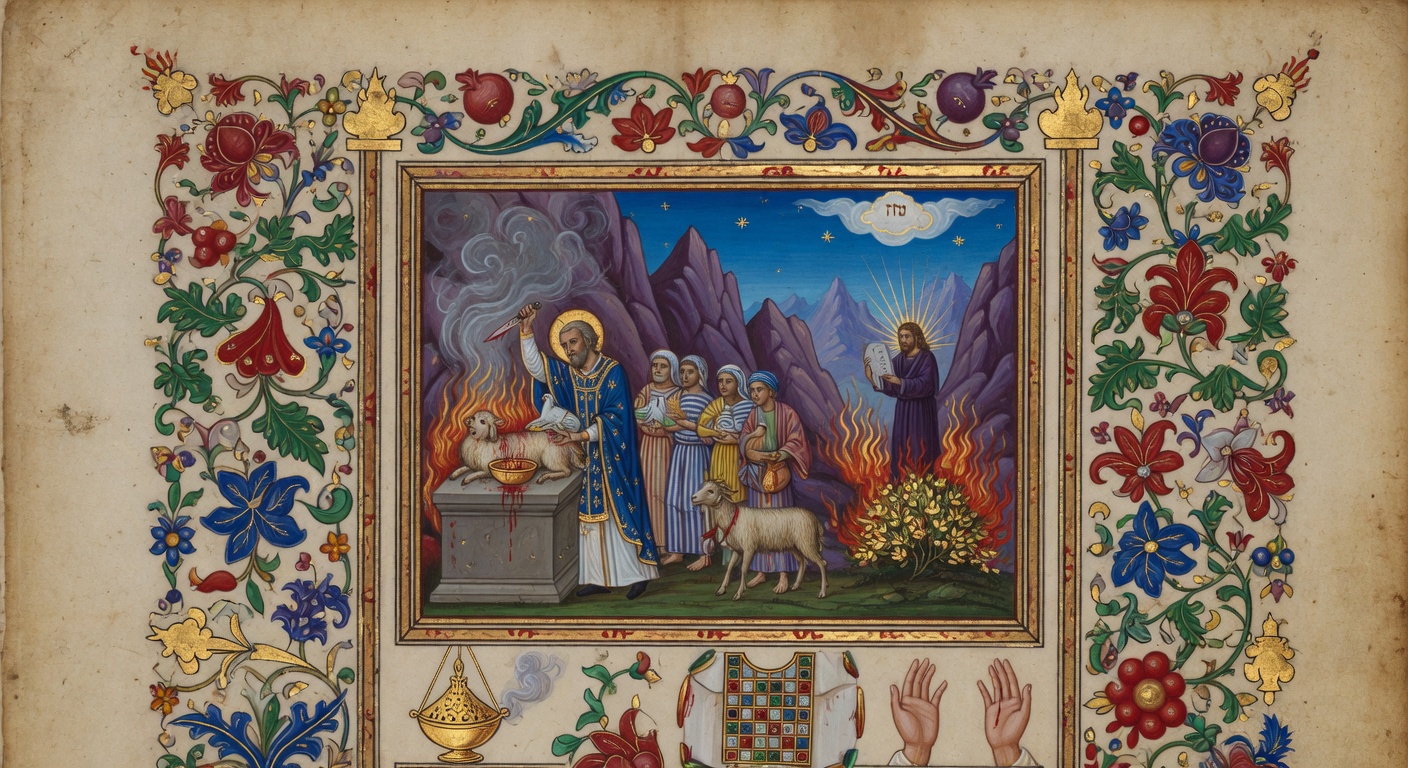
The placement of the blasphemy narrative immediately after the lampstand and shewbread instructions links the perpetual light and bread. Symbols of God's sustaining presence. With the lethal consequences of profaning the divine Name, framing blasphemy as an assault on the sanctuary's ongoing witness.
 1nd the LORD spake unto Moses, saying,
2 Command the children of Israel, that they bring unto thee pure oil olive beaten for the light, to cause the lamps to burn continually.
3 Without the vail of the testimony, in the tabernacle of the congregation, shall Aaron order it from the evening unto the morning before the LORD continually: it shall be a statute for ever in your generations.
4 He shall order the lamps upon the pure candlestick before the LORD continually.
5 And thou shalt take fine flour, and bake twelve cakes thereof: two tenth deals shall be in one cake.
6 And thou shalt set them in two rows, six on a row, upon the pure table before the LORD.
7 And thou shalt put pure frankincense upon each row, that it may be on the bread for a memorial, even an offering made by fire unto the LORD.
8 Every sabbath he shall set it in order before the LORD continually, being taken from the children of Israel by an everlasting covenant.
9 And it shall be Aaron’s and his sons’; and they shall eat it in the holy place: for it is most holy unto him of the offerings of the LORD made by fire by a perpetual statute.
10 And the son of an Israelitish woman, whose father was an Egyptian, went out among the children of Israel: and this son of the Israelitish woman and a man of Israel strove together in the camp;
11 And the Israelitish woman’s son blasphemed the name of the Lord, and cursed. And they brought him unto Moses: (and his mother’s name was Shelomith, the daughter of Dibri, of the tribe of Dan:)
12 And they put him in ward, that the mind of the LORD might be shewed them.
13 And the LORD spake unto Moses, saying,
14 Bring forth him that hath cursed without the camp; and let all that heard him lay their hands upon his head, and let all the congregation stone him.
15 And thou shalt speak unto the children of Israel, saying, Whosoever curseth his God shall bear his sin.
16 And he that blasphemeth the name of the LORD, he shall surely be put to death, and all the congregation shall certainly stone him: as well the stranger, as he that is born in the land, when he blasphemeth the name of the Lord, shall be put to death.
17 And he that killeth any man shall surely be put to death.
18 And he that killeth a beast shall make it good; beast for beast.
19 And if a man cause a blemish in his neighbour; as he hath done, so shall it be done to him;
20 Breach for breach, eye for eye, tooth for tooth: as he hath caused a blemish in a man, so shall it be done to him again.
21 And he that killeth a beast, he shall restore it: and he that killeth a man, he shall be put to death.
22 Ye shall have one manner of law, as well for the stranger, as for one of your own country: for I am the LORD your God.
23 And Moses spake to the children of Israel, that they should bring forth him that had cursed out of the camp, and stone him with stones. And the children of Israel did as the LORD commanded Moses.
← → arrow keys to navigate chapters · spacebar to play/pause audio
Did You Know?
The placement of the blasphemy narrative immediately after the lampstand and shewbread instructions links the perpetual light and bread. Symbols of God's sustaining presence. With the lethal consequences of profaning the divine Name, framing blasphemy as an assault on the sanctuary's ongoing witness.
The shewbread, though twelve loaves corresponding to the tribes, is eaten solely by priests on the Sabbath, creating a weekly priestly participation in what was originally a wilderness provision of manna and thereby transforming a miraculous gift into a fixed cultic rhythm.
The single named woman in the chapter, Shelomith daughter of Dibri of Dan, is identified through matrilineal descent in a text otherwise dominated by patrilineal genealogies, underscoring how Israelite identity could be transmitted through the mother when the father was a foreigner.
Verses 15-16 distinguish between merely cursing 'his God' (bearing one's own sin) and explicitly blaspheming 'the Name' (requiring communal stoning), revealing an early theological gradation in the sanctity of divine titles that later rabbinic literature would expand.
The lex talionis statutes are explicitly applied to both the native-born and the sojourner (v. 22), embedding a principle of legal equality within the same chapter that recounts an execution carried out 'outside the camp,' thereby connecting retributive justice to the boundaries of sacred space.
Moses was barred from entering Canaan for striking the rock at Meribah instead of speaking to it as instructed, a failure that ancient interpreters linked to broader themes of leadership accountability and the limits of Mosaic authority.
Aaron and his sister Miriam once challenged Moses' unique authority, resulting in Miriam's temporary leprosy, while Aaron escaped similar punishment possibly due to his future role in the priesthood, revealing complex family dynamics in the wilderness period.
Eleazar's burial on a hill in Ephraim belonging to his son Phinehas marks one of the few recorded priestly graves from the conquest era, highlighting the enduring high priestly dynasty through the line of Phinehas.
Moses spent 40 days on Mount Sinai. Twice.
Commentary & Study Notes Jamieson-Fausset-Brown (1871) · Public Domain Command the children of Israel — This is the repetition of a law previously given (Ex 27:20, 21). pure oil olive beaten — or cold-drawn, which is always of great purity.
Classic verse-by-verse commentary on Leviticus 24 from Jamieson, Fausset & Brown (1871). Covers: Oil for the lamps.
- 2
- Command the children of Israel — This is the repetition of a law previously given (Ex 27:20, 21). pure oil olive beaten — or cold-drawn, which is always of great purity.
- 3,4
- Aaron shall order it from the evening unto the morning — The daily presence of the priests was necessary to superintend the cleaning and trimming.
Read all 10 notes on Leviticus 24 →