Malachi 4 KJV
The Day of the Lord
The Day of the Lord
Malachi 4 serves as the canonical conclusion to the Nevi'im in the Hebrew Bible, positioning its call to remember the Torah of Moses as the final prophetic exhortation before the Ketuvim.
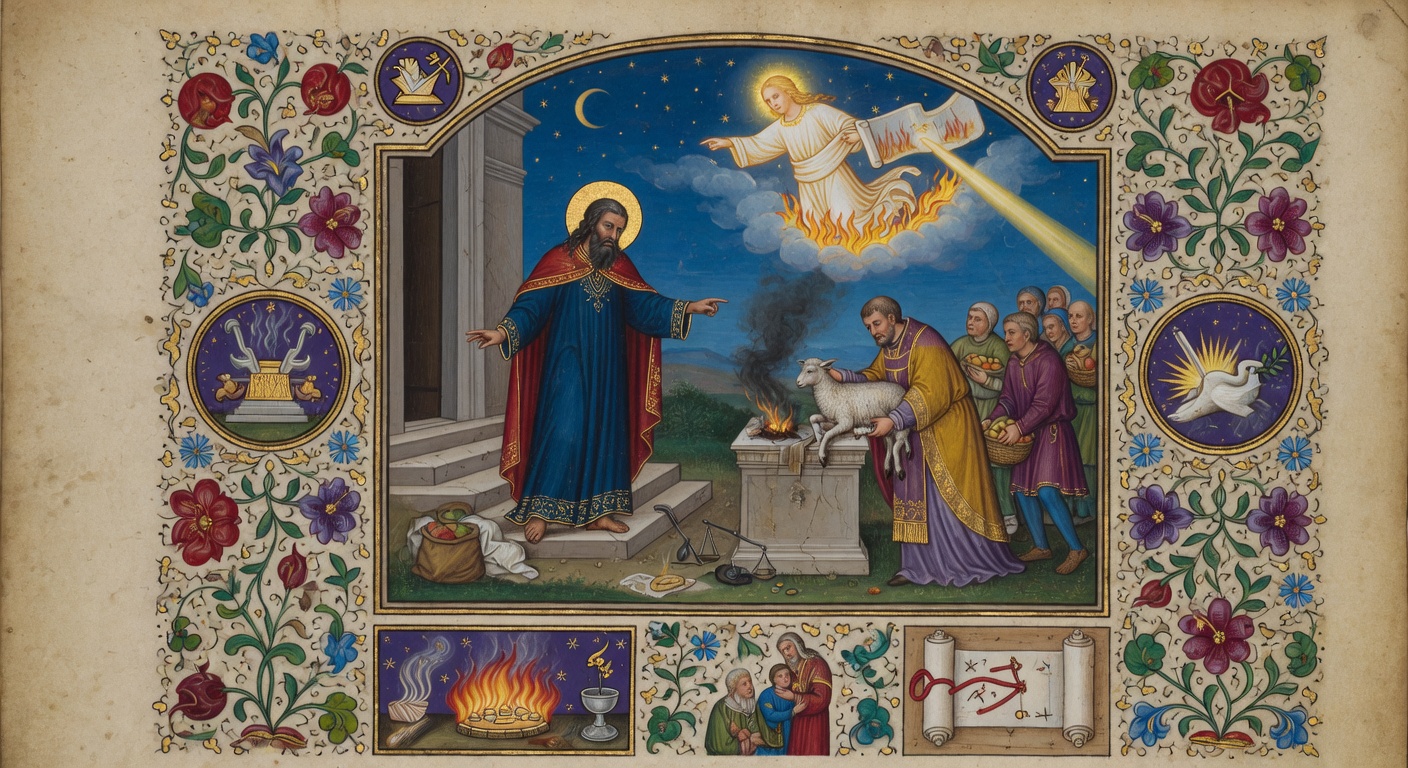
 1or, behold, the day cometh, that shall burn as an oven; and all the proud, yea, and all that do wickedly, shall be stubble: and the day that cometh shall burn them up, saith the LORD of hosts, that it shall leave them neither root nor branch.
2 But unto you that fear my name shall the Sun of righteousness arise with healing in his wings; and ye shall go forth, and grow up as calves of the stall.
3 And ye shall tread down the wicked; for they shall be ashes under the soles of your feet in the day that I shall do this, saith the LORD of hosts.
4 Remember ye the law of Moses my servant, which I commanded unto him in Horeb for all Israel, with the statutes and judgments.
5 Behold, I will send you Elijah the prophet before the coming of the great and dreadful day of the LORD:
6 And he shall turn the heart of the fathers to the children, and the heart of the children to their fathers, lest I come and smite the earth with a curse.
← → arrow keys to navigate chapters · spacebar to play/pause audio
Did You Know?
Malachi 4 serves as the canonical conclusion to the Nevi'im in the Hebrew Bible, positioning its call to remember the Torah of Moses as the final prophetic exhortation before the Ketuvim.
The unique phrase "sun of righteousness" with healing in its wings draws on solar imagery from ancient Near Eastern religions but applies it to YHWH's eschatological justice.
Verses 5-6 provide the scriptural basis for the Jewish expectation of Elijah's return, which the New Testament identifies with John the Baptist in the Gospels.
The chapter's division differs in the Masoretic Text, where its content forms the concluding verses of chapter 3, highlighting editorial differences between Christian and Jewish traditions.
By juxtaposing the fiery judgment on the wicked with the promise of restoration through Elijah, it underscores the theological tension between divine wrath and covenantal reconciliation at the close of the Old Testament.
The prophet condemns the practice of men divorcing their Israelite wives to marry foreign women, linking this social issue directly to the covenant unfaithfulness that delayed God's blessings.
As a priest's son from the division of Abijah, John would have been eligible for temple service in Jerusalem, yet he chose a prophetic ministry in the Judean desert, echoing the lifestyle of Old Testament figures like Elijah (Luke 1:5).
Jerusalem is mentioned over 800 times in the Bible. More than any other city.
Edom was the nation descended from Esau, the brother of Jacob, and was located southeast of the Dead Sea in the rugged hill country of Seir.
Commentary & Study Notes Jamieson-Fausset-Brown (1871) · Public Domain the day cometh... burn — (Mal 3:2; 2Pe 3:7). Primarily is meant the judgment coming on Jerusalem; but as this will not exhaust the meaning, without supposing what is inadmissible i…
Classic verse-by-verse commentary on Malachi 4 from Jamieson, Fausset & Brown (1871). Covers: God's coming judgment: triumph of the godly: return to the law the best preparation for Jehovah's coming: elijah's preparatory mission of reformation.
- 1
- the day cometh... burn — (Mal 3:2; 2Pe 3:7). Primarily is meant the judgment coming on Jerusalem; but as this will not exhaust the meaning, without supposing what is inadmissible in Scripture — exaggeration — the final and full accomplishment, of which the former was the earnest, is the day of general judgment. This principle of interpretation is not double, but successive fulfilment. The language is abrupt, "Behold, the day cometh! It burns like a furnace." The abruptness imparts terrible reality to the picture, as if it suddenly burst on the prophet's view. all the proud — in opposition to the cavil above (Mal 3:15), "now we call the proud (haughty despisers of God) happy." stubble — (Ob 18; Mt 3:12). As Canaan, the inheritance of the Israelites, was prepared for their possession by purging out the heathen, so judgment on the apostates shall usher in the entrance of the saints upon the Lord's inheritance, of which Canaan is the type — not heaven, but earth to its utmost bounds (Ps 2:8) purged of all things that offend (Mt 13:41), which are to be "gathered out of His kingdom," the scene of the judgment being that also of the kingdom. The present dispensation is a spiritual kingdom, parenthetical between the Jews' literal kingdom and its antitype, the coming literal kingdom of the Lord Jesus. neither root nor branch — proverbial for utter destruction (Am 2:9).
- 2
- The effect of the judgment on the righteous, as contrasted with its effect on the wicked (Mal 4:1). To the wicked it shall be as an oven that consumes the stubble (Mt 6:30); to the righteous it shall be the advent of the gladdening Sun, not of condemnation, but "of righteousness"; not destroying, but "healing" (Jer 23:6). you that fear my name — The same as those in Mal 3:16, who confessed God amidst abounding blasphemy (Isa 66:5; Mt 10:32). The spiritual blessings brought by Him are summed up in the two, "righteousness" (1Co 1:30) and spiritual "healing" (Ps 103:3; Isa 57:19). Those who walk in the dark now may take comfort in the certainty that they shall walk hereafter in eternal light (Isa 50:10). in his wings — implying the winged swiftness with which He shall appear (compare "suddenly," Mal 3:1) for the relief of His people. The beams of the Sun are His "wings." Compare "wings of the morning," Ps 139:9. The "Sun" gladdening the righteous is suggested by the previous "day" of terror consuming the wicked. Compare as to Christ, 2Sa 23:4; Ps 84:11; Lu 1:78; Joh 1:9; 8:12; Eph 5:14; and in His second coming, 2Pe 1:19. The Church is the moon reflecting His light (Re 12:1). The righteous shall by His righteousness "shine as the Sun in the kingdom of the Father" (Mt 13:43). ye shall go forth — from the straits in which you were, as it were, held captive. An earnest of this was given in the escape of the Christians to Pella before the destruction of Jerusalem. grow up — rather, "leap" as frisking calves [CALVIN]; literally, "spread," "take a wide range." as calves of the stall — which when set free from the stall disport with joy (Ac 8:8; 13:52; 20:24; Ro 14:17; Ga 5:22; Php 1:4; 1Pe 1:8). Especially the godly shall rejoice at their final deliverance at Christ's second coming (Isa 61:10).
Read all 6 notes on Malachi 4 →