Nehemiah 2 KJV
Nehemiah Inspects the Walls
Nehemiah Inspects the Walls
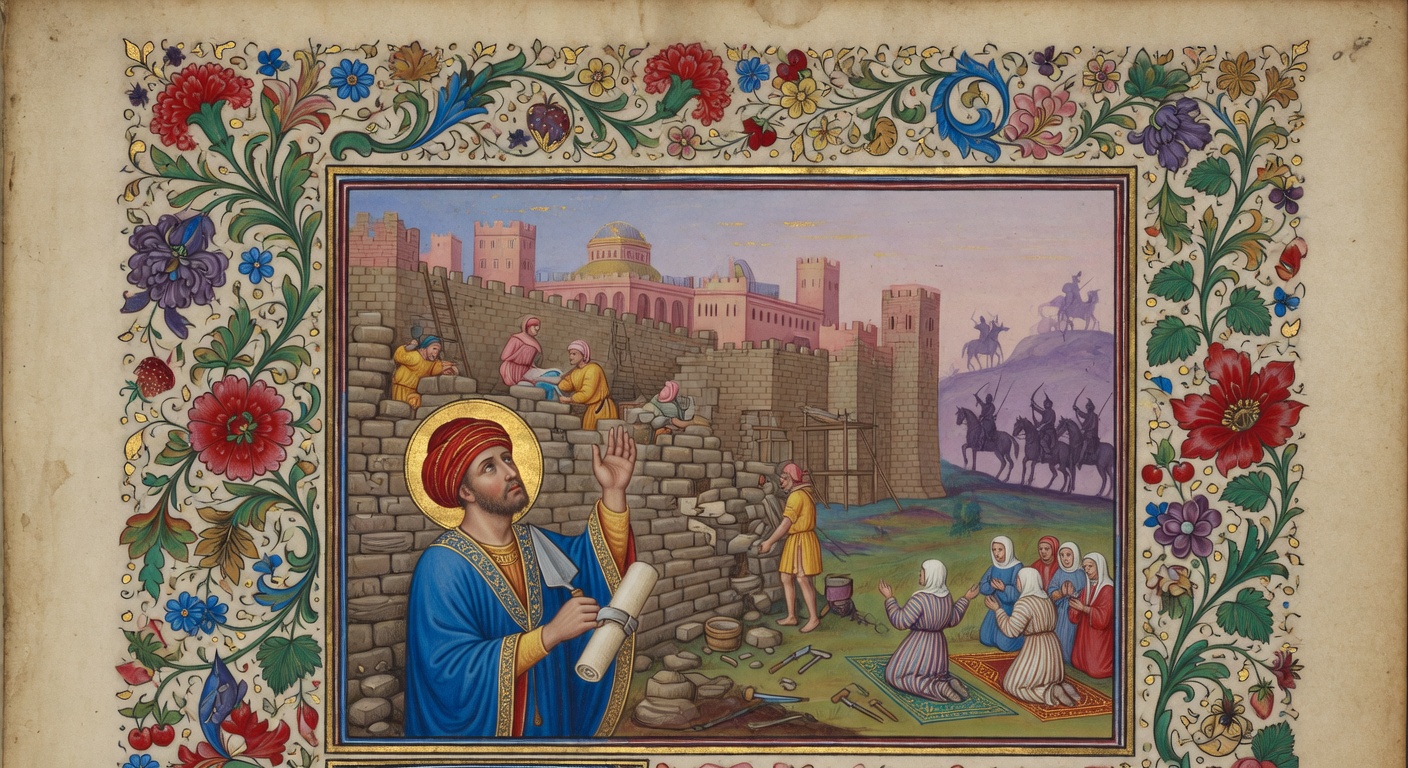
Nehemiah's silent prayer inserted directly into his conversation with Artaxerxes (v. 4) models an impromptu, non-ritualized dependence on God that treats the Persian court itself as sacred space.
 1nd it came to pass in the month Nisan, in the twentieth year of Artaxerxes the king, that wine was before him: and I took up the wine, and gave it unto the king. Now I had not been beforetime sad in his presence.
2 Wherefore the king said unto me, Why is thy countenance sad, seeing thou art not sick? this is nothing else but sorrow of heart. Then I was very sore afraid,
3 And said unto the king, Let the king live for ever: why should not my countenance be sad, when the city, the place of my fathers’ sepulchres, lieth waste, and the gates thereof are consumed with fire?
4 Then the king said unto me, For what dost thou make request? So I prayed to the God of heaven.
5 And I said unto the king, If it please the king, and if thy servant have found favour in thy sight, that thou wouldest send me unto Judah, unto the city of my fathers’ sepulchres, that I may build it.
6 And the king said unto me, (the queen also sitting by him,) For how long shall thy journey be? and when wilt thou return? So it pleased the king to send me; and I set him a time.
7 Moreover I said unto the king, If it please the king, let letters be given me to the governors beyond the river, that they may convey me over till I come into Judah;
8 And a letter unto Asaph the keeper of the king’s forest, that he may give me timber to make beams for the gates of the palace which appertained to the house, and for the wall of the city, and for the house that I shall enter into. And the king granted me, according to the good hand of my God upon me.
9 Then I came to the governors beyond the river, and gave them the king’s letters. Now the king had sent captains of the army and horsemen with me.
10 When Sanballat the Horonite, and Tobiah the servant, the Ammonite, heard of it, it grieved them exceedingly that there was come a man to seek the welfare of the children of Israel.
11 So I came to Jerusalem, and was there three days.
12 And I arose in the night, I and some few men with me; neither told I any man what my God had put in my heart to do at Jerusalem: neither was there any beast with me, save the beast that I rode upon.
13 And I went out by night by the gate of the valley, even before the dragon well, and to the dung port, and viewed the walls of Jerusalem, which were broken down, and the gates thereof were consumed with fire.
14 Then I went on to the gate of the fountain, and to the king’s pool: but there was no place for the beast that was under me to pass.
15 Then went I up in the night by the brook, and viewed the wall, and turned back, and entered by the gate of the valley, and so returned.
16 And the rulers knew not whither I went, or what I did; neither had I as yet told it to the Jews, nor to the priests, nor to the nobles, nor to the rulers, nor to the rest that did the work.
17 Then said I unto them, Ye see the distress that we are in, how Jerusalem lieth waste, and the gates thereof are burned with fire: come, and let us build up the wall of Jerusalem, that we be no more a reproach.
18 Then I told them of the hand of my God which was good upon me; as also the king’s words that he had spoken unto me. And they said, Let us rise up and build. So they strengthened their hands for this good work.
19 But when Sanballat the Horonite, and Tobiah the servant, the Ammonite, and Geshem the Arabian, heard it, they laughed us to scorn, and despised us, and said, What is this thing that ye do? will ye rebel against the king?
20 Then answered I them, and said unto them, The God of heaven, he will prosper us; therefore we his servants will arise and build: but ye have no portion, nor right, nor memorial, in Jerusalem.
← → arrow keys to navigate chapters · spacebar to play/pause audio
Did You Know?
Nehemiah's silent prayer inserted directly into his conversation with Artaxerxes (v. 4) models an impromptu, non-ritualized dependence on God that treats the Persian court itself as sacred space.
The timber request from the 'king's forest' deliberately recalls Solomon's cedar procurement from Lebanon, framing the wall project as a resumption of pre-exilic royal temple-building rather than a mere civic repair.
Nehemiah's nocturnal circuit, entering and exiting through the same ruined gates without detection, functions as a deliberate inversion of the daytime public processions later described in chapter 12, encoding the shift from hidden reconnaissance to communal dedication.
Identifying Sanballat as 'the Horonite' and Tobiah as 'the Ammonite servant' invokes pre-exilic land-dispute traditions (cf. Deuteronomy 23 and 2 Kings 17), casting the opposition as a continuation of ancient claims rather than merely local jealousy.
The letters to the governors 'beyond the river' place Nehemiah inside the Achaemenid postal and satrapy system, showing how Persian bureaucracy, not just divine favor, supplied the legal infrastructure for Judah's restoration.
Nehemiah secretly inspected Jerusalem's ruined walls at night on horseback before organizing the rebuilding effort, assigning specific sections to families and priests to foster communal ownership.
The decree of Artaxerxes is one of the anchor points interpreters use for the 'seventy weeks' prophecy of Daniel 9, tying Persian imperial policy to the biblical timeline of the Messiah.
After discovering extensive intermarriage with foreign women, Ezra remained in stunned silence until the evening sacrifice, then oversaw the divorce of 113 Israelite men from their non-Jewish wives in a public assembly.
Sanballat arranged for his daughter to marry a son of the high priest Eliashib, a union Nehemiah later condemned and dissolved by expelling the priest from Jerusalem to preserve the purity of the Aaronic line.
Jerusalem sits at about 2,500 feet elevation. Higher than most surrounding areas.
In the unfolding of God's redemptive purposes, Persia rose as the empire that subdued Babylon and issued the decree enabling the Jewish exiles to return and rebuild the temple in Jerusalem.
Commentary & Study Notes Jamieson-Fausset-Brown (1871) · Public Domain it came to pass in the month Nisan — This was nearly four months after he had learned the desolate and ruinous state of Jerusalem (Ne 1:1). The reasons for so long a delay cannot b…
Classic verse-by-verse commentary on Nehemiah 2 from Jamieson, Fausset & Brown (1871). Covers: Artaxerxes, understanding the cause of nehemiah's sadness, sends him with letters and a commission to build again the walls of Jerusalem.
- 1
- it came to pass in the month Nisan — This was nearly four months after he had learned the desolate and ruinous state of Jerusalem (Ne 1:1). The reasons for so long a delay cannot be ascertained. I took up the wine, and gave it unto the king — XENOPHON has particularly remarked about the polished and graceful manner in which the cupbearers of the Median, and consequently the Persian, monarchs performed their duty of presenting the wine to their royal master. Having washed the cup in the king's presence and poured into their left hand a little of the wine, which they drank in his presence, they then handed the cup to him, not grasped, but lightly held with the tips of their thumb and fingers. This description has received some curious illustrations from the monuments of Assyria and Persia, on which the cupbearers are frequently represented in the act of handing wine to the king.
- 2-5
- the king said unto me, Why is thy countenance sad? — It was deemed highly unbecoming to appear in the royal presence with any weeds or signs of sorrow (Es 4:2); and hence it was no wonder that the king was struck with the dejected air of his cupbearer, while that attendant, on his part, felt his agitation increased by his deep anxiety about the issue of the conversation so abruptly begun. But the piety and intense earnestness of the man immediately restored [Nehemiah] to calm self-possession and enabled him to communicate, first, the cause of his sadness (Ne 2:3), and next, the patriotic wish of his heart to be the honored instrument of reviving the ancient glory of the city of his fathers.
Read all 11 notes on Nehemiah 2 →