Psalms 21 KJV
The King Rejoices in God
About This Psalm
The king celebrates answered prayer. When God gives you what you asked for, take time to publicly thank Him.
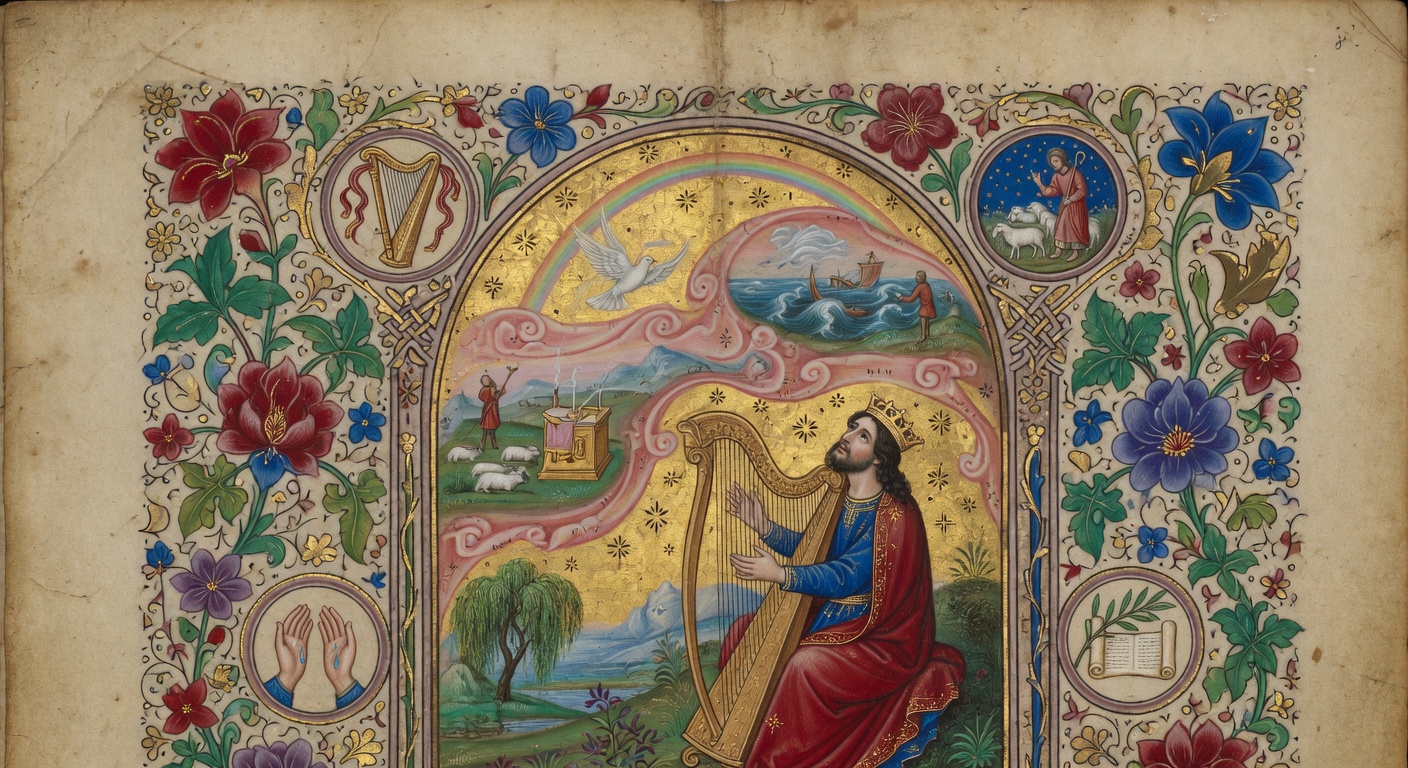
 1he king shall joy in thy strength, O LORD; and in thy salvation how greatly shall he rejoice!
2 Thou hast given him his heart’s desire, and hast not withholden the request of his lips. Selah.
3 For thou preventest him with the blessings of goodness: thou settest a crown of pure gold on his head.
4 He asked life of thee, and thou gavest it him, even length of days for ever and ever.
5 His glory is great in thy salvation: honour and majesty hast thou laid upon him.
6 For thou hast made him most blessed for ever: thou hast made him exceeding glad with thy countenance.
7 For the king trusteth in the LORD, and through the mercy of the most High he shall not be moved.
8 Thine hand shall find out all thine enemies: thy right hand shall find out those that hate thee.
9 Thou shalt make them as a fiery oven in the time of thine anger: the LORD shall swallow them up in his wrath, and the fire shall devour them.
10 Their fruit shalt thou destroy from the earth, and their seed from among the children of men.
11 For they intended evil against thee: they imagined a mischievous device, which they are not able to perform.
12 Therefore shalt thou make them turn their back, when thou shalt make ready thine arrows upon thy strings against the face of them.
13 Be thou exalted, LORD, in thine own strength: so will we sing and praise thy power.
← → arrow keys to navigate chapters · spacebar to play/pause audio
Did You Know?
Psalm 21 forms a deliberate liturgical diptych with Psalm 20, shifting from pre-battle petition to post-victory thanksgiving and thereby mirroring ancient Israelite temple rituals that moved worshippers from intercession to communal praise.
The promise that the king will be made 'most blessed for ever' (v. 6) deliberately echoes the Abrahamic covenant language of Genesis 12 and 22, transferring patriarchal promises of universal blessing onto the Davidic line.
Verse 9's furnace imagery, in which enemies become fuel that the Lord 'swallows' in his wrath, adapts ancient Near Eastern smelting and cremation motifs to portray divine judgment as both refining and consuming, a theme later echoed in Malachi 4.
Unlike most royal psalms that focus on the monarch's victories, Psalm 21 repeatedly attributes every success to God's prior action ('thou preventest him,' 'thou settest a crown'), presenting kingship as entirely derivative of divine initiative.
Early Jewish and Christian interpreters linked the 'length of days for ever and ever' granted in verse 4 to messianic expectation, seeing the psalm as describing an eternal rather than merely long-lived ruler, a reading that influenced New Testament portrayals of Christ's reign.
David purchased Araunah the Jebusite's threshing floor for fifty shekels of silver after the plague halted, establishing the exact site that later became the Temple Mount under Solomon.
Biblical tradition attributes 3,000 proverbs and 1,005 songs to Solomon, along with expertise in botany and zoology covering everything from cedar trees to hyssop and from livestock to birds, fish, and reptiles, yet only fragments survive in Proverbs, Ecclesiastes, and Song of Songs.
This location became the focal point of national worship and divine promises, later extending symbolically to encompass the Temple Mount where Solomon built the house of the Lord.
The city has been destroyed at least twice, besieged 23 times, and captured 44 times.
Commentary & Study Notes Jamieson-Fausset-Brown (1871) · Public Domain thy strength... thy salvation — as supplied by Thee.
Classic verse-by-verse commentary on Psalms 21 from Jamieson, Fausset & Brown (1871). Covers: The pious are led by the psalmist to celebrate God's favor to the king in the already conferred and in prospective victories. The doxology added may relate to both psalms; The preceding of petition, chiefly this of thanksgiving, ascribing honor to God for his display of grace and power to his church in all ages, not only under David, but also under his last greatest successor, "the king of the jews.".
- 1
- thy strength... thy salvation — as supplied by Thee.
- 2
- The sentiment affirmed in the first clause is reaffirmed by the negation of its opposite in the second.
Read all 12 notes on Psalms 21 →