Psalms 49 KJV
The Folly of Trusting Riches
About This Psalm
Money can't buy immortality. The rich and poor both die. A meditation on what truly lasts versus what we foolishly chase.
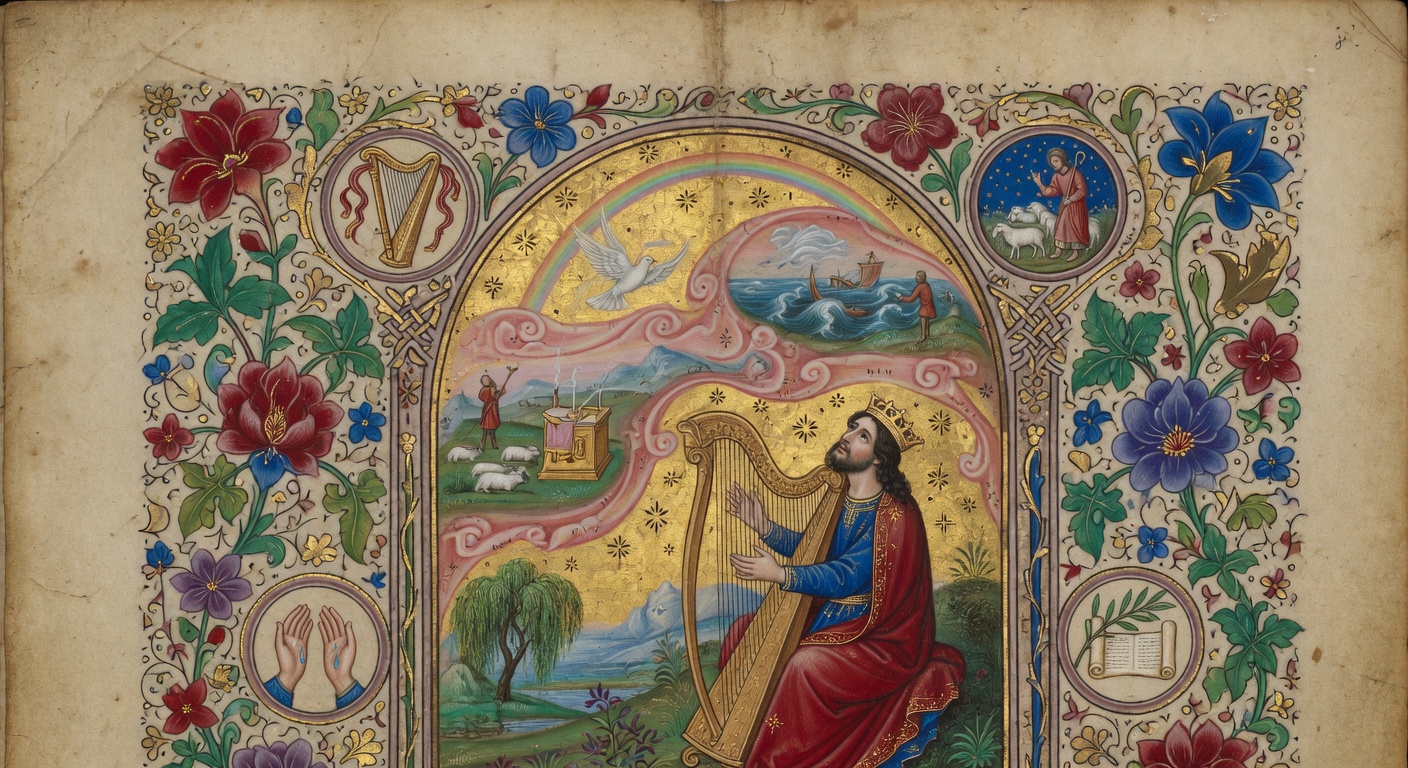
 1ear this, all ye people; give ear, all ye inhabitants of the world:
2 Both low and high, rich and poor, together.
3 My mouth shall speak of wisdom; and the meditation of my heart shall be of understanding.
4 I will incline mine ear to a parable: I will open my dark saying upon the harp.
5 Wherefore should I fear in the days of evil, when the iniquity of my heels shall compass me about?
6 They that trust in their wealth, and boast themselves in the multitude of their riches;
7 None of them can by any means redeem his brother, nor give to God a ransom for him:
8 (For the redemption of their soul is precious, and it ceaseth for ever:)
9 That he should still live for ever, and not see corruption.
10 For he seeth that wise men die, likewise the fool and the brutish person perish, and leave their wealth to others.
11 Their inward thought is, that their houses shall continue for ever, and their dwelling places to all generations; they call their lands after their own names.
12 Nevertheless man being in honour abideth not: he is like the beasts that perish.
13 This their way is their folly: yet their posterity approve their sayings. Selah.
14 Like sheep they are laid in the grave; death shall feed on them; and the upright shall have dominion over them in the morning; and their beauty shall consume in the grave from their dwelling.
15 But God will redeem my soul from the power of the grave: for he shall receive me. Selah.
16 Be not thou afraid when one is made rich, when the glory of his house is increased;
17 For when he dieth he shall carry nothing away: his glory shall not descend after him.
18 Though while he lived he blessed his soul: and men will praise thee, when thou doest well to thyself.
19 He shall go to the generation of his fathers; they shall never see light.
20 Man that is in honour, and understandeth not, is like the beasts that perish.
← → arrow keys to navigate chapters · spacebar to play/pause audio
Did You Know?
The psalm inverts the shepherd metaphor by portraying Death itself as the shepherd who gathers both the wealthy and their admirers like sheep into Sheol, subverting the usual divine-pastoral imagery found elsewhere in the Psalter.
Its declaration that no human payment can ransom a soul (v. 7-8) functions as an implicit critique of ancient Near Eastern redemption practices involving silver or substitutionary offerings, underscoring human helplessness before mortality.
The double refrain in verses 12 and 20 equates humanity that dies without understanding to beasts that perish, echoing Genesis creation theology while implying that reflective wisdom alone distinguishes humans from animals in the face of death.
Addressed universally to "all ye people" and "all ye inhabitants of the world," the psalm adopts prophetic rather than cultic language, positioning its wisdom message outside temple ritual and toward a global audience regardless of covenant status.
Composed by the sons of Korah, the psalm's theme of riches failing to secure lasting houses gains ironic depth from the Korahites' own survival through divine mercy amid their forefather's failed rebellion (Numbers 16), illustrating preservation by grace rather than wealth or status.
In old age David could not keep warm even under heavy blankets, prompting his officials to bring the young Shunammite Abishag to lie beside him as a human heat source without becoming his wife.
Despite completing the temple, Solomon later built shrines to foreign deities like Ashtoreth, Chemosh, and Molech on the Mount of Olives for his 700 wives and 300 concubines, directly contributing to the kingdom's division after his death.
In the prophetic writings it stands as the center of God's redemptive plan, embodying covenant faithfulness and the expectation of a coming Messiah who would rule from Zion in justice and peace.
The city has been destroyed at least twice, besieged 23 times, and captured 44 times.
Commentary & Study Notes Jamieson-Fausset-Brown (1871) · Public Domain All are called to hear what interests all. world — literally, "duration of life," the present time.
Classic verse-by-verse commentary on Psalms 49 from Jamieson, Fausset & Brown (1871). Covers: This psalm instructs and consoles. It teaches that earthly advantages are not reliable for permanent happiness, and that, however prosperous worldly men may be for a time, their ultimate destiny is ruin, while the pious are safe in God's care.
- 1-3
- All are called to hear what interests all. world — literally, "duration of life," the present time.
- 4
- incline — to hear attentively (Ps 17:6; 31:2). parable — In Hebrew and Greek "parable" and "proverb" are translations of the same word. It denotes a comparison, or form of speech, which under one image includes many, and is expressive of a general truth capable of various illustrations. Hence it may be used for the illustration itself. For the former sense, "proverb" (that is, one word for several) is the usual English term, and for the latter, in which comparison is prominent, "parable" (that is, one thing laid by another). The distinction is not always observed, since here, and in Ps 78:2; "proverb" would better express the style of the composition (compare also Pr 26:7, 9; Hab 2:6; Joh 16:25, 29). Such forms of speech are often very figurative and also obscure (compare Mt 13:12-15). Hence the use of the parallel word — dark saying — or, "riddle" (compare Eze 17:2). open — is to explain. upon the harp — the accompaniment for a lyric.
Read all 16 notes on Psalms 49 →