Psalms 6 KJV
A Prayer in Distress
About This Psalm
David is physically ill and emotionally broken, begging God for mercy. Raw honesty about suffering - sometimes faith looks like tears on a pillow.
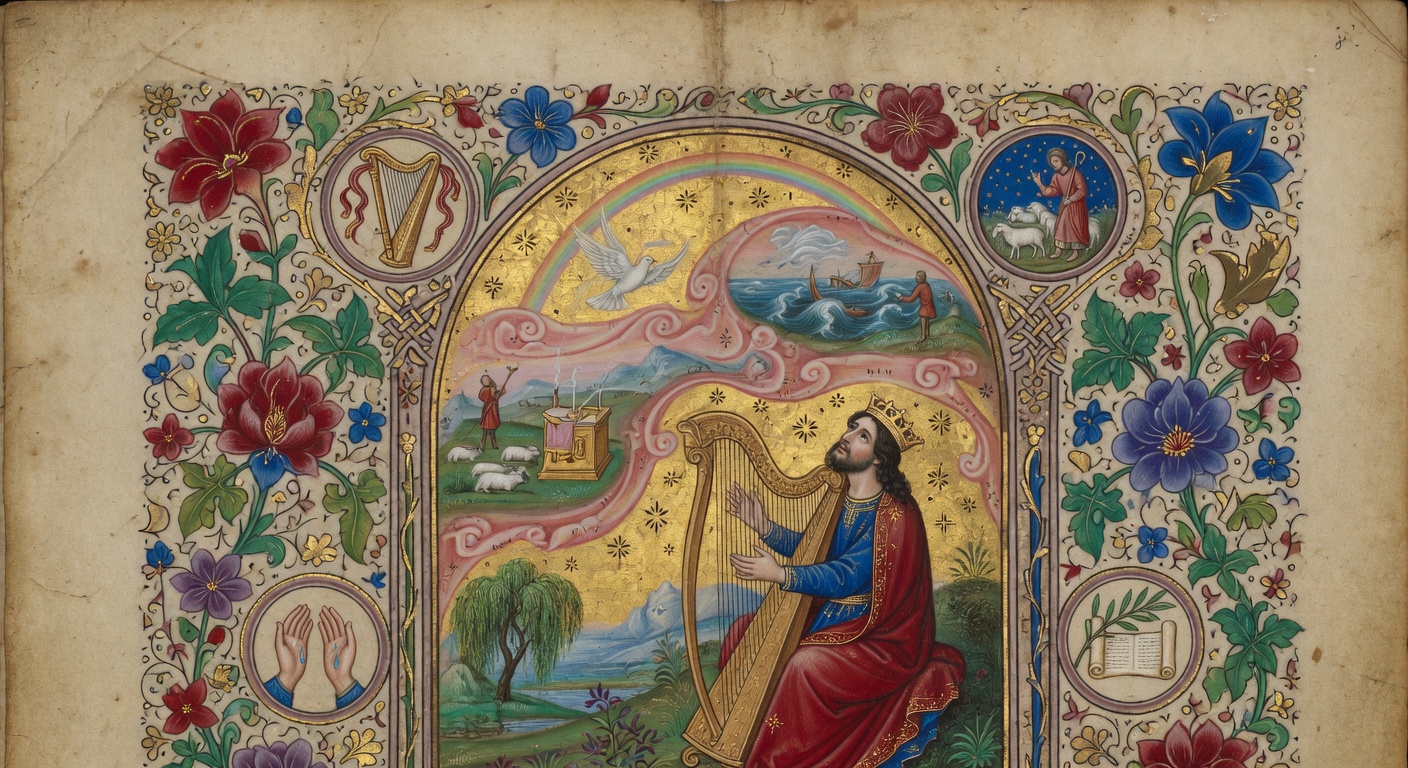
 1 LORD, rebuke me not in thine anger, neither chasten me in thy hot displeasure.
2 Have mercy upon me, O LORD; for I am weak: O LORD, heal me; for my bones are vexed.
3 My soul is also sore vexed: but thou, O LORD, how long?
4 Return, O LORD, deliver my soul: oh save me for thy mercies’ sake.
5 For in death there is no remembrance of thee: in the grave who shall give thee thanks?
6 I am weary with my groaning; all the night make I my bed to swim; I water my couch with my tears.
7 Mine eye is consumed because of grief; it waxeth old because of all mine enemies.
8 Depart from me, all ye workers of iniquity; for the LORD hath heard the voice of my weeping.
9 The LORD hath heard my supplication; the LORD will receive my prayer.
10 Let all mine enemies be ashamed and sore vexed: let them return and be ashamed suddenly.
← → arrow keys to navigate chapters · spacebar to play/pause audio
Did You Know?
Psalm 6 opens the traditional sequence of seven Penitential Psalms, a grouping first formalized by Cassiodorus in the sixth century that pairs each psalm with one of the seven gifts of the Holy Spirit.
The superscription 'upon Sheminith' likely denotes an eight-stringed lyre or a mode linked to the eighth day, evoking covenant renewal and pointing forward to circumcision on the eighth day in later Jewish and early Christian exegesis.
Verse 5's rhetorical question about remembrance in Sheol participates in a wisdom dialogue with Ecclesiastes and Job, underscoring the psalm's contribution to Old Testament reflection on whether the dead can still praise God.
The sudden pivot from desperate lament to confident address of enemies in verses 8-10 exemplifies the 'certainty of a hearing' form-critical pattern identified by Joachim Begrich, illustrating how many individual laments move from plea to assurance before any external change occurs.
The closing phrase 'depart from me, all ye workers of iniquity' is quoted verbatim by Jesus in Matthew 7:23, forging an intertextual bridge between David's distress and eschatological judgment.
David purchased Araunah the Jebusite's threshing floor for fifty shekels of silver after the plague halted, establishing the exact site that later became the Temple Mount under Solomon.
Biblical tradition attributes 3,000 proverbs and 1,005 songs to Solomon, along with expertise in botany and zoology covering everything from cedar trees to hyssop and from livestock to birds, fish, and reptiles, yet only fragments survive in Proverbs, Ecclesiastes, and Song of Songs.
This location became the focal point of national worship and divine promises, later extending symbolically to encompass the Temple Mount where Solomon built the house of the Lord.
Jerusalem sits at about 2,500 feet elevation. Higher than most surrounding areas.
Commentary & Study Notes Jamieson-Fausset-Brown (1871) · Public Domain He owns his ill desert in begging a relief from chastisement.
Classic verse-by-verse commentary on Psalms 6 from Jamieson, Fausset & Brown (1871). Covers: On neginoth (see on ps 4:1, title) upon sheminith--the eighth--an instrument for the eighth key; Or, more probably, the bass, as it is contrasted with alamoth (the treble, ps 46:1) in 1ch 15:20, 21. In deep affliction the psalmist appeals to God's mercy for relief from chastisement, which otherwise must destroy him, and thus disable him for God's service. Sure of a gracious answer, he triumphantly rebukes his foes.
- 1
- He owns his ill desert in begging a relief from chastisement.
- 2
- I am weak — as a culled plant (Isa 24:4). my bones — the very frame. are vexed — (Ps 2:5) — shaken with fear.
Read all 9 notes on Psalms 6 →