Psalms 60 KJV
A Prayer After Defeat
About This Psalm
After a military defeat, David asks God to restore the nation. Sometimes God lets you lose so you remember who actually wins your battles.
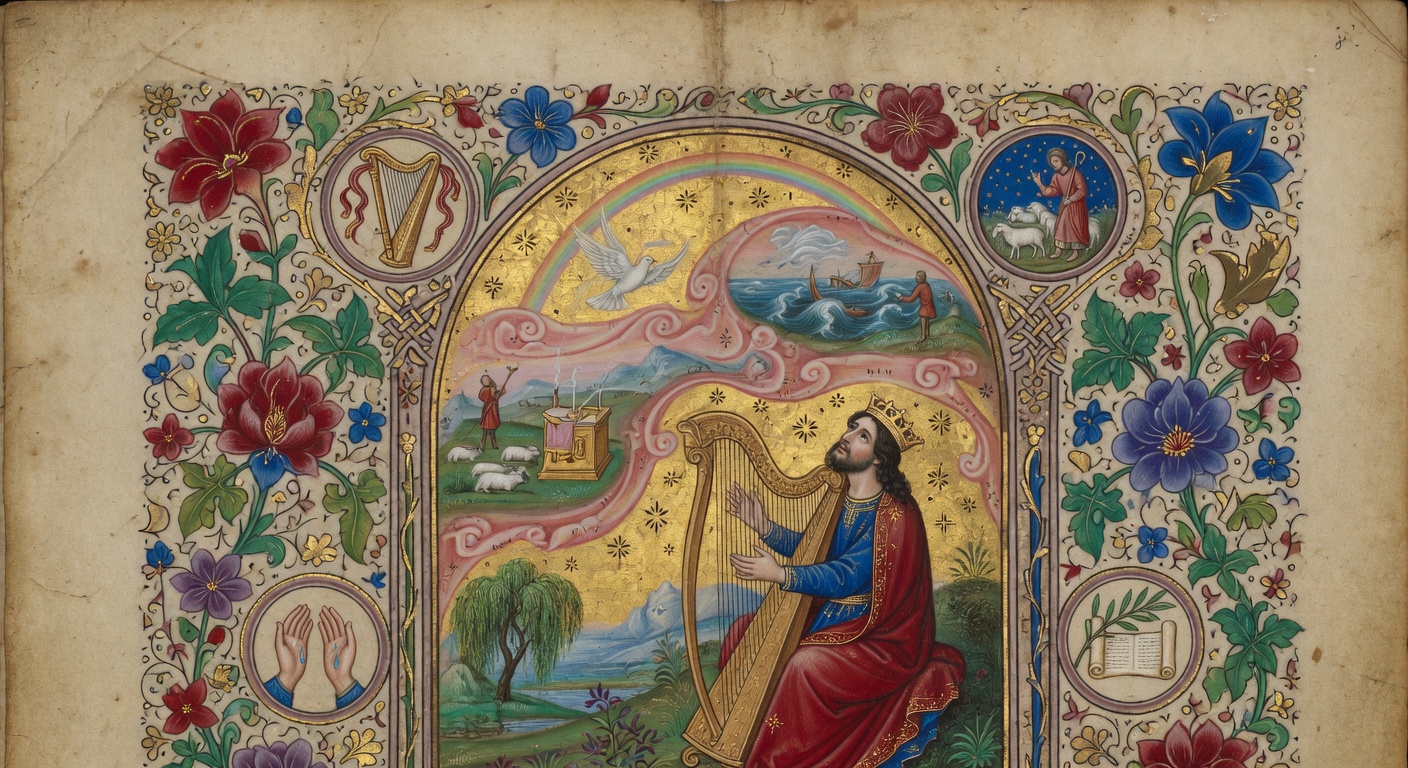
 1 God, thou hast cast us off, thou hast scattered us, thou hast been displeased; O turn thyself to us again.
2 Thou hast made the earth to tremble; thou hast broken it: heal the breaches thereof; for it shaketh.
3 Thou hast shewed thy people hard things: thou hast made us to drink the wine of astonishment.
4 Thou hast given a banner to them that fear thee, that it may be displayed because of the truth. Selah.
5 That thy beloved may be delivered; save with thy right hand, and hear me.
6 God hath spoken in his holiness; I will rejoice, I will divide Shechem, and mete out the valley of Succoth.
7 Gilead is mine, and Manasseh is mine; Ephraim also is the strength of mine head; Judah is my lawgiver;
8 Moab is my washpot; over Edom will I cast out my shoe: Philistia, triumph thou because of me.
9 Who will bring me into the strong city? who will lead me into Edom?
10 Wilt not thou, O God, which hadst cast us off? and thou, O God, which didst not go out with our armies?
11 Give us help from trouble: for vain is the help of man.
12 Through God we shall do valiantly: for he it is that shall tread down our enemies.
← → arrow keys to navigate chapters · spacebar to play/pause audio
Did You Know?
The superscription's reference to fighting Aram-naharaim and Aram-zobah alongside Joab's Edomite victory in the Valley of Salt points to a historical coalition war (likely 2 Samuel 8) in which initial setbacks against Syrian forces preceded the decisive southern campaign, revealing layered military strategy rather than a single battle.
Verses 6-8 preserve a rare divine oracle spoken in the first person, in which Yahweh asserts ownership by casting lots over Shechem and Succoth, claiming Gilead and Manasseh, designating Ephraim as his helmet and Judah his scepter, while reducing Moab to a washbasin and Edom to a sandal-throwing site, thereby mapping cosmic sovereignty onto specific Transjordanian and Canaanite territories.
The psalm's reuse of verses 5-12 (nearly verbatim) as the second half of Psalm 108 creates a deliberate liturgical composite that pairs northern tribal imagery with a thanksgiving motif from Psalm 57, illustrating how post-exilic or Second Temple editors repurposed defeat-oracles into victory hymns.
Despite its communal-lament classification, the sudden shift after the oracle transforms the plea for help against fortified Edom into confident expectation, underscoring a theological pattern in which acknowledged divine rejection (v. 1) becomes the very ground for renewed military trust rather than an indication of permanent abandonment.
The enigmatic phrase 'Moab is my washpot' alongside the command to 'cast out my shoe' over Edom employs domestic and legal metaphors drawn from ancient Near Eastern boundary rituals and servitude customs, subtly asserting Israel's suzerainty while inverting the expected outcome of the reported defeat.
While fleeing Saul, David sought refuge among the Philistines and feigned madness before King Achish of Gath by scribbling on the city gates and letting saliva run down his beard, successfully avoiding recognition.
Solomon conscripted 30,000 Israelite men for monthly rotations of forced labor in Lebanon to harvest cedar and cypress timber for the temple, while assigning an additional 150,000 Canaanite laborers to quarry and transport stone, reflecting the ancient Near Eastern practice of corvée labor systems.
This location became the focal point of national worship and divine promises, later extending symbolically to encompass the Temple Mount where Solomon built the house of the Lord.
Jerusalem is mentioned over 800 times in the Bible. More than any other city.
Commentary & Study Notes Jamieson-Fausset-Brown (1871) · Public Domain allude to disasters. cast... off — in scorn (Ps 43:2; 44:9). scattered — broken our strength (compare 2Sa 5:20). Oh, turn thyself — or, "restore to us" (prosperity). The figures of…
Classic verse-by-verse commentary on Psalms 60 from Jamieson, Fausset & Brown (1871). Covers: Shushan-eduth--lily of testimony. The lily is an emblem of beauty (see on ps 45:1, title). As a description of the psalm, those terms combined may denote a beautiful poem, witnessing--that is, for God's faithfulness as evinced in the victories referred to in the history cited. Aram-naharaim--syria of the two rivers, or mesopotamia beyond the river (euphrates) (2sa 10:16). Aram-zobah--syria of zobah (2sa 10:6), to whose king the king of the former was tributary. The war with Edom, by joab and abishai (2ch 18:12, 25), occurred about the same time. Probably, while doubts and fears alternately prevailed respecting the issue of these wars, the writer composed this psalm, in which he depicts, in the language of God's people, their sorrows under former disasters, offers prayer in present straits, and rejoices in confident hope of triumph by God's aid.
- 1-3
- allude to disasters. cast... off — in scorn (Ps 43:2; 44:9). scattered — broken our strength (compare 2Sa 5:20). Oh, turn thyself — or, "restore to us" (prosperity). The figures of physical, denote great civil, commotions (Ps 46:2, 3).
- 3
- drink... wine of astonishment — literally, "of staggering" — that is, made us weak (compare Ps 75:8; Isa 51:17, 22).
Read all 10 notes on Psalms 60 →