Psalms 61 KJV
A Prayer from the Ends of the Earth
About This Psalm
From the end of the earth I cry to you. When you feel far from God and far from home, this is your prayer.
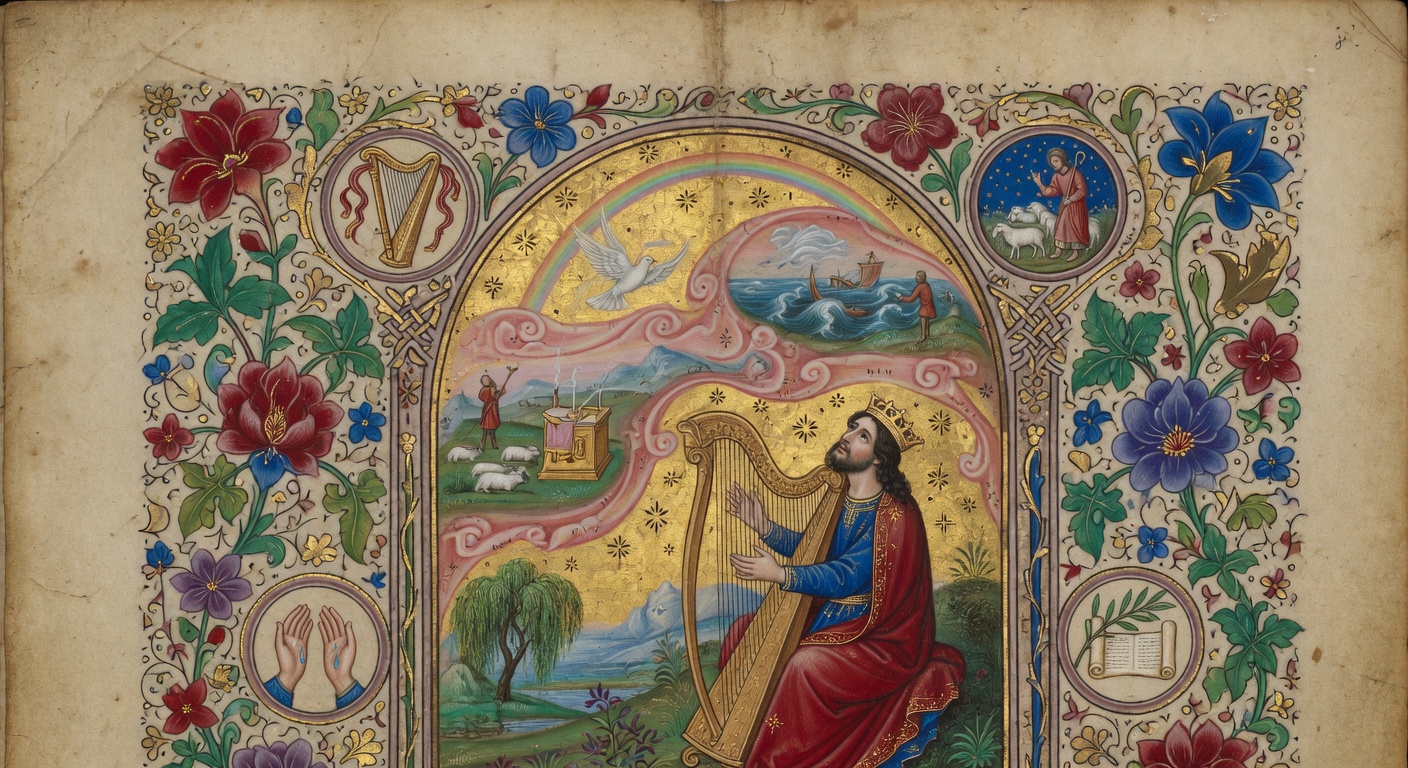
 1ear my cry, O God; attend unto my prayer.
2 From the end of the earth will I cry unto thee, when my heart is overwhelmed: lead me to the rock that is higher than I.
3 For thou hast been a shelter for me, and a strong tower from the enemy.
4 I will abide in thy tabernacle for ever: I will trust in the covert of thy wings. Selah.
5 For thou, O God, hast heard my vows: thou hast given me the heritage of those that fear thy name.
6 Thou wilt prolong the king’s life: and his years as many generations.
7 He shall abide before God for ever: O prepare mercy and truth, which may preserve him.
8 So will I sing praise unto thy name for ever, that I may daily perform my vows.
← → arrow keys to navigate chapters · spacebar to play/pause audio
Did You Know?
The psalm's shift from a personal lament uttered 'from the ends of the earth' to intercession for the king's endless days reflects an ancient Israelite royal theology in which the individual's survival is bound to the Davidic ruler's endurance.
Its unique pairing of 'rock that is higher than I' with 'shelter of thy wings' fuses two distinct divine-protection motifs: the high mountain fortress typical of Canaanite El imagery and the maternal bird imagery associated with the Jerusalem temple cherubim.
Verse 5's reference to receiving 'the heritage of those that fear thy name' subtly invokes the land-promise language of Deuteronomy, recasting national inheritance as an individual spiritual bequest available even to one exiled at earth's edge.
The closing vow to 'sing praise unto thy name for ever' while 'daily performing' vows suggests a liturgical cycle in which this psalm functioned as both petition and thank-offering text, possibly linked to the daily tamid sacrifices.
Early Jewish and Christian interpreters noted the psalm's verbal overlap with Isaiah 32:2 ('a hiding place from the wind'), allowing it to be read as a messianic foreshadowing in which the 'rock higher than I' anticipates the coming king who himself becomes refuge.
David purchased Araunah the Jebusite's threshing floor for fifty shekels of silver after the plague halted, establishing the exact site that later became the Temple Mount under Solomon.
Biblical tradition attributes 3,000 proverbs and 1,005 songs to Solomon, along with expertise in botany and zoology covering everything from cedar trees to hyssop and from livestock to birds, fish, and reptiles, yet only fragments survive in Proverbs, Ecclesiastes, and Song of Songs.
In the prophetic writings it stands as the center of God's redemptive plan, embodying covenant faithfulness and the expectation of a coming Messiah who would rule from Zion in justice and peace.
The city has been destroyed at least twice, besieged 23 times, and captured 44 times.
Commentary & Study Notes Jamieson-Fausset-Brown (1871) · Public Domain From the end — that is, places remote from the sanctuary (De 28:64).
Classic verse-by-verse commentary on Psalms 61 from Jamieson, Fausset & Brown (1871). Covers: Neginah--or, neginoth (see on ps 4:1, title). Separated from his usual spiritual privileges, perhaps by absalom's rebellion, the psalmist prays for divine aid, and, in view of past mercies, with great confidence of being heard.
- 1-3
- From the end — that is, places remote from the sanctuary (De 28:64).
- 2
- heart is overwhelmed — literally, "covered over with darkness," or, "distress." to the rock — (Ps 18:2; 40:2). higher than I — which otherwise I cannot ascend.
Read all 8 notes on Psalms 61 →