Psalms 7 KJV
A Prayer for Justice
About This Psalm
Falsely accused, David asks God to judge between him and his accusers. When you've been wronged and can't defend yourself, you hand it to the ultimate Judge.
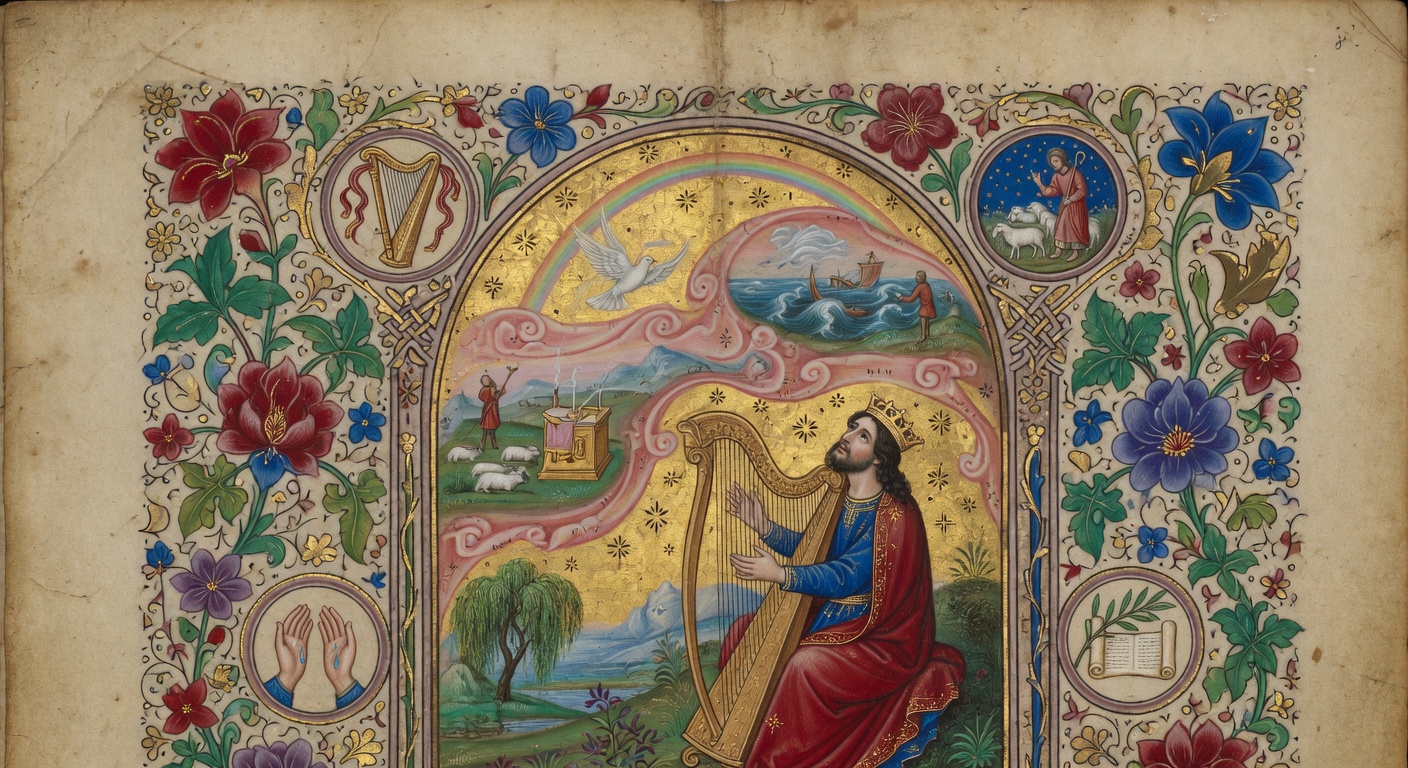
 1 LORD my God, in thee do I put my trust: save me from all them that persecute me, and deliver me:
2 Lest he tear my soul like a lion, rending it in pieces, while there is none to deliver.
3 O LORD my God, if I have done this; if there be iniquity in my hands;
4 If I have rewarded evil unto him that was at peace with me; (yea, I have delivered him that without cause is mine enemy:)
5 Let the enemy persecute my soul, and take it; yea, let him tread down my life upon the earth, and lay mine honour in the dust. Selah.
6 Arise, O LORD, in thine anger, lift up thyself because of the rage of mine enemies: and awake for me to the judgment that thou hast commanded.
7 So shall the congregation of the people compass thee about: for their sakes therefore return thou on high.
8 The LORD shall judge the people: judge me, O LORD, according to my righteousness, and according to mine integrity that is in me.
9 Oh let the wickedness of the wicked come to an end; but establish the just: for the righteous God trieth the hearts and reins.
10 My defence is of God, which saveth the upright in heart.
11 God judgeth the righteous, and God is angry with the wicked every day.
12 If he turn not, he will whet his sword; he hath bent his bow, and made it ready.
13 He hath also prepared for him the instruments of death; he ordaineth his arrows against the persecutors.
14 Behold, he travaileth with iniquity, and hath conceived mischief, and brought forth falsehood.
15 He made a pit, and digged it, and is fallen into the ditch which he made.
16 His mischief shall return upon his own head, and his violent dealing shall come down upon his own pate.
17 I will praise the LORD according to his righteousness: and will sing praise to the name of the LORD most high.
← → arrow keys to navigate chapters · spacebar to play/pause audio
Did You Know?
The superscription's unique designation of the psalm as a 'Shiggaion' (appearing elsewhere in the Bible only in Habakkuk 3) likely denotes an impassioned, rhythmically irregular lament whose erratic structure enacts the psychological disorientation of one falsely accused.
David's appeal concerning 'Cush the Benjamite' subtly situates the prayer amid Saulide court intrigues, transforming a personal protest of innocence into a theological claim that intra-tribal betrayal must be adjudicated by God rather than by retaliatory violence.
Verse 6's imperative for YHWH to 'awake' for judgment reverses the usual ancient Near Eastern portrayal of slumbering deities, presenting divine justice instead as deliberately responsive to covenantal cries rather than mechanically automatic.
The psalm's use of 'reins' (kidneys) alongside 'heart' in verse 9 draws on ancient Israelite anthropology in which the kidneys were regarded as the hidden seat of moral intuition, so that the request for divine testing probes the petitioner's conscience at its most inaccessible level.
The final vow to 'sing praise to the name of the Lord most high' (verse 17) links vindication directly to liturgical response, implying that the resolution of injustice is incomplete until it issues in public magnification of God's character rather than private satisfaction.
Jonathan sealed his covenant with David by giving him his royal robe, armor, sword, bow, and belt, ritually transferring symbols of kingship despite being Saul's heir.
Solomon's throne, overlaid with gold and ivory, featured six steps flanked by twelve lions symbolizing the tribes of Israel and incorporated a calf-shaped seat back, making it a unique artifact unmatched by any other royal throne of the era.
In the prophetic writings it stands as the center of God's redemptive plan, embodying covenant faithfulness and the expectation of a coming Messiah who would rule from Zion in justice and peace.
Three major world religions consider Jerusalem a holy city.
Commentary & Study Notes Jamieson-Fausset-Brown (1871) · Public Domain Though many enemies set upon him, one is singled out as prominent, and compared to a wild beast tearing his prey to pieces (compare 1Sa 20:1; 23:23; 26:19).
Classic verse-by-verse commentary on Psalms 7 from Jamieson, Fausset & Brown (1871). Covers: Shiggaion--a plaintive song or elegy. Though obscure in details, this title seems to intimate that the occasion of this psalm was some event in David's persecution by saul. He prays for relief because he is innocent, and God will be glorified in his vindication. He thus passes to the celebration of God's righteous government, in defending the upright and punishing the wicked, whose malignant devices will result in their own ruin; And, confident of God's aid, he closes with rejoicing.
- 1,2
- Though many enemies set upon him, one is singled out as prominent, and compared to a wild beast tearing his prey to pieces (compare 1Sa 20:1; 23:23; 26:19).
- 3
- if I have done this — that is, the crime charged in the "words of Cush" (compare 1Sa 24:9).
Read all 15 notes on Psalms 7 →