Psalms 8 KJV
The Majesty of God in Creation
About This Psalm
Looking at the night sky and marveling that the God who made galaxies cares about humans. The original 'pale blue dot' moment.
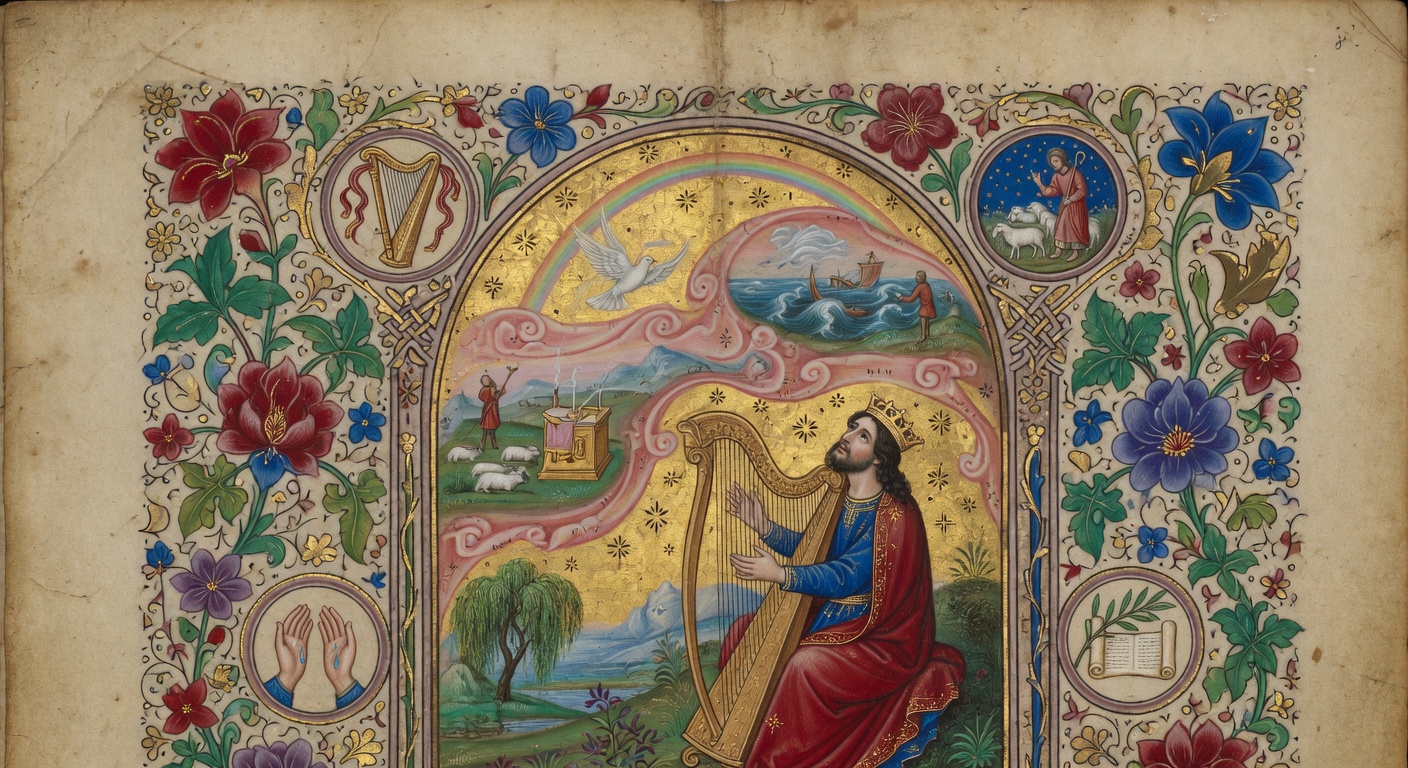
 1 LORD, our Lord, how excellent is thy name in all the earth! who hast set thy glory above the heavens.
2 Out of the mouth of babes and sucklings hast thou ordained strength because of thine enemies, that thou mightest still the enemy and the avenger.
3 When I consider thy heavens, the work of thy fingers, the moon and the stars, which thou hast ordained;
4 What is man, that thou art mindful of him? and the son of man, that thou visitest him?
5 For thou hast made him a little lower than the angels, and hast crowned him with glory and honour.
6 Thou madest him to have dominion over the works of thy hands; thou hast put all things under his feet:
7 All sheep and oxen, yea, and the beasts of the field;
8 The fowl of the air, and the fish of the sea, and whatsoever passeth through the paths of the seas.
9 O LORD our Lord, how excellent is thy name in all the earth!
← → arrow keys to navigate chapters · spacebar to play/pause audio
Did You Know?
The superscription 'upon Gittith' ties the psalm to a Philistine musical form or instrument from Gath, ironically placing a song of cosmic dominion on the lips of David while he lived among Israel's enemies.
Verse 2's image of perfected praise from infants is the only Old Testament text Jesus explicitly cites to justify children's shouts during his triumphal entry (Matthew 21:16), transforming a creation hymn into a defense of messianic recognition.
The phrase 'son of man' in verse 4 uses the ordinary Hebrew 'ben adam' yet becomes the seed for the apocalyptic title later applied to the Messiah in Daniel 7 and the Gospels, linking creational anthropology directly to eschatological kingship.
By listing domesticated animals (sheep, oxen) alongside untamed creatures (beasts of the field, fowl, fish) under human feet, the psalm quietly subverts ancient Near Eastern royal ideology that reserved such dominion exclusively for kings or gods.
The double divine name 'O LORD our Lord' (Yahweh Adonenu) at the psalm's opening and close forms an inclusio that moves from transcendent creator to covenantal ruler, a rhetorical move unique among the creation psalms.
David twice spared Saul's life in the wilderness, once cutting off a piece of his robe in the En Gedi cave and later removing his spear and water jug while he slept, demonstrating restraint amid pursuit.
The Queen of Sheba traveled roughly 1,200 miles from her Arabian kingdom with a caravan of camels carrying spices, gold, and stones to test Solomon's wisdom with riddles, then exchanged lavish gifts including 120 talents of gold that funded further temple adornments.
The New Testament further develops this imagery to portray the heavenly Jerusalem where believers gather to the living God.
Jerusalem is mentioned over 800 times in the Bible. More than any other city.
Commentary & Study Notes Jamieson-Fausset-Brown (1871) · Public Domain thy name — perfections (Ps 5:11; 7:17). who hast set — literally, "which set Thou Thy glory," &c., or "which glory of Thine set Thou," &c., that is, make it more conspicuou…
Classic verse-by-verse commentary on Psalms 8 from Jamieson, Fausset & Brown (1871). Covers: Upon [or according to the] gittith, probably means that the musical performance was directed to be according to a tune of that name; Which, derived from gath, a "wine-press," denotes a tune (used in connection with gathering the vintage) of a joyous character. All the psalms to which this term is prefixed [ps 8:1; 81:1; 84:1] are of such a character. The psalmist gives vent to his admiration of God's manifested perfections, by celebrating his condescending and beneficent providence to man as evinced by the position of the race, as originally created and assigned a dominion over the works of his hands.
- 1
- thy name — perfections (Ps 5:11; 7:17). who hast set — literally, "which set Thou Thy glory," &c., or "which glory of Thine set Thou," &c., that is, make it more conspicuous as if earth were too small a theater for its display. A similar exposition suits the usual rendering.
- 2
- So manifest are God's perfections, that by very weak instruments He conclusively sets forth His praise. Infants are not only wonderful illustrations of God's power and skill, in their physical constitution, instincts, and early developed intelligence, but also in their spontaneous admiration of God's works, by which they put to shame — still — or, silence men who rail and cavil against God. A special illustration of the passage is afforded in Mt 21:16, when our Saviour stilled the cavillers by quoting these words; for the glories with which God invested His incarnate Son, even in His humiliation, constitute a most wonderful display of the perfections of His wisdom, love, and power. In view of the scope of Ps 8:4-8 (see below), this quotation by our Saviour may be regarded as an exposition of the prophetical character of the words. sucklings — among the Hebrews were probably of an age to speak (compare 1Sa 1:22-24; Mr 7:27). ordained — founded, or prepared, and perfected, which occurs in Mt 21:16; taken from the Septuagint, has the same meaning. strength — In the quotation in the New Testament, praise occurs as the consequence or effect put for the cause (compare Ps 118:14). avenger — as in Ps 44:16; one desirous of revenge, disposed to be quarrelsome, and so apt to cavil against God's government.
Read all 6 notes on Psalms 8 →