Revelation 1 KJV
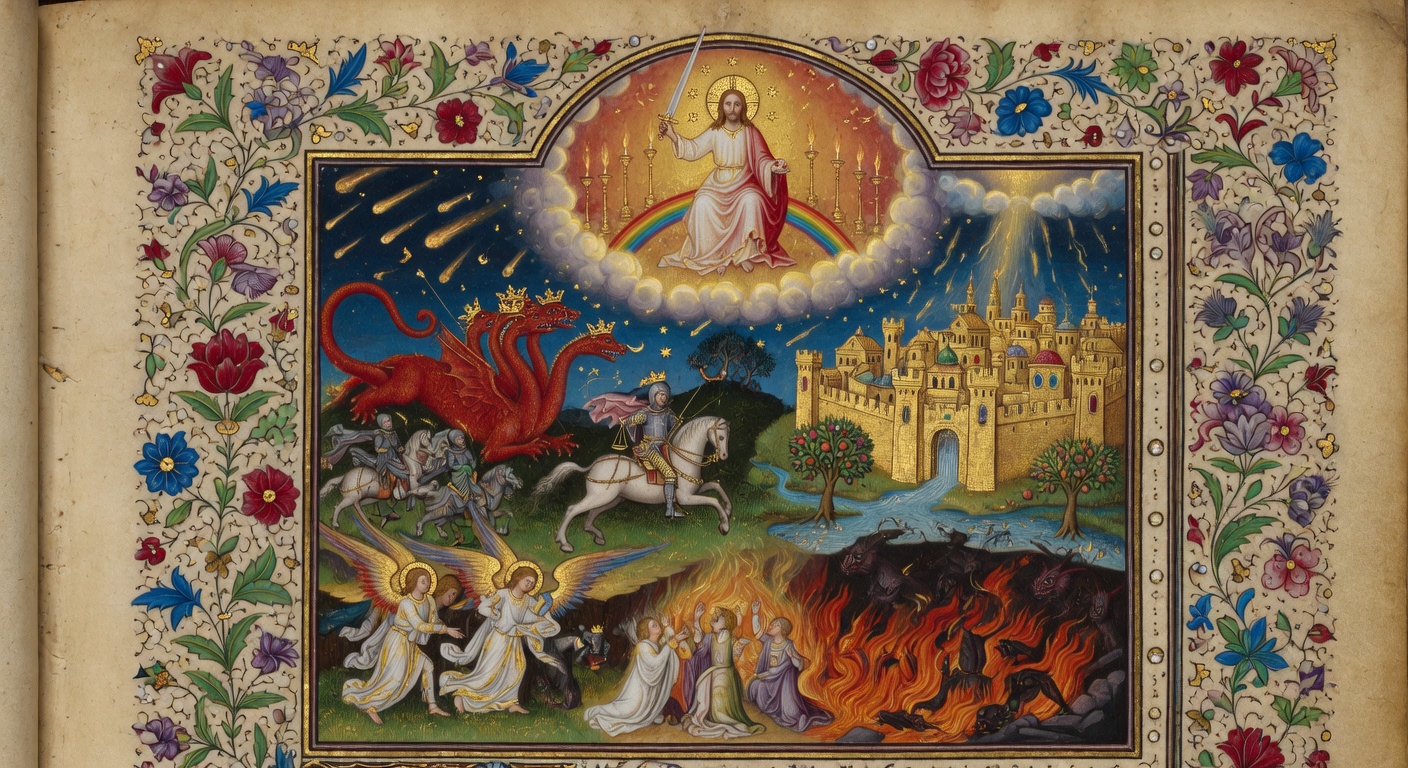
The Vision of Christ
Echoes & Connections 1 connections
Revelation 1 uses a chiastic vision structure moving from John's commissioning through the glorified Christ's attributes back to the command to write.
The Vision of Christ
The only book that promises a blessing for reading it aloud (v.3) Themes: Second Coming
 1he Revelation of Jesus Christ, which God gave unto him, to shew unto his servants things which must shortly come to pass; and he sent and signified it by his angel unto his servant John:
2 Who bare record of the word of God, and of the testimony of Jesus Christ, and of all things that he saw.
3 Blessed is he that readeth, and they that hear the words of this prophecy, and keep those things which are written therein: for the time is at hand.
4 John to the seven churches which are in Asia: Grace be unto you, and peace, from him which is, and which was, and which is to come; and from the seven Spirits which are before his throne;
5 And from Jesus Christ, who is the faithful witness, and the first begotten of the dead, and the prince of the kings of the earth. Unto him that loved us, and washed us from our sins in his own blood,
6 And hath made us kings and priests unto God and his Father; to him be glory and dominion for ever and ever. Amen.
7 Behold, he cometh with clouds; and every eye shall see him, and they also which pierced him: and all kindreds of the earth shall wail because of him. Even so, Amen.
8 I am Alpha and Omega, the beginning and the ending, saith the Lord, which is, and which was, and which is to come, the Almighty.
9 I John, who also am your brother, and companion in tribulation, and in the kingdom and patience of Jesus Christ, was in the isle that is called Patmos, for the word of God, and for the testimony of Jesus Christ.
10 I was in the Spirit on the Lord’s day, and heard behind me a great voice, as of a trumpet,
11 Saying, I am Alpha and Omega, the first and the last: and, What thou seest, write in a book, and send it unto the seven churches which are in Asia; unto Ephesus, and unto Smyrna, and unto Pergamos, and unto Thyatira, and unto Sardis, and unto Philadelphia, and unto Laodicea.
12 And I turned to see the voice that spake with me. And being turned, I saw seven golden candlesticks;
13 And in the midst of the seven candlesticks one like unto the Son of man, clothed with a garment down to the foot, and girt about the paps with a golden girdle.
14 His head and his hairs were white like wool, as white as snow; and his eyes were as a flame of fire;
15 And his feet like unto fine brass, as if they burned in a furnace; and his voice as the sound of many waters.
16 And he had in his right hand seven stars: and out of his mouth went a sharp twoedged sword: and his countenance was as the sun shineth in his strength.
17 And when I saw him, I fell at his feet as dead. And he laid his right hand upon me, saying unto me, Fear not; I am the first and the last:
18 I am he that liveth, and was dead; and, behold, I am alive for evermore, Amen; and have the keys of hell and of death.
19 Write the things which thou hast seen, and the things which are, and the things which shall be hereafter;
20 The mystery of the seven stars which thou sawest in my right hand, and the seven golden candlesticks. The seven stars are the angels of the seven churches: and the seven candlesticks which thou sawest are the seven churches.
Words in red are the direct words of Jesus Christ.
← → arrow keys to navigate chapters · spacebar to play/pause audio
Did You Know?
The only book that promises a blessing for reading it aloud (v.3)
John's description of the risen Christ (v.13-16) is terrifying - nothing like gentle Jesus
'I am Alpha and Omega, the first and the last' - Jesus claims God's own title
The seven churches were real churches in a mail route circuit in modern Turkey
'I was in the Spirit on the Lord's day' - the earliest reference to Sunday worship
John was the only apostle explicitly present at the crucifixion; from the cross Jesus entrusted his mother Mary to John's care, after which John took her into his own home (John 19:26-27).
Jesus paid the annual temple tax by instructing Peter to catch a fish whose mouth contained the exact coin needed, a detail unique to Matthew 17 that blends miracle with practical provision in first-century Jewish life.
The New Testament's identification of the serpent with Satan appears only in Revelation 12:9 and 20:2, centuries after Genesis was written.
The only explicit dispute between Michael and Satan in the Bible occurs in Jude 9, where Michael declines to rebuke the devil himself over Moses' body and instead declares, 'The Lord rebuke you.'
John was exiled here during Emperor Domitian's persecution around AD 95.
The city has been destroyed at least twice, besieged 23 times, and captured 44 times.
Babylon's walls were reportedly wide enough for two chariots to pass side by side.
Commentary & Study Notes Jamieson-Fausset-Brown (1871) · Public Domain Revelation — an apocalypse or unveiling of those things which had been veiled. A manifesto of the kingdom of Christ. The travelling manual of the Church for the Gentile Christian t…
Classic verse-by-verse commentary on Revelation 1 from Jamieson, Fausset & Brown (1871). Covers: Title: source and object of this revelation: blessing on the reader and keeper of it, as the time is near: inscription to the seven churches: apostolic greeting: keynote, "behold he cometh" (compare at the close, re 22:20, "surely i come quickly"): introductory vision of the son of man in glory, amidst the seven candlesticks, with seven stars in his right hand.
- 1
- Revelation — an apocalypse or unveiling of those things which had been veiled. A manifesto of the kingdom of Christ. The travelling manual of the Church for the Gentile Christian times. Not a detailed history of the future, but a representation of the great epochs and chief powers in developing the kingdom of God in relation to the world. The "Church-historical" view goes counter to the great principle that Scripture interprets itself. Revelation is to teach us to understand the times, not the times to interpret to us the Apocalypse, although it is in the nature of the case that a reflex influence is exerted here and is understood by the prudent [AUBERLEN]. The book is in a series of parallel groups, not in chronological succession. Still there is an organic historical development of the kingdom of God. In this book all the other books of the Bible end and meet: in it is the consummation of all previous prophecy. Daniel foretells as to Christ and the Roman destruction of Jerusalem, and the last Antichrist. But John's Revelation fills up the intermediate period, and describes the millennium and final state beyond Antichrist. Daniel, as a godly statesman, views the history of God's people in relation to the four world kingdoms. John, as an apostle, views history from the Christian Church aspect. The term Apocalypse is applied to no Old Testament book. Daniel is the nearest approach to it; but what Daniel was told to seal and shut up till the time of the end, John, now that the time is at hand (Re 1:3), is directed to reveal. of Jesus Christ — coming from Him. Jesus Christ, not John the writer, is the Author of the Apocalypse. Christ taught many things before His departure; but those which were unsuitable for announcement at that time He brought together into the Apocalypse [BENGEL]. Compare His promise, Joh 15:15, "All things that I have heard of My Father, I have made known unto you"; also, Joh 16:13, "The Spirit of truth will show you things to come." The Gospels and Acts are the books, respectively, of His first advent, in the flesh, and in the Spirit; the Epistles are the inspired comment on them. The Apocalypse is the book of His second advent and the events preliminary to it. which God gave unto him — The Father reveals Himself and His will in, and by, His Son. to show — The word recurs in Re 22:6: so entirely have the parts of Revelation reference to one another. It is its peculiar excellence that it comprises in a perfect compendium future things, and these widely differing: things close at hand, far off, and between the two; great and little; destroying and saving; repeated from old prophecies and new; long and short, and these interwoven with one another, opposed and mutually agreeing; mutually involving and evolving one another; so that in no book more than in this would the addition, or taking away, of a single word or clause (Re 22:18, 19), have the effect of marring the sense of the context and the comparison of passages together [BENGEL]. his servants — not merely to "His servant John," but to all His servants (compare Re 22:3). shortly — Greek, "speedily"; literally, "in," or "with speed." Compare "the time is at hand," Re 1:3; 22:6, "shortly"; Re 22:7, "Behold, I come quickly." Not that the things prophesied were according to man's computation near; but this word "shortly" implies a corrective of our estimate of worldly events and periods. Though a "thousand years" (Re 20:1-15) at least are included, the time is declared to be at hand. Lu 18:8, "speedily." The Israelite Church hastened eagerly to the predicted end, which premature eagerness prophecy restrains (compare Da 9:1-27). The Gentile Church needs to be reminded of the transitoriness of the world (which it is apt to make its home) and the nearness of Christ's advent. On the one hand Revelation says, "the time is at hand"; on the other, the succession of seals, &c., show that many intermediate events must first elapse. he sent — Jesus Christ sent. by his angel — joined with "sent." The angel does not come forward to "signify" things to John until Re 17:1; 19:9,
- 10
- Previous to that John receives information from others. Jesus Christ opens the Revelation, Re 1:10, 11; 4:1; in Re 6:1 one of the four living creatures acts as his informant; in Re 7:13, one of the elders; in Re 10:8, 9, the Lord and His angel who stood on the sea and earth. Only at the end (Re 17:1) does the one angel stand by Him (compare Da 8:16; 9:21; Zec 1:19).
Read all 25 notes on Revelation 1 →