Revelation 6 KJV
The Six Seals
The Six Seals
The first seal's white horse and bow evoke not only Zechariah 6 but also the Parthian mounted archers who threatened Rome, framing conquest as an ironic divine weapon against imperial power.
 1nd I saw when the Lamb opened one of the seals, and I heard, as it were the noise of thunder, one of the four beasts saying, Come and see.
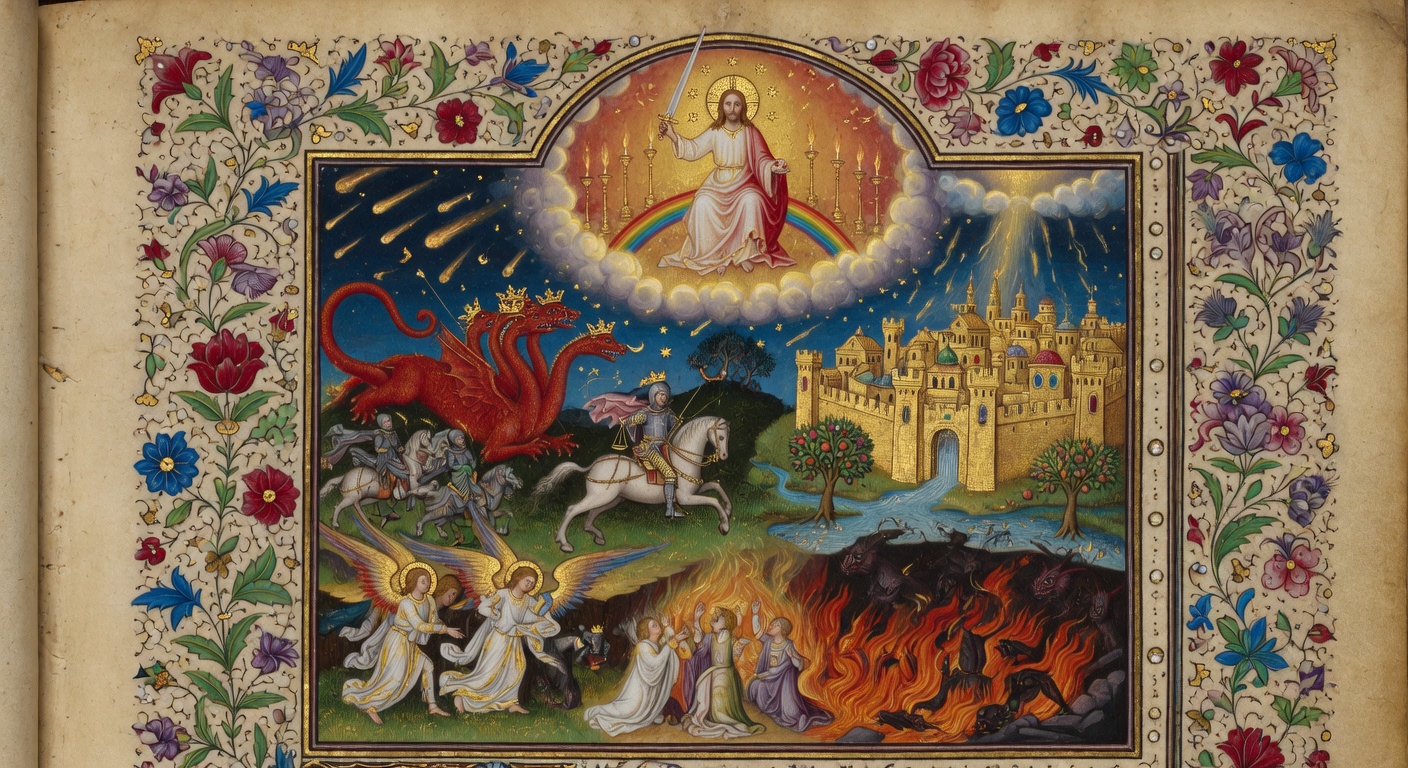
2 And I saw, and behold a white horse: and he that sat on him had a bow; and a crown was given unto him: and he went forth conquering, and to conquer.
3 And when he had opened the second seal, I heard the second beast say, Come and see.
4 And there went out another horse that was red: and power was given to him that sat thereon to take peace from the earth, and that they should kill one another: and there was given unto him a great sword.
5 And when he had opened the third seal, I heard the third beast say, Come and see. And I beheld, and lo a black horse; and he that sat on him had a pair of balances in his hand.
6 And I heard a voice in the midst of the four beasts say, A measure of wheat for a penny, and three measures of barley for a penny; and see thou hurt not the oil and the wine.
7 And when he had opened the fourth seal, I heard the voice of the fourth beast say, Come and see.
8 And I looked, and behold a pale horse: and his name that sat on him was Death, and Hell followed with him. And power was given unto them over the fourth part of the earth, to kill with sword, and with hunger, and with death, and with the beasts of the earth.
9 And when he had opened the fifth seal, I saw under the altar the souls of them that were slain for the word of God, and for the testimony which they held:
10 And they cried with a loud voice, saying, How long, O Lord, holy and true, dost thou not judge and avenge our blood on them that dwell on the earth?
11 And white robes were given unto every one of them; and it was said unto them, that they should rest yet for a little season, until their fellowservants also and their brethren, that should be killed as they were, should be fulfilled.
12 And I beheld when he had opened the sixth seal, and, lo, there was a great earthquake; and the sun became black as sackcloth of hair, and the moon became as blood;
13 And the stars of heaven fell unto the earth, even as a fig tree casteth her untimely figs, when she is shaken of a mighty wind.
14 And the heaven departed as a scroll when it is rolled together; and every mountain and island were moved out of their places.
15 And the kings of the earth, and the great men, and the rich men, and the chief captains, and the mighty men, and every bondman, and every free man, hid themselves in the dens and in the rocks of the mountains;
16 And said to the mountains and rocks, Fall on us, and hide us from the face of him that sitteth on the throne, and from the wrath of the Lamb:
17 For the great day of his wrath is come; and who shall be able to stand?
← → arrow keys to navigate chapters · spacebar to play/pause audio
Did You Know?
The first seal's white horse and bow evoke not only Zechariah 6 but also the Parthian mounted archers who threatened Rome, framing conquest as an ironic divine weapon against imperial power.
The fifth seal's martyrs under the altar echo the blood crying from the ground in Genesis 4, yet here their plea prompts a temporary delay rather than immediate curse, highlighting eschatological restraint.
The sixth seal's stars falling like untimely figs directly alludes to the LXX of Isaiah 34:4, transforming a prophecy against Edom into a universal cosmic uncreation event.
The sequence of the four horsemen mirrors the four judgments of Ezekiel 14:21 but reorders them to culminate in death, underscoring how Revelation intensifies and reconfigures prophetic curses.
The souls receiving white robes before the final seal anticipates the overcomers' reward in Revelation 7, linking martyrological vindication to the sealing of the 144,000.
Jesus paid the annual temple tax by instructing Peter to catch a fish whose mouth contained the exact coin needed, a detail unique to Matthew 17 that blends miracle with practical provision in first-century Jewish life.
John was the only apostle explicitly present at the crucifixion; from the cross Jesus entrusted his mother Mary to John's care, after which John took her into his own home (John 19:26-27).
The New Testament's identification of the serpent with Satan appears only in Revelation 12:9 and 20:2, centuries after Genesis was written.
The only explicit dispute between Michael and Satan in the Bible occurs in Jude 9, where Michael declines to rebuke the devil himself over Moses' body and instead declares, 'The Lord rebuke you.'
Patmos is a tiny island only 10 miles long and 6 miles wide.
Jerusalem sits at about 2,500 feet elevation. Higher than most surrounding areas.
The Hanging Gardens of Babylon were one of the Seven Wonders of the Ancient World.
Commentary & Study Notes Jamieson-Fausset-Brown (1871) · Public Domain There can, however, be no doubt that at least the sixth seal is future, and is to be at the coming again of Christ. The great objection to supposing the seals to be finally and exh…
Classic verse-by-verse commentary on Revelation 6 from Jamieson, Fausset & Brown (1871). Covers: The opening of the first six of the seven seals.
- 312
- There can, however, be no doubt that at least the sixth seal is future, and is to be at the coming again of Christ. The great objection to supposing the seals to be finally and exhaustively fulfilled (though, probably, particular events may be partial fulfilments typical of the final and fullest one), is that, if so, they ought to furnish (as the destruction of Jerusalem, according to Christ's prophecy, does) a strong external evidence of Revelation. But it is clear they cannot be used for this, as hardly any two interpreters of this school are agreed on what events constitute the fulfilment of each seal. Probably not isolated facts, but classes of events preparing the way for Christ's coming kingdom, are intended by the opening of the seals. The four living creatures severally cry at the opening of the first four seals, "Come," which fact marks the division of the seven, as often occurs in this sacred number, into four and three.
- 1
- one of the seals — The oldest manuscripts, A, B, C, Vulgate, and Syriac read, "one of the seven seals." noise — The three oldest manuscripts read this in the nominative or dative, not the genitive, as English Version, "I heard one from among the four living creatures saying, as (it were) the voice (or, 'as with the voice') of thunder." The first living creature was like a lion (Re 4:7): his voice is in consonance. Implying the lion-like boldness with which, in the successive great revivals, the faithful have testified for Christ, and especially a little before His coming shall testify. Or, rather, their earnestness in praying for Christ's coming. Come and see — One oldest manuscript, B, has "And see." But A, C, and Vulgate reject it. ALFORD rightly objects to English Version reading: "Whither was John to come? Separated as he was by the glassy sea from the throne, was he to cross it?" Contrast the form of expression, Re 10:8. It is much more likely to be the cry of the redeemed to the Redeemer, "Come" and deliver the groaning creature from the bondage of corruption. Thus, Re 6:2 is an answer to the cry, went (literally, "came") forth corresponding to "Come." "Come," says GROTIUS, is the living creature's address to John, calling his earnest attention. But it seems hard to see how "Come" by itself can mean this. Compare the only other places in Revelation where it is used, Re 4:1; 22:17. If the four living creatures represent the four Gospels, the "Come" will be their invitation to everyone (for it is not written that they addressed John) to accept Christ's salvation while there is time, as the opening of the seals marks a progressive step towards the end (compare Re 22:17). Judgments are foretold as accompanying the preaching of the Gospel as a witness to all nations (Re 14:6-11; Mt 24:6-14). Thus the invitation, "Come," here, is aptly parallel to Mt 24:14. The opening of the first four seals is followed by judgments preparatory for His coming. At the opening of the fifth seal, the martyrs above express the same (Re 6:9, 10; compare Zec 1:10). At the opening of the sixth seal, the Lord's coming is ushered in with terrors to the ungodly. At the seventh, the consummation is fully attained (Re 11:15).
Read all 19 notes on Revelation 6 →