1 Chronicles 13 KJV
The Ark Brought from Kiriath-Jearim
The Ark Brought from Kiriath-Jearim
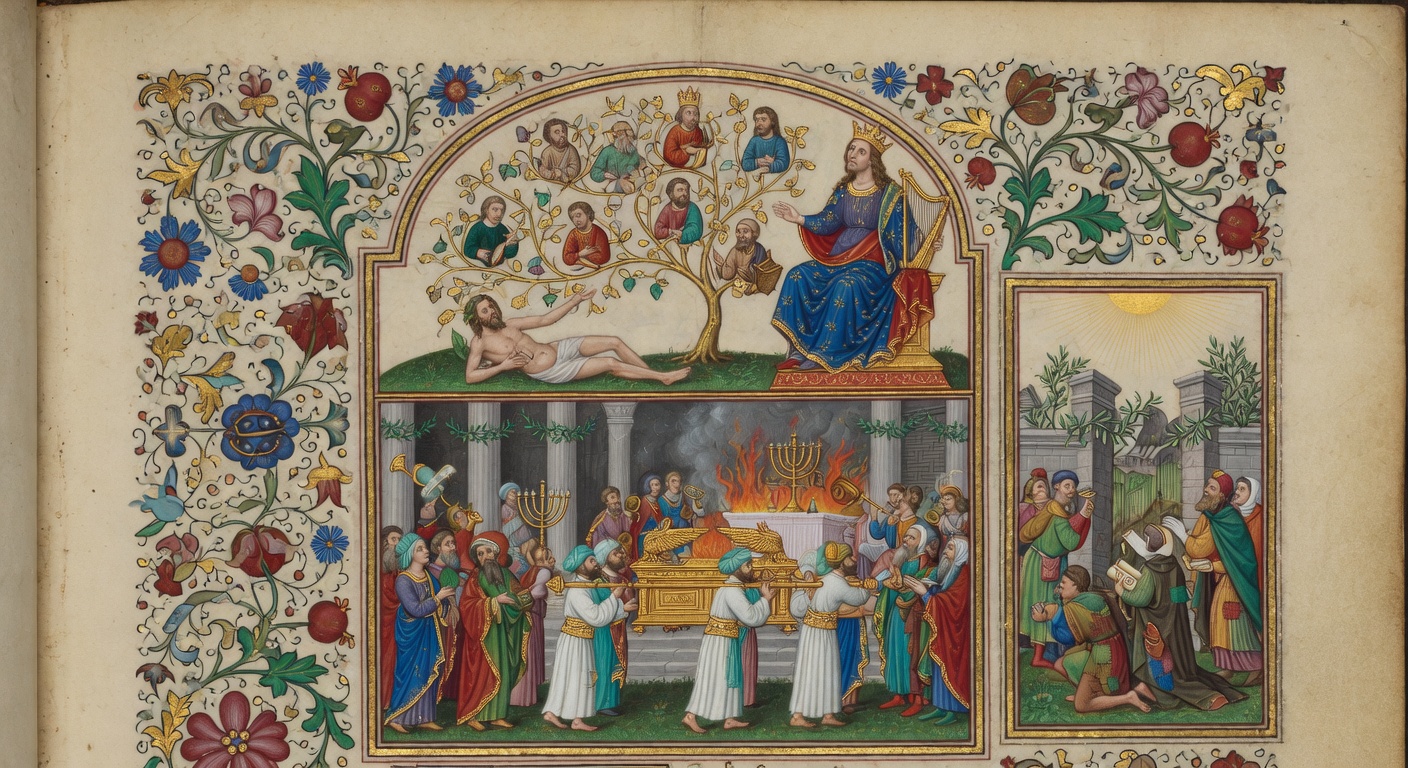
The narrative underscores that even well-intentioned royal initiative cannot override Levitical regulations for ark transport, as the cart method echoes the Philistines' expedient in 1 Samuel rather than the poles prescribed in Exodus.
 1nd David consulted with the captains of thousands and hundreds, and with every leader.
2 And David said unto all the congregation of Israel, If it seem good unto you, and that it be of the LORD our God, let us send abroad unto our brethren every where, that are left in all the land of Israel, and with them also to the priests and Levites which are in their cities and suburbs, that they may gather themselves unto us:
3 And let us bring again the ark of our God to us: for we enquired not at it in the days of Saul.
4 And all the congregation said that they would do so: for the thing was right in the eyes of all the people.
5 So David gathered all Israel together, from Shihor of Egypt even unto the entering of Hemath, to bring the ark of God from Kirjathjearim.
6 And David went up, and all Israel, to Baalah, that is, to Kirjathjearim, which belonged to Judah, to bring up thence the ark of God the LORD, that dwelleth between the cherubims, whose name is called on it.
7 And they carried the ark of God in a new cart out of the house of Abinadab: and Uzza and Ahio drave the cart.
8 And David and all Israel played before God with all their might, and with singing, and with harps, and with psalteries, and with timbrels, and with cymbals, and with trumpets.
9 And when they came unto the threshingfloor of Chidon, Uzza put forth his hand to hold the ark; for the oxen stumbled.
10 And the anger of the LORD was kindled against Uzza, and he smote him, because he put his hand to the ark: and there he died before God.
11 And David was displeased, because the LORD had made a breach upon Uzza: wherefore that place is called Perezuzza to this day.
12 And David was afraid of God that day, saying, How shall I bring the ark of God home to me?
13 So David brought not the ark home to himself to the city of David, but carried it aside into the house of Obededom the Gittite.
14 And the ark of God remained with the family of Obededom in his house three months. And the LORD blessed the house of Obededom, and all that he had.
← → arrow keys to navigate chapters · spacebar to play/pause audio
Did You Know?
The narrative underscores that even well-intentioned royal initiative cannot override Levitical regulations for ark transport, as the cart method echoes the Philistines' expedient in 1 Samuel rather than the poles prescribed in Exodus.
By locating the fatal incident at an otherwise obscure threshing floor of Chidon, the chapter transforms a mundane agricultural site into an enduring toponym Perez-uzzah, functioning as an etiological marker that perpetually warns against presumptuous contact with holiness.
David's decision to consult the assembly of Israel and the captains of thousands before acting reflects the Chronicler's distinctive portrayal of kingship as covenantally accountable rather than unilaterally charismatic.
The three-month sojourn of the ark in the house of Obed-edom the Gittite produces household blessing for a Philistine resident alien, subtly anticipating the extension of divine favor beyond ethnic Israel.
This episode is deliberately sequenced before the construction of David's palace and the defeat of the Philistines, framing proper cultic restoration as the prerequisite for securing both dynastic house and national borders.
David twice spared Saul's life in the wilderness, once cutting off a piece of his robe in the En Gedi cave and later removing his spear and water jug while he slept, demonstrating restraint amid pursuit.
The Queen of Sheba traveled roughly 1,200 miles from her Arabian kingdom with a caravan of camels carrying spices, gold, and stones to test Solomon's wisdom with riddles, then exchanged lavish gifts including 120 talents of gold that funded further temple adornments.
The spirit of Samuel summoned by the medium at Endor appeared wearing his distinctive mantle, the same garment he had used decades earlier to signal the tearing away of Saul's kingdom when David secretly cut its hem in the cave of En Gedi.
The city has been destroyed at least twice, besieged 23 times, and captured 44 times.
In the prophetic writings it stands as the center of God's redemptive plan, embodying covenant faithfulness and the expectation of a coming Messiah who would rule from Zion in justice and peace.
The Cave of Machpelah is the first recorded real estate transaction in the Bible.
Commentary & Study Notes Jamieson-Fausset-Brown (1871) · Public Domain David consulted... And let us bring again the ark of our God — Gratitude for the high and splendid dignity to which he had been elevated would naturally, at this period, impart a f…
Classic verse-by-verse commentary on 1 Chronicles 13 from Jamieson, Fausset & Brown (1871). Covers: David fetches the ark from kirjath-jearim.
- 1-3
- David consulted... And let us bring again the ark of our God — Gratitude for the high and splendid dignity to which he had been elevated would naturally, at this period, impart a fresh animation and impulse to the habitually fervent piety of David; but, at the same time, he was animated by other motives. He fully understood his position as ruler under the theocracy, and, entering on his duties, he was resolved to fulfil his mission as a constitutional king of Israel. Accordingly, his first act as a sovereign related to the interests of religion. The ark being then the grand instrument and ornament of it, he takes the opportunity of the official representatives of the nation being with him, to consult them about the propriety of establishing it in a more public and accessible locality. The assembly at which he spoke of this consisted of the Sheloshim, princes of thousands (2Sa 6:1). During the reign of the late king, the ark had been left in culpable neglect. Consequently the people had, to a great extent, been careless about the ordinances of divine worship, or had contented themselves with offering sacrifices at Gibeon, without any thought of the ark, though it was the chief and most vital part of the tabernacle. The duty and advantages of this religious movement suggested by the king were apparent, and the proposal met with universal approval.
- 2
- If it seem good unto you, and... it be of the Lord — that is, I shall conclude that this favorite measure of mine is agreeable to the mind of God, if it receive your hearty concurrence. let us send abroad to our brethren everywhere — He wished to make it known throughout the country, in order that there might be a general assembly of the nation, and that preparations might be made on a scale and of a kind suitable to the inauguration of the august ceremonial. with them also to the priests and Levites... in their cities and suburbs — (See on Nu 35:2). The original terms, "Let us send," imply immediate execution; and, doubtless, the publication of the royal edict would have been followed by the appointment of an early day for the contemplated solemnity, had it not been retarded by a sudden invasion of the Philistines, who were twice repulsed with great loss (2Sa 5:17), by the capture of Jerusalem, and the transference of the seat of government to that city. Finding, however, soon after, peace restored and his throne established, he resumed his preparations for removing the ark to the metropolis.
Read all 4 notes on 1 Chronicles 13 →