1 Chronicles 20 KJV
The Capture of Rabbah
The Capture of Rabbah
The Chronicler deliberately excises the entire Bathsheba-Uriah narrative that immediately precedes this material in 2 Samuel, preserving an unbroken portrait of David as the temple-founding king whose wars are purely preparatory rather than punitive.
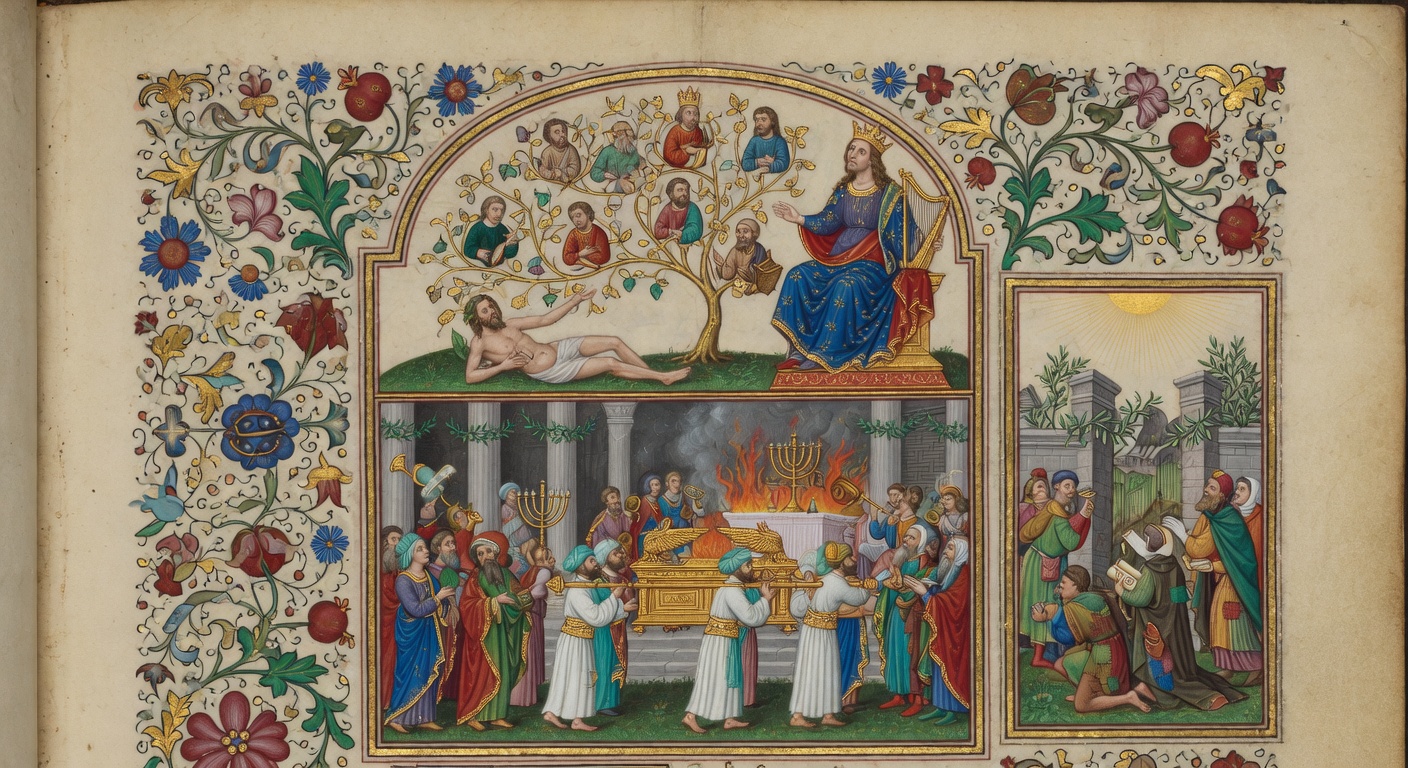
 1nd it came to pass, that after the year was expired, at the time that kings go out to battle, Joab led forth the power of the army, and wasted the country of the children of Ammon, and came and besieged Rabbah. But David tarried at Jerusalem. And Joab smote Rabbah, and destroyed it.
2 And David took the crown of their king from off his head, and found it to weigh a talent of gold, and there were precious stones in it; and it was set upon David’s head: and he brought also exceeding much spoil out of the city.
3 And he brought out the people that were in it, and cut them with saws, and with harrows of iron, and with axes. Even so dealt David with all the cities of the children of Ammon. And David and all the people returned to Jerusalem.
4 And it came to pass after this, that there arose war at Gezer with the Philistines; at which time Sibbechai the Hushathite slew Sippai, that was of the children of the giant: and they were subdued.
5 And there was war again with the Philistines; and Elhanan the son of Jair slew Lahmi the brother of Goliath the Gittite, whose spear staff was like a weaver’s beam.
6 And yet again there was war at Gath, where was a man of great stature, whose fingers and toes were four and twenty, six on each hand, and six on each foot and he also was the son of the giant.
7 But when he defied Israel, Jonathan the son of Shimea David’s brother slew him.
8 These were born unto the giant in Gath; and they fell by the hand of David, and by the hand of his servants.
← → arrow keys to navigate chapters · spacebar to play/pause audio
Did You Know?
The Chronicler deliberately excises the entire Bathsheba-Uriah narrative that immediately precedes this material in 2 Samuel, preserving an unbroken portrait of David as the temple-founding king whose wars are purely preparatory rather than punitive.
The single talent-weight golden crown taken from the Ammonite king and set on David’s head (v. 2) is the only instance in the Hebrew Bible where a foreign royal crown is physically transferred to an Israelite monarch, functioning as a tangible sign of YHWH’s transfer of Gentile sovereignty.
Verse 5’s notice that Elhanan killed “Lahmi the brother of Goliath” is the earliest extant harmonization of the duplicate giant-slaying traditions; the Chronicler alters the Samuel text to protect the uniqueness of David’s victory while still acknowledging additional Rephaim in Gath.
The otherwise superfluous detail that the final giant’s fingers and toes numbered six on each hand and foot (v. 6) echoes ancient Near Eastern teratological omens in which polydactyly marked a figure as both monstrous and quasi-divine, underscoring that these opponents were not ordinary warriors but boundary-crossing anomalies defeated by ordinary Israelites.
By grouping the Rabbah campaign with three Philistine giant episodes under a single chapter, the Chronicler creates a chiastic frame around David’s reign that begins and ends with the subjugation of the same two peoples (Ammon and Philistia) first mentioned in 1 Chronicles 18, signaling the completion of the conquest motif before Solomon’s temple-building begins.
While fleeing Saul, David sought refuge among the Philistines and feigned madness before King Achish of Gath by scribbling on the city gates and letting saliva run down his beard, successfully avoiding recognition.
Solomon conscripted 30,000 Israelite men for monthly rotations of forced labor in Lebanon to harvest cedar and cypress timber for the temple, while assigning an additional 150,000 Canaanite laborers to quarry and transport stone, reflecting the ancient Near Eastern practice of corvée labor systems.
Samuel is one of the few biblical figures whose birth narrative includes a specific song of praise by his mother Hannah, which shares striking linguistic parallels with the Magnificat of Mary in the New Testament.
Jerusalem is mentioned over 800 times in the Bible. More than any other city.
The New Testament further develops this imagery to portray the heavenly Jerusalem where believers gather to the living God.
David ruled from Hebron for 7.5 years before moving his capital to Jerusalem.
Commentary & Study Notes Jamieson-Fausset-Brown (1871) · Public Domain at the time when kings go out to battle — in spring, the usual season in ancient times for entering on a campaign; that is, a year subsequent to the Syrian war. Joab led forth the…
Classic verse-by-verse commentary on 1 Chronicles 20 from Jamieson, Fausset & Brown (1871). Covers: Rabbah besieged by joab, spoiled by David, and the people tortured; Three overthrows of the philistines and three giants slain.
- 1
- at the time when kings go out to battle — in spring, the usual season in ancient times for entering on a campaign; that is, a year subsequent to the Syrian war. Joab led forth the power of the army, and wasted the country... of Ammon — The former campaign had been disastrous, owing chiefly to the hired auxiliaries of the Ammonites; and as it was necessary, as well as just, that they should be severely chastised for their wanton outrage on the Hebrew ambassadors, Joab ravaged their country and invested their capital, Rabbah. After a protracted siege, Joab took one part of it, the lower town or "city of waters," insulated by the winding course of the Jabbok. Knowing that the fort called "the royal city" would soon fall, he invited the king to come in person, and have the honor of storming it. The knowledge of this fact (mentioned in 2Sa 12:26) enables us to reconcile the two statements — "David tarried at Jerusalem" (1Ch 20:1), and "David and all the people returned to Jerusalem" (1Ch 20:3).
- 2
- David took the crown of their king..., and found it to weigh a talent of gold — equal to one hundred twenty-five pounds. Some think that Malcom, rendered in our version "their king," should be taken as a proper name, Milcom or Molech, the Ammonite idol, which, of course, might bear a heavy weight. But, like many other state crowns of Eastern kings, the crown got at Rabbah was not worn on the head, but suspended by chains of gold above the throne. precious stones — Hebrew, a "stone," or cluster of precious stones, which was set on David's head.
Read all 3 notes on 1 Chronicles 20 →