1 Chronicles 25 KJV
The Musicians
The Musicians
The chapter equates musical performance with prophecy, as the sons of Asaph, Heman, and Jeduthun are said to prophesy with harps, psalteries, and cymbals, framing temple music as a vehicle for divine revelation rather than mere accompaniment.
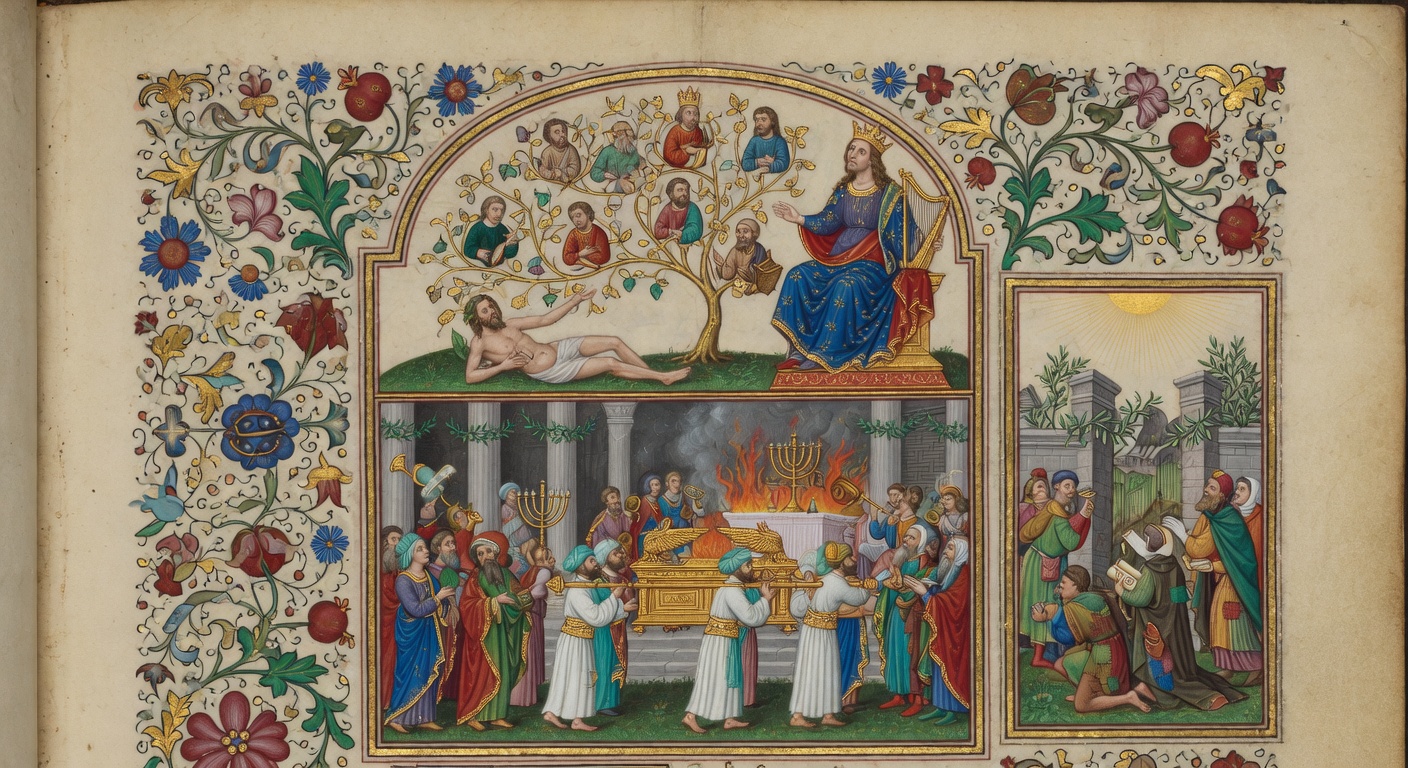
 1oreover David and the captains of the host separated to the service of the sons of Asaph, and of Heman, and of Jeduthun, who should prophesy with harps, with psalteries, and with cymbals: and the number of the workmen according to their service was:
2 Of the sons of Asaph; Zaccur, and Joseph, and Nethaniah, and Asarelah, the sons of Asaph under the hands of Asaph, which prophesied according to the order of the king.
3 Of Jeduthun: the sons of Jeduthun; Gedaliah, and Zeri, and Jeshaiah, Hashabiah, and Mattithiah, six, under the hands of their father Jeduthun, who prophesied with a harp, to give thanks and to praise the LORD.
4 Of Heman: the sons of Heman: Bukkiah, Mattaniah, Uzziel, Shebuel, and Jerimoth, Hananiah, Hanani, Eliathah, Giddalti, and Romamtiezer, Joshbekashah, Mallothi, Hothir, and Mahazioth:
5 All these were the sons of Heman the king’s seer in the words of God, to lift up the horn. And God gave to Heman fourteen sons and three daughters.
6 All these were under the hands of their father for song in the house of the LORD, with cymbals, psalteries, and harps, for the service of the house of God, according to the king’s order to Asaph, Jeduthun, and Heman.
7 So the number of them, with their brethren that were instructed in the songs of the LORD, even all that were cunning, was two hundred fourscore and eight.
8 And they cast lots, ward against ward, as well the small as the great, the teacher as the scholar.
9 Now the first lot came forth for Asaph to Joseph: the second to Gedaliah, who with his brethren and sons were twelve:
10 The third to Zaccur, he, his sons, and his brethren, were twelve:
11 The fourth to Izri, he, his sons, and his brethren, were twelve:
12 The fifth to Nethaniah, he, his sons, and his brethren, were twelve:
13 The sixth to Bukkiah, he, his sons, and his brethren, were twelve:
14 The seventh to Jesharelah, he, his sons, and his brethren, were twelve:
15 The eighth to Jeshaiah, he, his sons, and his brethren, were twelve:
16 The ninth to Mattaniah, he, his sons, and his brethren, were twelve:
17 The tenth to Shimei, he, his sons, and his brethren, were twelve:
18 The eleventh to Azareel, he, his sons, and his brethren, were twelve:
19 The twelfth to Hashabiah, he, his sons, and his brethren, were twelve:
20 The thirteenth to Shubael, he, his sons, and his brethren, were twelve:
21 The fourteenth to Mattithiah, he, his sons, and his brethren, were twelve:
22 The fifteenth to Jeremoth, he, his sons, and his brethren, were twelve:
23 The sixteenth to Hananiah, he, his sons, and his brethren, were twelve:
24 The seventeenth to Joshbekashah, he, his sons, and his brethren, were twelve:
25 The eighteenth to Hanani, he, his sons, and his brethren, were twelve:
26 The nineteenth to Mallothi, he, his sons, and his brethren, were twelve:
27 The twentieth to Eliathah, he, his sons, and his brethren, were twelve:
28 The one and twentieth to Hothir, he, his sons, and his brethren, were twelve:
29 The two and twentieth to Giddalti, he, his sons, and his brethren, were twelve:
30 The three and twentieth to Mahazioth, he, his sons, and his brethren, were twelve:
31 The four and twentieth to Romamtiezer, he, his sons, and his brethren, were twelve.
← → arrow keys to navigate chapters · spacebar to play/pause audio
Did You Know?
The chapter equates musical performance with prophecy, as the sons of Asaph, Heman, and Jeduthun are said to prophesy with harps, psalteries, and cymbals, framing temple music as a vehicle for divine revelation rather than mere accompaniment.
Heman receives the distinctive title of the king's seer while heading a musical family of fourteen sons and three daughters, merging royal prophetic authority with Levitical artistry in a way that blurs lines between court and sanctuary.
Casting lots for the twenty-four courses treats teacher and scholar, small and great, with identical status, revealing an unexpected egalitarianism in sacred duty that overrides typical ancient hierarchies of age or expertise.
The musicians' rotational structure precisely parallels the twenty-four priestly divisions of the prior chapter, showing David's deliberate design for a symmetrical liturgy in which song and sacrifice function as coordinated temple ministries.
By anchoring the Asaph, Heman, and Jeduthun lineages in David's reign, the text supplies a historical warrant for the canonical psalms attributed to these figures, portraying their compositions as extensions of authorized temple prophecy.
While fleeing Saul, David sought refuge among the Philistines and feigned madness before King Achish of Gath by scribbling on the city gates and letting saliva run down his beard, successfully avoiding recognition.
Solomon conscripted 30,000 Israelite men for monthly rotations of forced labor in Lebanon to harvest cedar and cypress timber for the temple, while assigning an additional 150,000 Canaanite laborers to quarry and transport stone, reflecting the ancient Near Eastern practice of corvée labor systems.
Samuel is one of the few biblical figures whose birth narrative includes a specific song of praise by his mother Hannah, which shares striking linguistic parallels with the Magnificat of Mary in the New Testament.
The city has been destroyed at least twice, besieged 23 times, and captured 44 times.
In the prophetic writings it stands as the center of God's redemptive plan, embodying covenant faithfulness and the expectation of a coming Messiah who would rule from Zion in justice and peace.
The Cave of Machpelah is the first recorded real estate transaction in the Bible.
Commentary & Study Notes Jamieson-Fausset-Brown (1871) · Public Domain David and the captains of the host — that is, the princes (1Ch 23:2; 24:6). It is probable that the king was attended on the occasion of arranging the singers by the same parties t…
Classic verse-by-verse commentary on 1 Chronicles 25 from Jamieson, Fausset & Brown (1871). Covers: Number and office of the singers; Their division by lot into four and twenty orders.
- 1
- David and the captains of the host — that is, the princes (1Ch 23:2; 24:6). It is probable that the king was attended on the occasion of arranging the singers by the same parties that are mentioned as having assisted him in regulating the order of the priests and Levites.
- 2
- according to the order of the king — Hebrew, "by the hands of the king," that is, "according to the king's order," under the personal superintendence of Asaph and his colleagues. which prophesied — that is, in this connection, played with instruments. This metaphorical application of the term "prophecy" most probably originated in the practice of the prophets, who endeavored to rouse their prophetic spirit by the animating influence of music (see on 2Ki 3:15). It is said that Asaph did this "according to David's order," because by royal appointment he officiated in the tabernacle on Zion (1Ch 16:37-41), while other leaders of the sacred music were stationed at Gibeon.
Read all 4 notes on 1 Chronicles 25 →