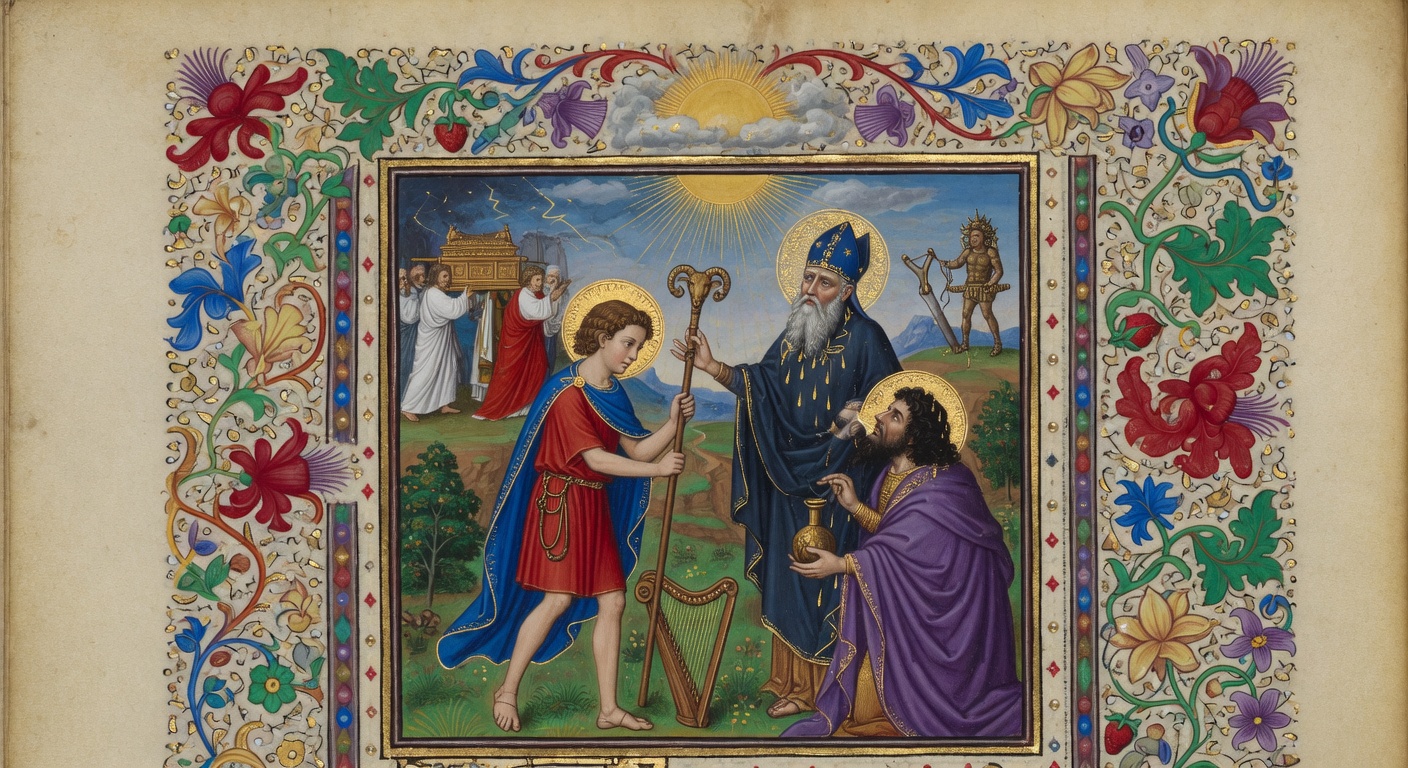
1 Samuel 1 KJV
The Birth of Samuel
The Birth of Samuel
Hannah's silent prayer leads Eli to accuse her of drunkenness, exposing the spiritual dullness of the Shiloh priesthood on the eve of its replacement by prophetic leadership.
 1ow there was a certain man of Ramathaimzophim, of mount Ephraim, and his name was Elkanah, the son of Jeroham, the son of Elihu, the son of Tohu, the son of Zuph, an Ephrathite:
2 And he had two wives; the name of the one was Hannah, and the name of the other Peninnah: and Peninnah had children, but Hannah had no children.
3 And this man went up out of his city yearly to worship and to sacrifice unto the LORD of hosts in Shiloh. And the two sons of Eli, Hophni and Phinehas, the priests of the LORD, were there.
4 And when the time was that Elkanah offered, he gave to Peninnah his wife, and to all her sons and her daughters, portions:
5 But unto Hannah he gave a worthy portion; for he loved Hannah: but the LORD had shut up her womb.
6 And her adversary also provoked her sore, for to make her fret, because the LORD had shut up her womb.
7 And as he did so year by year, when she went up to the house of the LORD, so she provoked her; therefore she wept, and did not eat.
8 Then said Elkanah her husband to her, Hannah, why weepest thou? and why eatest thou not? and why is thy heart grieved? am not I better to thee than ten sons?
9 So Hannah rose up after they had eaten in Shiloh, and after they had drunk. Now Eli the priest sat upon a seat by a post of the temple of the LORD.
10 And she was in bitterness of soul, and prayed unto the LORD, and wept sore.
11 And she vowed a vow, and said, O LORD of hosts, if thou wilt indeed look on the affliction of thine handmaid, and remember me, and not forget thine handmaid, but wilt give unto thine handmaid a man child, then I will give him unto the LORD all the days of his life, and there shall no razor come upon his head.
12 And it came to pass, as she continued praying before the LORD, that Eli marked her mouth.
13 Now Hannah, she spake in her heart; only her lips moved, but her voice was not heard: therefore Eli thought she had been drunken.
14 And Eli said unto her, How long wilt thou be drunken? put away thy wine from thee.
15 And Hannah answered and said, No, my lord, I am a woman of a sorrowful spirit: I have drunk neither wine nor strong drink, but have poured out my soul before the LORD.
16 Count not thine handmaid for a daughter of Belial: for out of the abundance of my complaint and grief have I spoken hitherto.
17 Then Eli answered and said, Go in peace: and the God of Israel grant thee thy petition that thou hast asked of him.
18 And she said, Let thine handmaid find grace in thy sight. So the woman went her way, and did eat, and her countenance was no more sad.
19 And they rose up in the morning early, and worshipped before the LORD, and returned, and came to their house to Ramah: and Elkanah knew Hannah his wife; and the LORD remembered her.
20 Wherefore it came to pass, when the time was come about after Hannah had conceived, that she bare a son, and called his name Samuel, saying, Because I have asked him of the LORD.
21 And the man Elkanah, and all his house, went up to offer unto the LORD the yearly sacrifice, and his vow.
22 But Hannah went not up; for she said unto her husband, I will not go up until the child be weaned, and then I will bring him, that he may appear before the LORD, and there abide for ever.
23 And Elkanah her husband said unto her, Do what seemeth thee good; tarry until thou have weaned him; only the LORD establish his word. So the woman abode, and gave her son suck until she weaned him.
24 And when she had weaned him, she took him up with her, with three bullocks, and one ephah of flour, and a bottle of wine, and brought him unto the house of the LORD in Shiloh: and the child was young.
25 And they slew a bullock, and brought the child to Eli.
26 And she said, Oh my lord, as thy soul liveth, my lord, I am the woman that stood by thee here, praying unto the LORD.
27 For this child I prayed; and the LORD hath given me my petition which I asked of him:
28 Therefore also I have lent him to the LORD; as long as he liveth he shall be lent to the LORD. And he worshipped the LORD there.
← → arrow keys to navigate chapters · spacebar to play/pause audio
Did You Know?
Hannah's silent prayer leads Eli to accuse her of drunkenness, exposing the spiritual dullness of the Shiloh priesthood on the eve of its replacement by prophetic leadership.
The repeated Hebrew root sha'al ('ask') throughout the chapter creates a wordplay on Samuel's name that foreshadows Israel's later demand for a king in 1 Samuel 8.
Elkanah's yearly pilgrimage to Shiloh with his entire household reflects pre-monarchic covenant renewal practices at the central sanctuary before the ark's capture and the rise of Jerusalem.
Hannah's vow imposes a permanent Nazirite-like dedication on Samuel from birth, distinguishing him from temporary Nazirites like Samson and aligning him instead with lifelong prophetic service.
The detail that Hannah continues to bring Samuel a handmade coat each year after dedicating him subtly underscores ongoing maternal bonds within a radical act of consecration, softening the narrative's emphasis on total surrender.
Eli's sons Hophni and Phinehas violated sacrificial laws by seizing raw portions of meat before the fat was offered to God and by coercing sexual relations with women serving at the tabernacle entrance.
Elkanah's custom of traveling yearly to Shiloh for sacrifice predates the centralized Jerusalem temple and shows a northern Levite participating in what was likely one of Israel's earliest national pilgrimage festivals during the period of the judges.
Although Elkanah already had children through Peninnah, he consistently gave the childless Hannah a double sacrificial portion at the annual Shiloh feast, an act biblical scholars interpret as both an expression of affection and an attempt to compensate for her social shame in a polygamous culture.
Though genealogies confirm Samuel belonged to the Kohathite Levites, he performed priestly sacrifices at various altars outside Shiloh because Eli's sons had corrupted the central sanctuary, illustrating a pragmatic shift in worship practices during the late judges period.
The city later suffered destruction after the Philistines captured the Ark of the Covenant, which had been housed there, signaling a major shift away from this early sanctuary.
Samuel lived there after his service at Shiloh, built an altar to the Lord, and judged Israel from Ramah during the period of transition from tribal leadership to monarchy.
Archaeological excavations at Tell el-Ful have revealed a fortress dating to the Iron Age that may correspond to Saul's palace.
Commentary & Study Notes Jamieson-Fausset-Brown (1871) · Public Domain a certain man of Ramathaim-zophim — The first word being in the dual number, signifies the double city — the old and new town of Ramah (1Sa 1:19). There were five cities of this na…
Classic verse-by-verse commentary on 1 Samuel 1 from Jamieson, Fausset & Brown (1871). Covers: Of elkanah and his two wives; Hannah's prayer; Samuel born.
- 1,2
- a certain man of Ramathaim-zophim — The first word being in the dual number, signifies the double city — the old and new town of Ramah (1Sa 1:19). There were five cities of this name, all on high ground. This city had the addition of Zophim attached to it, because it was founded by Zuph, "an Ephrathite," that is a native of Ephratha. Beth-lehem, and the expression "of Ramathaim-zophim" must, therefore, be understood as Ramah in the land of Zuph in the hill country of Ephratha. Others, considering "mount Ephraim" as pointing to the locality in Joseph's territory, regard "Zophim" not as a proper but a common noun, signifying watchtowers, or watchmen, with reference either to the height of its situation, or its being the residence of prophets who were watchmen (Eze 3:17). Though a native of Ephratha or Beth-lehem-judah (Ru 1:2), Elkanah was a Levite (1Ch 6:33, 34). Though of this order, and a good man, he practised polygamy. This was contrary to the original law, but it seems to have been prevalent among the Hebrews in those days, when there was no king in Israel, and every man did what seemed right in his own eyes [Jud 21:25].
- 3
- this man went up out of his city yearly to worship in Shiloh — In that place was the "earth's one sanctuary," and thither he repaired at the three solemn feasts, accompanied by his family at one of them — probably the passover. Although a Levite, he could not personally offer a sacrifice — that was exclusively the office of the priests; and his piety in maintaining a regular attendance on the divine ordinances is the more worthy of notice because the character of the two priests who administered them was notoriously bad. But doubtless he believed, and acted on the belief, that the ordinances were "effectual means of salvation, not from any virtue in them, or in those who administered them, but from the grace of God being communicated through them."
Read all 10 notes on 1 Samuel 1 →