2 Kings 1 KJV
Elijah and King Ahaziah
Elijah and King Ahaziah
The name Baal-zebub, consulted by Ahaziah, is rendered in the KJV as 'the god of Ekron' and later becomes the etymological root for Beelzebub in the New Testament, creating an explicit lexical bridge between this Canaanite deity and later demonic nomenclature.
 1hen Moab rebelled against Israel after the death of Ahab.
2 And Ahaziah fell down through a lattice in his upper chamber that was in Samaria, and was sick: and he sent messengers, and said unto them, Go, enquire of Baalzebub the god of Ekron whether I shall recover of this disease.
3 But the angel of the LORD said to Elijah the Tishbite, Arise, go up to meet the messengers of the king of Samaria, and say unto them, Is it not because there is not a God in Israel, that ye go to enquire of Baalzebub the god of Ekron?
4 Now therefore thus saith the LORD, Thou shalt not come down from that bed on which thou art gone up, but shalt surely die. And Elijah departed.
5 And when the messengers turned back unto him, he said unto them, Why are ye now turned back?
6 And they said unto him, There came a man up to meet us, and said unto us, Go, turn again unto the king that sent you, and say unto him, Thus saith the LORD, Is it not because there is not a God in Israel, that thou sendest to enquire of Baalzebub the god of Ekron? therefore thou shalt not come down from that bed on which thou art gone up, but shalt surely die.
7 And he said unto them, What manner of man was he which came up to meet you, and told you these words?
8 And they answered him, He was an hairy man, and girt with a girdle of leather about his loins. And he said, It is Elijah the Tishbite.
9 Then the king sent unto him a captain of fifty with his fifty. And he went up to him: and, behold, he sat on the top of an hill. And he spake unto him, Thou man of God, the king hath said, Come down.
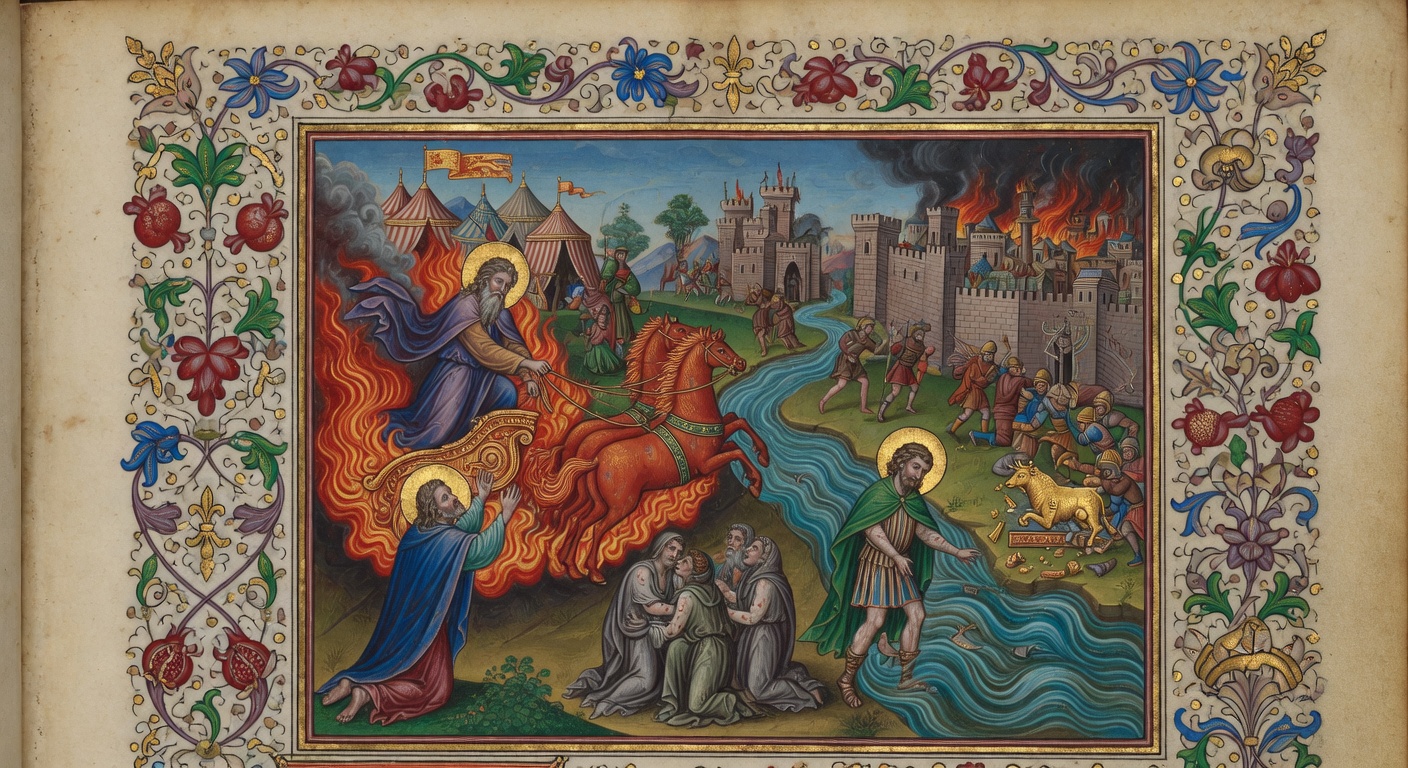
10 And Elijah answered and said to the captain of fifty, If I be a man of God, then let fire come down from heaven, and consume thee and thy fifty. And there came down fire from heaven, and consumed him and his fifty.
11 Again also he sent unto him another captain of fifty with his fifty. And he answered and said unto him, O man of God, thus hath the king said, Come down quickly.
12 And Elijah answered and said unto them, If I be a man of God, let fire come down from heaven, and consume thee and thy fifty. And the fire of God came down from heaven, and consumed him and his fifty.
13 And he sent again a captain of the third fifty with his fifty. And the third captain of fifty went up, and came and fell on his knees before Elijah, and besought him, and said unto him, O man of God, I pray thee, let my life, and the life of these fifty thy servants, be precious in thy sight.
14 Behold, there came fire down from heaven, and burnt up the two captains of the former fifties with their fifties: therefore let my life now be precious in thy sight.
15 And the angel of the LORD said unto Elijah, Go down with him: be not afraid of him. And he arose, and went down with him unto the king.
16 And he said unto him, Thus saith the LORD, Forasmuch as thou hast sent messengers to enquire of Baalzebub the god of Ekron, is it not because there is no God in Israel to enquire of his word? therefore thou shalt not come down off that bed on which thou art gone up, but shalt surely die.
17 So he died according to the word of the LORD which Elijah had spoken. And Jehoram reigned in his stead in the second year of Jehoram the son of Jehoshaphat king of Judah; because he had no son.
18 Now the rest of the acts of Ahaziah which he did, are they not written in the book of the chronicles of the kings of Israel?
← → arrow keys to navigate chapters · spacebar to play/pause audio
Did You Know?
The name Baal-zebub, consulted by Ahaziah, is rendered in the KJV as 'the god of Ekron' and later becomes the etymological root for Beelzebub in the New Testament, creating an explicit lexical bridge between this Canaanite deity and later demonic nomenclature.
The repeated question 'Is it not because there is no God in Israel?' functions as a covenant lawsuit formula that indicts the northern kingdom's leadership for treating Yahweh's exclusive presence as geographically limited rather than sovereign.
Elijah's posture 'on the top of an hill' when confronting the military detachments deliberately echoes Moses on Sinai and anticipates the Transfiguration setting, framing the prophet as a mediator whose word alone controls heavenly fire.
The third captain's use of the deferential particle 'I pray thee' and his prostration marks the sole instance in the chapter where human speech succeeds in altering Elijah's movement, illustrating that prophetic obedience is elicited by humility rather than royal command.
Ahaziah's fatal inquiry occurs while he is confined to an 'upper chamber,' a spatial detail that ironically reverses the typical royal elevation motif and underscores his political impotence before the prophetic word.
Even after burial, Elisha's bones restored life to a dead man whose body touched them during a hasty Moabite raid, underscoring the enduring power attributed to the prophet in 2 Kings 13.
While fleeing Ahab, Elijah was sustained at the Wadi Cherith by ravens delivering bread and meat twice daily, a detail underscoring divine provision outside the covenant land east of the Jordan.
After his healing, Naaman loaded two mules with soil from the Jordan valley to transport back to Aram, planning to erect an altar to Yahweh on Israelite earth so his worship would not occur on 'unclean' foreign ground.
To withstand Sennacherib's siege, Hezekiah commissioned a 533-meter tunnel carved through bedrock to channel the Gihon Spring inside Jerusalem's walls, an engineering project whose original Hebrew inscription was recovered in 1880 and confirms the biblical account in 2 Kings 20.
This account illustrates Scripture’s emphasis on the extension of salvation beyond Jewish boundaries and Jesus’ willingness to cross social barriers to reveal truth.
The city has been destroyed at least twice, besieged 23 times, and captured 44 times.
Babylon's walls were reportedly wide enough for two chariots to pass side by side.
Commentary & Study Notes Jamieson-Fausset-Brown (1871) · Public Domain 1. Then Moab rebelled — Subdued by David (2Sa 8:2), they had, in the partition of Israel and Judah, fallen to the share of the former kingdom. But they took advantage of the death…
Classic verse-by-verse commentary on 2 Kings 1 from Jamieson, Fausset & Brown (1871). Covers: Moab rebels; Ahaziah's judgment by elijah; Elijah brings fire from heaven on ahaziah's messengers; Ahaziah dies, and is succeeded by jehoram.
- 2-8
- Ahaziah fell down through a lattice in his upper chamber — This lattice was either a part of the wooden parapet, or fence, which surrounds the flat roofs of houses, and over which the king was carelessly leaning when it gave way; or it might be an opening like a skylight in the roof itself, done over with lattice-work, which, being slender or rotten, the king stepped on and slipped through. This latter supposition is most probably the true one, as Ahaziah did not fall either into the street or the court, but "in his upper chamber." inquire of Baalzebub — Anxious to learn whether he should recover from the effects of this severe fall, he sent to consult Baalzebub, that is, the god of flies, who was considered the patron deity of medicine. A temple to that idol was erected at Ekron, which was resorted to far and wide, though it afterwards led to the destruction of the place (Zec 9:5; Am 1:8; Zep 2:4). "After visiting Ekron, 'the god of flies' is a name that gives me no surprise. The flies there swarmed, in fact so innumerably, that I could hardly get any food without these troublesome insects getting into it" [VAN DE VELDE].
- 3
- the angel of the Lord — not an angel, but the angel, who carried on all communications between the invisible God and His chosen people [HENGSTENBERG]. This angel commissioned Elijah to meet the king's messengers, to stop them peremptorily on the idolatrous errand, and convey by them to the king information of his approaching death. This consultation of an idol, being a breach of the fundamental law of the kingdom (Ex 20:3; De 5:7), was a daring and deliberate rejection of the national religion. The Lord, in making this announcement of his death, designed that he should see in that event a judgment for his idolatry.
Read all 8 notes on 2 Kings 1 →