2 Samuel 2 KJV
David Anointed King of Judah
David Anointed King of Judah
David's repeated inquiry of the Lord before relocating to Hebron establishes a deliberate theological contrast with Saul's earlier rejection of divine counsel, framing David's rise as covenantally grounded rather than merely political.
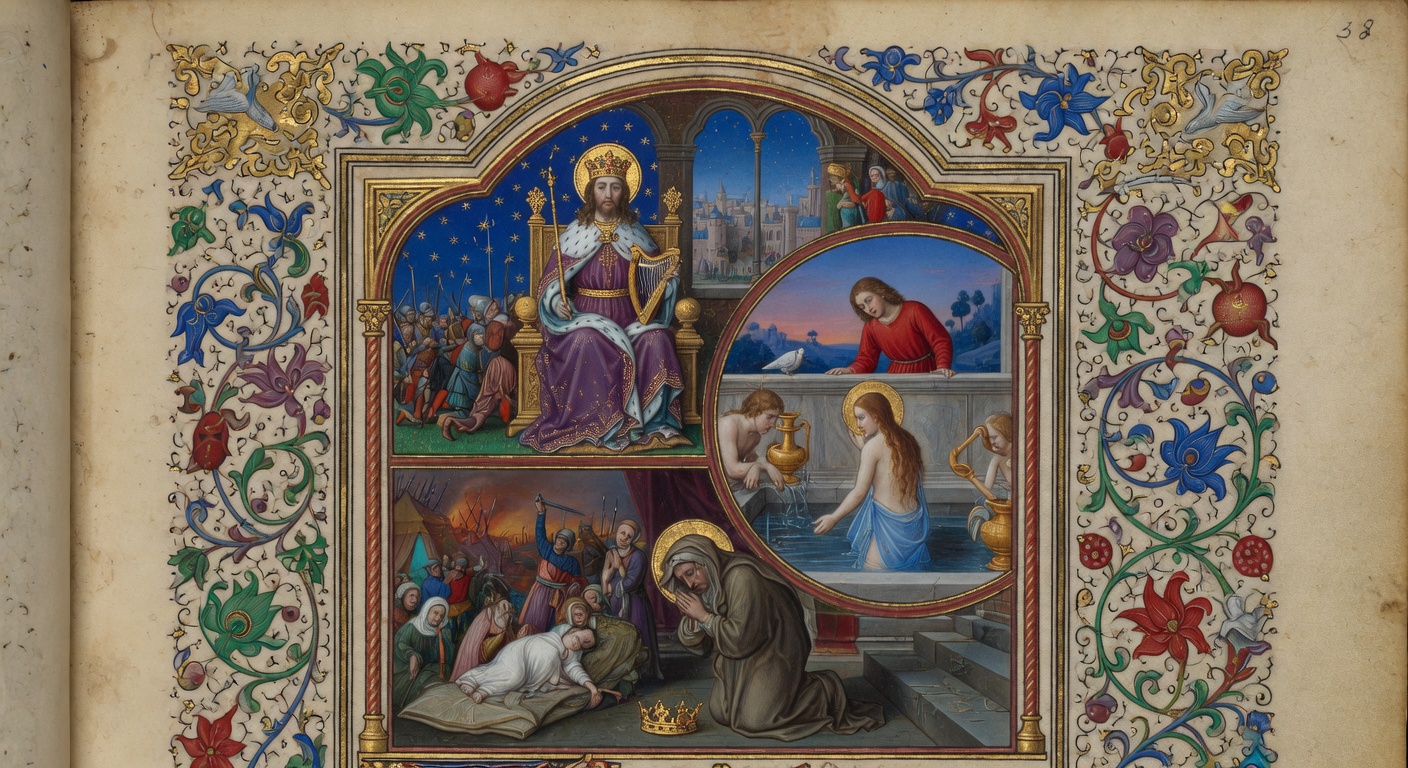
 1nd it came to pass after this, that David enquired of the LORD, saying, Shall I go up into any of the cities of Judah? And the LORD said unto him, Go up. And David said, Whither shall I go up? And he said, Unto Hebron.
2 So David went up thither, and his two wives also, Ahinoam the Jezreelitess, and Abigail Nabal’s wife the Carmelite.
3 And his men that were with him did David bring up, every man with his household: and they dwelt in the cities of Hebron.
4 And the men of Judah came, and there they anointed David king over the house of Judah. And they told David, saying, That the men of Jabeshgilead were they that buried Saul.
5 And David sent messengers unto the men of Jabeshgilead, and said unto them, Blessed be ye of the LORD, that ye have shewed this kindness unto your lord, even unto Saul, and have buried him.
6 And now the LORD shew kindness and truth unto you: and I also will requite you this kindness, because ye have done this thing.
7 Therefore now let your hands be strengthened, and be ye valiant: for your master Saul is dead, and also the house of Judah have anointed me king over them.
8 But Abner the son of Ner, captain of Saul’s host, took Ishbosheth the son of Saul, and brought him over to Mahanaim;
9 And made him king over Gilead, and over the Ashurites, and over Jezreel, and over Ephraim, and over Benjamin, and over all Israel.
10 Ishbosheth Saul’s son was forty years old when he began to reign over Israel, and reigned two years. But the house of Judah followed David.
11 And the time that David was king in Hebron over the house of Judah was seven years and six months.
12 And Abner the son of Ner, and the servants of Ishbosheth the son of Saul, went out from Mahanaim to Gibeon.
13 And Joab the son of Zeruiah, and the servants of David, went out, and met together by the pool of Gibeon: and they sat down, the one on the one side of the pool, and the other on the other side of the pool.
14 And Abner said to Joab, Let the young men now arise, and play before us. And Joab said, Let them arise.
15 Then there arose and went over by number twelve of Benjamin, which pertained to Ishbosheth the son of Saul, and twelve of the servants of David.
16 And they caught every one his fellow by the head, and thrust his sword in his fellow’s side; so they fell down together: wherefore that place was called Helkathhazzurim, which is in Gibeon.
17 And there was a very sore battle that day; and Abner was beaten, and the men of Israel, before the servants of David.
18 And there were three sons of Zeruiah there, Joab, and Abishai, and Asahel: and Asahel was as light of foot as a wild roe.
19 And Asahel pursued after Abner; and in going he turned not to the right hand nor to the left from following Abner.
20 Then Abner looked behind him, and said, Art thou Asahel? And he answered, I am.
21 And Abner said to him, Turn thee aside to thy right hand or to thy left, and lay thee hold on one of the young men, and take thee his armour. But Asahel would not turn aside from following of him.
22 And Abner said again to Asahel, Turn thee aside from following me: wherefore should I smite thee to the ground? how then should I hold up my face to Joab thy brother?
23 Howbeit he refused to turn aside: wherefore Abner with the hinder end of the spear smote him under the fifth rib, that the spear came out behind him; and he fell down there, and died in the same place: and it came to pass, that as many as came to the place where Asahel fell down and died stood still.
24 Joab also and Abishai pursued after Abner: and the sun went down when they were come to the hill of Ammah, that lieth before Giah by the way of the wilderness of Gibeon.
25 And the children of Benjamin gathered themselves together after Abner, and became one troop, and stood on the top of an hill.
26 Then Abner called to Joab, and said, Shall the sword devour for ever? knowest thou not that it will be bitterness in the latter end? how long shall it be then, ere thou bid the people return from following their brethren?
27 And Joab said, As God liveth, unless thou hadst spoken, surely then in the morning the people had gone up every one from following his brother.
28 So Joab blew a trumpet, and all the people stood still, and pursued after Israel no more, neither fought they any more.
29 And Abner and his men walked all that night through the plain, and passed over Jordan, and went through all Bithron, and they came to Mahanaim.
30 And Joab returned from following Abner: and when he had gathered all the people together, there lacked of David’s servants nineteen men and Asahel.
31 But the servants of David had smitten of Benjamin, and of Abner’s men, so that three hundred and threescore men died.
32 And they took up Asahel, and buried him in the sepulchre of his father, which was in Bethlehem. And Joab and his men went all night, and they came to Hebron at break of day.
← → arrow keys to navigate chapters · spacebar to play/pause audio
Did You Know?
David's repeated inquiry of the Lord before relocating to Hebron establishes a deliberate theological contrast with Saul's earlier rejection of divine counsel, framing David's rise as covenantally grounded rather than merely political.
The initial anointing by Judah alone at Hebron, a site tied to patriarchal burials, subtly invokes Abrahamic promises of land and kingship while signaling the tribal fractures that would define the monarchy's future division.
David's diplomatic message to Jabesh-gilead praising their loyalty to Saul functions as calculated outreach to Saulide loyalists in Gilead, revealing early efforts to unify rival factions through honor rather than conquest.
The contest of twelve champions beside Gibeon's pool echoes ancient Near Eastern ritual combat traditions meant to avert mass bloodshed, yet its immediate escalation underscores the tragic inevitability of Israelite civil strife post-Saul.
Abner's fatal wounding of Asahel, despite his repeated warnings and appeals for peace, initiates the personal blood feud with Joab that will later drive key political assassinations and realignments in the narrative.
Abner's break with Ish-bosheth occurred when the king accused him of having relations with Saul's concubine Rizpah, an allegation that publicly undermined Abner's authority and prompted his secret negotiations with David.
Her youngest son Asahel is singled out for his gazelle-like swiftness (2 Samuel 2:18), yet this very speed led him to pursue Abner alone and die at the hands of the older warrior's backward spear thrust.
When two of his own captains murdered him in his bed and brought his head to David, expecting a reward, David executed them instead - the same principled response he had shown to the man who claimed to have killed Saul.
Jonathan sealed his covenant with David by giving him his royal robe, armor, sword, bow, and belt, ritually transferring symbols of kingship despite being Saul's heir.
David ruled from Hebron for 7.5 years before moving his capital to Jerusalem.
Jerusalem sits at about 2,500 feet elevation. Higher than most surrounding areas.
The New Testament further develops this imagery to portray the heavenly Jerusalem where believers gather to the living God.
Commentary & Study Notes Jamieson-Fausset-Brown (1871) · Public Domain David inquired of the Lord — By Urim (1Sa 23:6, 9; 30:7, 8). He knew his destination, but he knew also that the providence of God would pave the way. Therefore he would take no ste…
Classic verse-by-verse commentary on 2 Samuel 2 from Jamieson, Fausset & Brown (1871). Covers: David, by God's direction, goes up to hebron, and is made king over Judah; Abner makes ish-bosheth king over Israel; Asahel slain.
- 1-4
- David inquired of the Lord — By Urim (1Sa 23:6, 9; 30:7, 8). He knew his destination, but he knew also that the providence of God would pave the way. Therefore he would take no step in such a crisis of his own and the nation's history, without asking and obtaining the divine direction. He was told to go into Judah, and fix his headquarters in Hebron, whither he accordingly repaired with his now considerable force. There his interests were very powerful; for he was not only within his own tribe, and near chiefs with whom he had been long in friendly relations (see on 1Sa 30:26), but Hebron was the capital and center of Judah, and one of the Levitical cities; the inhabitants of which were strongly attached to him, both from sympathy with his cause ever since the massacre at Nob, and from the prospect of realizing in his person their promised pre-eminence among the tribes. The princes of Judah, therefore, offered him the crown over their tribe, and it was accepted. More could not, with prudence, be done in the circumstances of the country (1Ch 11:3).
- 5-7
- David sent messengers unto the men of Jabesh-gilead — There can be no doubt that this message of thanks for their bold and dangerous enterprise in rescuing the bodies of Saul and his sons was an expression of David's personal and genuine feeling of satisfaction. At the same time, it was a stroke of sound and timely policy. In this view the announcement of his royal power in Judah, accompanied by the pledge of his protection of the men of Jabesh-gilead, should they be exposed to danger for their adventure at Beth-shan, would bear an important significance in all parts of the country and hold out an assurance that he would render them the same timely and energetic succor that Saul had done at the beginning of his reign.
Read all 6 notes on 2 Samuel 2 →