2 Timothy 3 KJV
Godlessness in the Last Days
Godlessness in the Last Days
Paul's citation of Jannes and Jambres draws on Jewish pseudepigraphal traditions (such as the Book of Jubilees and Targumic expansions) rather than the canonical Exodus account, illustrating his willingness to invoke extra-biblical lore to typify opposition to apostolic teaching.
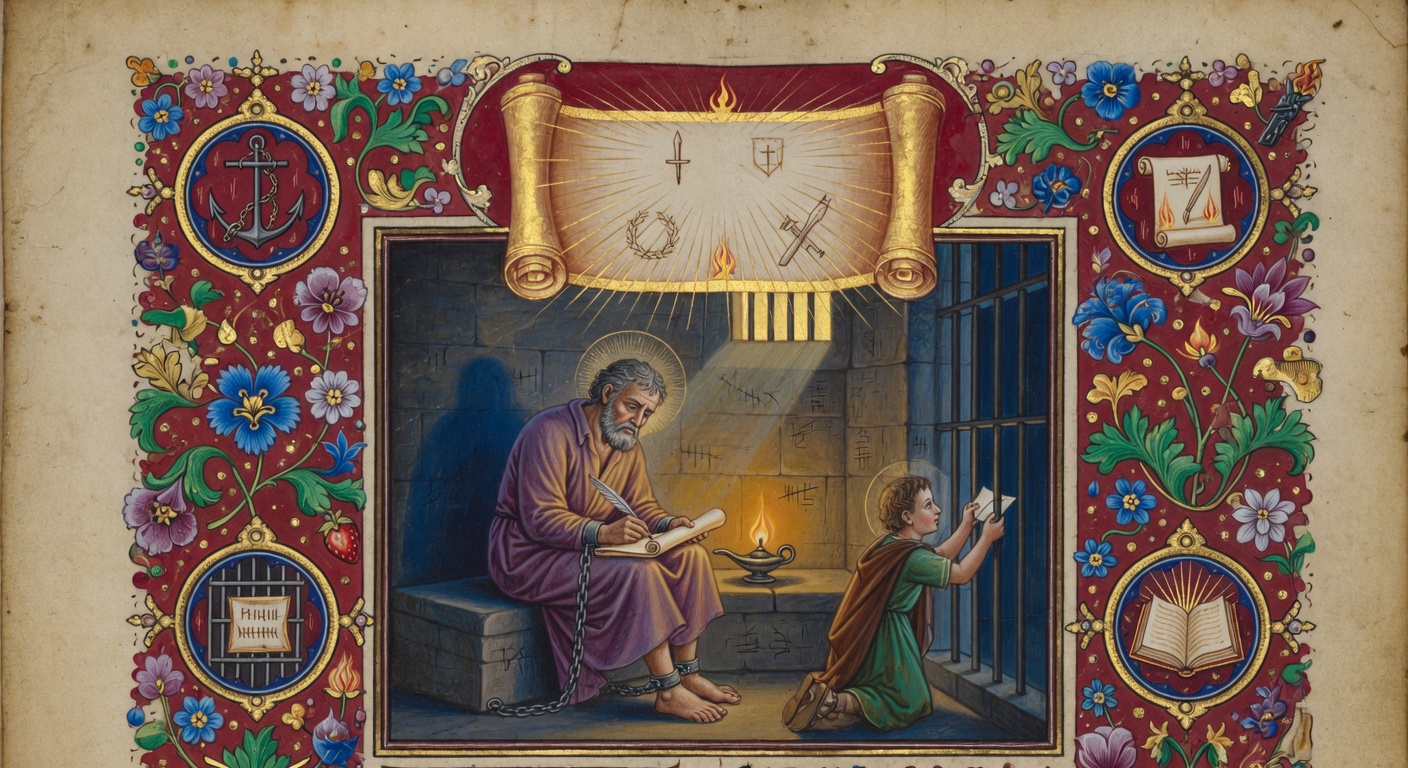
 1his know also, that in the last days perilous times shall come.
2 For men shall be lovers of their own selves, covetous, boasters, proud, blasphemers, disobedient to parents, unthankful, unholy,
3 Without natural affection, trucebreakers, false accusers, incontinent, fierce, despisers of those that are good,
4 Traitors, heady, highminded, lovers of pleasures more than lovers of God;
5 Having a form of godliness, but denying the power thereof: from such turn away.
6 For of this sort are they which creep into houses, and lead captive silly women laden with sins, led away with divers lusts,
7 Ever learning, and never able to come to the knowledge of the truth.
8 Now as Jannes and Jambres withstood Moses, so do these also resist the truth: men of corrupt minds, reprobate concerning the faith.
9 But they shall proceed no further: for their folly shall be manifest unto all men, as theirs also was.
10 But thou hast fully known my doctrine, manner of life, purpose, faith, longsuffering, charity, patience,
11 Persecutions, afflictions, which came unto me at Antioch, at Iconium, at Lystra; what persecutions I endured: but out of them all the Lord delivered me.
12 Yea, and all that will live godly in Christ Jesus shall suffer persecution.
13 But evil men and seducers shall wax worse and worse, deceiving, and being deceived.
14 But continue thou in the things which thou hast learned and hast been assured of, knowing of whom thou hast learned them;
15 And that from a child thou hast known the holy scriptures, which are able to make thee wise unto salvation through faith which is in Christ Jesus.
16 All scripture is given by inspiration of God, and is profitable for doctrine, for reproof, for correction, for instruction in righteousness:
17 That the man of God may be perfect, throughly furnished unto all good works.
← → arrow keys to navigate chapters · spacebar to play/pause audio
Did You Know?
Paul's citation of Jannes and Jambres draws on Jewish pseudepigraphal traditions (such as the Book of Jubilees and Targumic expansions) rather than the canonical Exodus account, illustrating his willingness to invoke extra-biblical lore to typify opposition to apostolic teaching.
The unique Pauline hapax 'theopneustos' (God-breathed) in verse 16 fuses Hellenistic notions of divine afflatus with Jewish conceptions of prophetic speech, creating a distinctive Christian claim that Scripture itself participates in God's creative breath rather than merely recording it.
The vice catalogue in verses 2-4 deliberately inverts the Roman household code virtues (e.g., replacing pietas with 'disobedient to parents'), functioning as an anti-imperial critique that recasts Greco-Roman social order as symptomatic of eschatological chaos.
Verse 15's reference to Timothy's childhood instruction in the 'sacred writings' subtly positions the apostle as spiritual successor to Lois and Eunice, underscoring a matrilineal chain of transmission that challenges the patriarchal assumptions of both Jewish and Roman educational norms.
The chapter's closing assertion that Scripture equips 'the man of God' (verse 17) echoes the Septuagint's use of the same phrase for Moses and the prophets, thereby transferring Mosaic authority directly onto Timothy and, by extension, onto the emerging pastoral office.
By grounding Timothy in the Hebrew Scriptures before Paul's arrival, Lois and Eunice equipped him with knowledge that Paul later called the foundation for his ministry, bypassing typical patriarchal transmission since Timothy's father remained uninvolved in the faith.
In 2 Corinthians, Paul details surviving three shipwrecks, a night and day adrift at sea, and being stoned and left for dead at Lystra, hardships that underscore the physical dangers of his travels beyond the more commonly recounted imprisonments.
Timothy received a spiritual gift through prophetic messages and the laying on of hands by Paul and the elders, marking one of the earliest recorded instances of ordination in Christian practice.
Early Christian tradition and the "we" sections align with the view that Luke, a Gentile from Antioch, was Paul's companion during the apostle's imprisonment in Rome, as referenced in 2 Timothy 4:11.
Iconium was an ancient city in the region of Lycaonia in Asia Minor, visited by Paul and Barnabas during their first missionary journey as recorded in Acts 14.
The Temple of Artemis in Ephesus was four times larger than the Parthenon in Athens.
Paul wrote his letter to the Romans before ever visiting the city.
Commentary & Study Notes Jamieson-Fausset-Brown (1871) · Public Domain also — Greek, "but." last days — preceding Christ's second coming (2Pe 3:3; Jude 18). "The latter times," 1Ti 4:1, refer to a period not so remote as "the last days," namely, the l…
Classic verse-by-verse commentary on 2 Timothy 3 from Jamieson, Fausset & Brown (1871). Covers: Coming evil days: signs of evil already: contrast in the doctrine and life of paul, which timothy should follow in accordance with his early training in scripture.
- 1
- also — Greek, "but." last days — preceding Christ's second coming (2Pe 3:3; Jude 18). "The latter times," 1Ti 4:1, refer to a period not so remote as "the last days," namely, the long days of papal and Greek anti-Christianity. perilous — literally, "difficult times," in which it is difficult to know what is to be done: "grievous times." shall come — Greek, "shall be imminent"; "shall come unexpectedly" [BENGEL].
- 2
- men — in the professing Church. Compare the catalogue, Ro 1:29, &c., where much the same sins are attributed to heathen men; it shall be a relapse into virtual heathendom, with all its beast-like propensities, whence the symbol of it is "a beast" (Re 13:1, 11, 12, &c.; 17:3, 8, 11). covetous — Translate, "money-loving," a distinct Greek word from that for "covetous" (see on Col 3:5). The cognate Greek substantive (1Ti 6:10) is so translated, "the love of money is a (Greek, not 'the') root of all evil." boasters — empty boasters [ALFORD]; boasting of having what they have not. proud — overweening: literally, showing themselves above their fellows. blasphemous — rather, "evil-speakers," revilers. disobedient to parents — The character of the times is even to be gathered especially from the manners of the young [BENGEL]. unthankful — The obligation to gratitude is next to that of obedience to parents. unholy — irreligious [ALFORD]; inobservant of the offices of piety.
Read all 18 notes on 2 Timothy 3 →