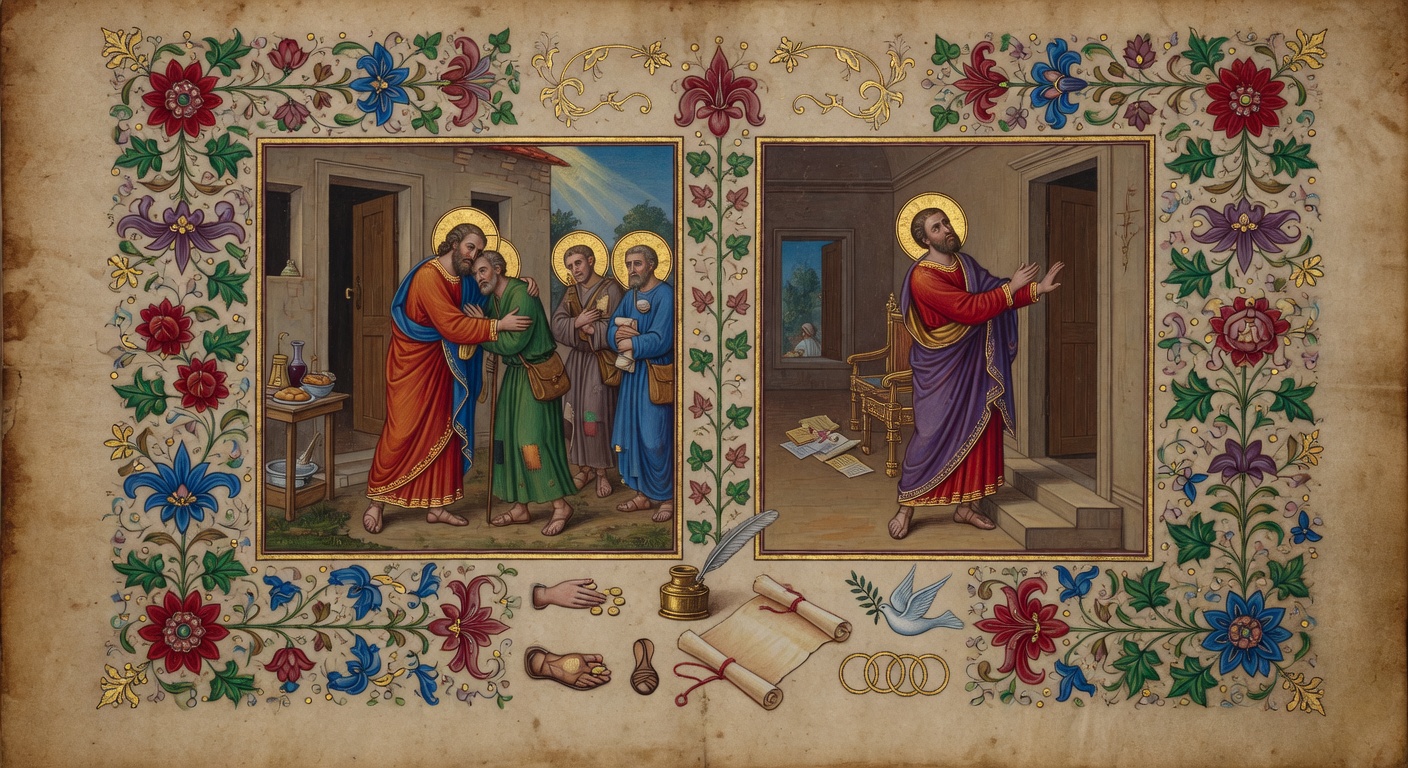
3 John 1 KJV
Hospitality and Opposition
Hospitality and Opposition
Diotrephes represents the earliest named instance of ambition-driven schism in church history, as his refusal to receive John's envoys stems explicitly from a desire for preeminence rather than doctrinal deviation.
 1he elder unto the wellbeloved Gaius, whom I love in the truth.
2 Beloved, I wish above all things that thou mayest prosper and be in health, even as thy soul prospereth.
3 For I rejoiced greatly, when the brethren came and testified of the truth that is in thee, even as thou walkest in the truth.
4 I have no greater joy than to hear that my children walk in truth.
5 Beloved, thou doest faithfully whatsoever thou doest to the brethren, and to strangers;
6 Which have borne witness of thy charity before the church: whom if thou bring forward on their journey after a godly sort, thou shalt do well:
7 Because that for his name’s sake they went forth, taking nothing of the Gentiles.
8 We therefore ought to receive such, that we might be fellowhelpers to the truth.
9 I wrote unto the church: but Diotrephes, who loveth to have the preeminence among them, receiveth us not.
10 Wherefore, if I come, I will remember his deeds which he doeth, prating against us with malicious words: and not content therewith, neither doth he himself receive the brethren, and forbiddeth them that would, and casteth them out of the church.
11 Beloved, follow not that which is evil, but that which is good. He that doeth good is of God: but he that doeth evil hath not seen God.
12 Demetrius hath good report of all men, and of the truth itself: yea, and we also bear record; and ye know that our record is true.
13 I had many things to write, but I will not with ink and pen write unto thee:
14 But I trust I shall shortly see thee, and we shall speak face to face. Peace be to thee. Our friends salute thee. Greet the friends by name.
← → arrow keys to navigate chapters · spacebar to play/pause audio
Did You Know?
Diotrephes represents the earliest named instance of ambition-driven schism in church history, as his refusal to receive John's envoys stems explicitly from a desire for preeminence rather than doctrinal deviation.
The commendation of Demetrius by 'all men, and of the truth itself' adapts Greco-Roman letters of recommendation into a distinctly Johannine framework where the gospel's own coherence functions as a witness.
John's statement that supporting traveling missionaries makes one a 'fellowhelper to the truth' theologically equates material hospitality with participatory agency in the mission, blurring lines between giver and proclaimer.
The epistle's closing preference for speaking 'face to face' over further writing underscores the early Christian valuation of embodied presence as superior to textual mediation for resolving relational fractures.
Unlike other Johannine writings, 3 John never names Jesus yet centers 'his name' as the sole motivation for the missionaries' journey, illustrating how Christological allegiance operates implicitly through ethical practice.
He not only refused to welcome traveling missionaries but expelled those who wanted to, showing how quickly a local leader could weaponize church hospitality.
John was the only apostle explicitly present at the crucifixion; from the cross Jesus entrusted his mother Mary to John's care, after which John took her into his own home (John 19:26-27).
Commentary & Study Notes Jamieson-Fausset-Brown (1871) · Public Domain ADDRESS: WISH FOR GAIUS' PROSPERITY: JOY AT HIS WALKING IN THE TRUTH. HOSPITALITY TO THE BRETHREN AND STRANGERS THE FRUIT OF LOVE. DIOTREPHES' OPPOSITION AND AMBITION. PRAISE OF DE…
Classic verse-by-verse commentary on 3 John 1 from Jamieson, Fausset & Brown (1871). Covers: Address: wish for gaius' prosperity: joy at his walking in the truth.
- 1-14
- ADDRESS: WISH FOR GAIUS' PROSPERITY: JOY AT HIS WALKING IN THE TRUTH. HOSPITALITY TO THE BRETHREN AND STRANGERS THE FRUIT OF LOVE. DIOTREPHES' OPPOSITION AND AMBITION. PRAISE OF DEMETRIUS. CONCLUSION.
- 1
- I — emphatical. I personally, for my part. On Gaius or Caius, see my Introduction before Second Epistle. love in the truth — (2Jo 1). "Beloved" is repeated often in this Epistle, indicating strong affection (3Jo 1, 2, 5, 11).
Read all 17 notes on 3 John 1 →